



 Chat with AI
Exam 4: Cell Membranes, Transport, and Communication

Exam 1: The Nature of Science and the Characteristics of Life80 Questions
Exam 2: The Chemistry of Life93 Questions
Exam 3: Cell Structure and Internal Compartments89 Questions
Exam 4: Cell Membranes, Transport, and Communication89 Questions
Exam 5: Energy, Metabolism, and Enzymes85 Questions
Exam 6: Photo Synthesis and Cellular Respiration89 Questions
Exam 7: Cell Division84 Questions
Exam 8: Cancer and Human Health86 Questions
Exam 9: Patterns of Inheritance86 Questions
Exam 10: Chromosomes and Human Genetics77 Questions
Exam 11: DNA and Genes83 Questions
Exam 12: From Gene to Protein88 Questions
Exam 13: DNA Technology96 Questions
Exam 14: How Evolution Works72 Questions
Exam 15: The Origin of Species76 Questions
Exam 16: The Evolution of Biodiversity102 Questions
Exam 17: Biological Diversity, Bacteria, and Archaea80 Questions
Exam 18: Protista, Plantae, and Fungi83 Questions
Exam 19: Animalia80 Questions
Exam 20: The Biosphere88 Questions
Exam 21: Growth of Populations70 Questions
Exam 22: Animal Behavior82 Questions
Exam 23: Ecological Communities105 Questions
Exam 24: Ecosystems74 Questions
Exam 25: Global Change73 Questions
Select questions type


Tight junctions prevent the movement of the extracellular matrix between cells.
(True/False)
4.8/5  (70)
(70) The arrows in the following figure show the movement of water across the cell wall and plasma membrane of a plant cell. 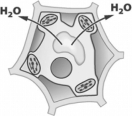 For water to move in the direction indicated,the solution surrounding the cell must be
 (Multiple Choice)
5.0/5 (85)
(85) You place some Elodea,an aquarium plant,in a hypertonic solution.The cells of the Elodea
(Multiple Choice)
4.8/5 (85)
(85) Epithelial tissue in animals provides a barrier against the invasion of bacteria into the body.Which of the following is most likely to be responsible for creating a tight enough barrier between cells to prevent the passage of bacteria between them?
(Multiple Choice)
4.8/5 (78)
(78) A red blood cell is placed in a solution and it begins to shrink.Which of the following describes the solution?
(Multiple Choice)
4.9/5 (84)
(84) Muscle cells require high concentrations of calcium to function properly.As a result,these cells use ________ transport to move calcium from areas of low concentration outside the cell into the cytoplasm.
(Short Answer)
4.7/5 (74)
(74) Imagine two solutions separated by a selectively permeable membrane that is impermeable to glucose.On one side of the membrane,solution A contains 10 percent glucose and on the other side,solution B contains 25 percent glucose.Which of the following is true?
(Multiple Choice)
4.9/5 (72)
(72) Passive carrier molecules often require active carrier proteins to provide amino acids for transport.
(True/False)
4.9/5 (88)
(88) You observe a vesicle moving toward the plasma membrane from inside a cell.Once it reaches and fuses with the plasma membrane,you will most likely see an example of
(Multiple Choice)
4.9/5 (72)
(72) Animal cells are attached to neighboring cells by all of the following,EXCEPT
(Multiple Choice)
4.8/5 (73)
(73) You observe a cell in a solution that swells until it bursts.What you have seen is an instance of osmosis in a(n)________ solution.
(Multiple Choice)
4.8/5 (74)
(74) Soon after a certain molecule enters a cell,the cell begins producing a new type of protein.The molecule was probably a
(Multiple Choice)
4.9/5 (74)
(74) Hikers can detect a dead skunk along a trail long before they actually see it.What process allows the scent of the skunk to be so widely dispersed?
(Multiple Choice)
4.8/5 (81)
(81) Imagine a cell needing an essential specific amino acid (one the cell cannot synthesize).What process could acquire the amino acid most quickly?
(Multiple Choice)
4.8/5 (84)
(84) 
Filters
- Essay(0)
- Multiple Choice(0)
- Short Answer(0)
- True False(0)
- Matching(0)