



 Chat with AI
Exam 4: Cell Membranes, Transport, and Communication

Exam 1: The Nature of Science and the Characteristics of Life80 Questions
Exam 2: The Chemistry of Life93 Questions
Exam 3: Cell Structure and Internal Compartments89 Questions
Exam 4: Cell Membranes, Transport, and Communication89 Questions
Exam 5: Energy, Metabolism, and Enzymes85 Questions
Exam 6: Photo Synthesis and Cellular Respiration89 Questions
Exam 7: Cell Division84 Questions
Exam 8: Cancer and Human Health86 Questions
Exam 9: Patterns of Inheritance86 Questions
Exam 10: Chromosomes and Human Genetics77 Questions
Exam 11: DNA and Genes83 Questions
Exam 12: From Gene to Protein88 Questions
Exam 13: DNA Technology96 Questions
Exam 14: How Evolution Works72 Questions
Exam 15: The Origin of Species76 Questions
Exam 16: The Evolution of Biodiversity102 Questions
Exam 17: Biological Diversity, Bacteria, and Archaea80 Questions
Exam 18: Protista, Plantae, and Fungi83 Questions
Exam 19: Animalia80 Questions
Exam 20: The Biosphere88 Questions
Exam 21: Growth of Populations70 Questions
Exam 22: Animal Behavior82 Questions
Exam 23: Ecological Communities105 Questions
Exam 24: Ecosystems74 Questions
Exam 25: Global Change73 Questions
Select questions type


Signaling molecules can be "tagged" by attaching glow-in-the-dark molecules to them.After adding tagged signaling molecules to the fluid around several cells,you observe the cells with a microscope designed to see the glow-in-the-dark molecules.After a few minutes,you notice that the plasma membrane of some of the cells begins to glow.This observation indicates that some cells
(Multiple Choice)
5.0/5  (85)
(85) If a red blood cell is placed in a hypertonic solution,what happens to it?
(Multiple Choice)
4.9/5 (77)
(77) Many hormones are large and hydrophilic.Where would you expect the receptor proteins for these hormones to be located?
(Multiple Choice)
4.8/5 (82)
(82) Which of the following types of molecules could NOT easily diffuse across a plasma membrane?
(Multiple Choice)
5.0/5 (88)
(88) What best explains the double-headed arrows associated with carbon dioxide and molecular oxygen shown in the following illustration? 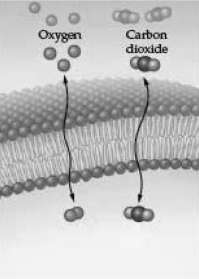
(Multiple Choice)
4.8/5 (87)
(87) Elevated cholesterol and LDL (the particles that transport cholesterol)have been strongly associated with vascular disease; what process(es)lead to the elevated levels?
(Multiple Choice)
4.9/5 (84)
(84) Several types of lipoproteins exist; the best balance for cardiovascular health is achieved with ________ amount of LDL and ________ amount of HDL.
(Short Answer)
4.7/5 (82)
(82) All movement,including that of diffusing molecules,requires a small expenditure of energy; which of the following small sources of energy is most likely to make diffusion possible across the cell membrane from the cell exterior into the cell interior?
(Multiple Choice)
4.7/5 (66)
(66) When the solute concentration outside a cell is equal to the solute concentration inside the cell,the cell is in a(n)________ solution.
(Short Answer)
5.0/5 (89)
(89) Receptors in target cells can be located in the plasma membrane,the cytosol,or the ________.
(Short Answer)
4.8/5 (77)
(77) Ingested protein is always degraded to amino acids before absorption in the mature human small intestine,but nursing infants can absorb intact antibodies (large protein molecules)from breast milk.How might this difference in intestinal function be explained?
(Multiple Choice)
4.8/5 (84)
(84) The fragrance of bread baking in a kitchen spreads to other rooms by
(Multiple Choice)
4.9/5 (76)
(76) The following figure shows the movement of solutes across a plasma membrane in the direction indicated by the arrows. 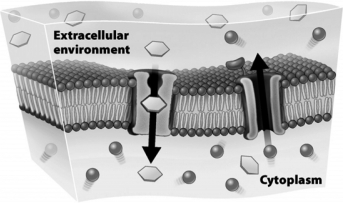 This movement across the membrane
 (Multiple Choice)
4.8/5 (82)
(82) For a cell to be a target for a particular hormone,it must usually
(Multiple Choice)
4.8/5 (84)
(84) Active carrier proteins can transfer molecules into areas of higher concentration.
(True/False)
4.8/5 (88)
(88) When placed in a 2 percent sucrose solution,red blood cells shrink (lose volume); relative to the red blood cell cytoplasm,a 2 percent solution must be
(Multiple Choice)
4.8/5 (70)
(70) Active carrier proteins are not found in the same cells as passive carrier proteins.
(True/False)
4.8/5 (84)
(84) 
Filters
- Essay(0)
- Multiple Choice(0)
- Short Answer(0)
- True False(0)
- Matching(0)