



 Chat with AI
Exam 14: Glacial and Periglacial Landforms

Exam 1: Discovering the Earths Dimensions104 Questions
Exam 2: The Earths Global Energy Balance129 Questions
Exam 3: Air Temperature157 Questions
Exam 4: Atmospheric Moisture and Precipitation132 Questions
Exam 5: Global Atmospheric and Oceanic Circulation138 Questions
Exam 6: Weather Systems130 Questions
Exam 7: Global Climates and Climate Change148 Questions
Exam 8: Earth From the Inside Out79 Questions
Exam 9: Plate Tectonics, Earthquakes, and Volcanoes79 Questions
Exam 10: Weathering and Mass Wasting56 Questions
Exam 11: Fresh Water of the Continents67 Questions
Exam 12: Land-Forms Made by Running Water59 Questions
Exam 13: Landforms Made by Wind and Waves65 Questions
Exam 14: Glacial and Periglacial Landforms105 Questions
Exam 15: Global Soils137 Questions
Exam 16: Biogeographic Processes105 Questions
Exam 17: Global Biogeography142 Questions
Select questions type


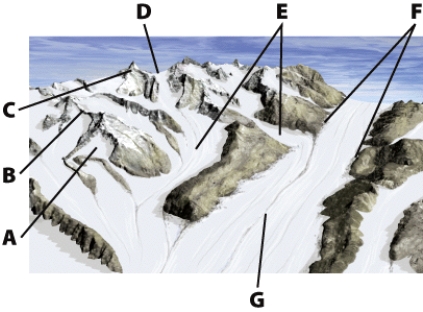
When intersecting cirques carve away the mountain, narrow, sharp ridges called what are formed?
(Multiple Choice)
4.8/5  (85)
(85) 
Where exposed cirques have intersected deeply, a notch is formed. This is called a/an:
(Multiple Choice)
4.9/5 (78)
(78) A large, thick plate of glacial ice moving outwards in all directions is a(n):
(Multiple Choice)
4.8/5 (67)
(67) Permafrost presently occurs in regions of Eurasia and North America even where glaciers are not currently found.
(True/False)
4.8/5 (86)
(86) The last period of glacial advance began about 140,000 years ago.
(True/False)
4.9/5 (91)
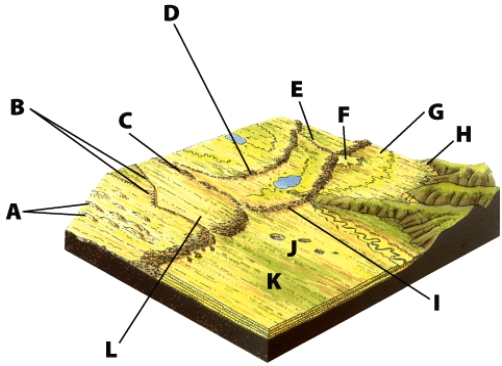
(91) Beyond the moraine, a smooth area of water-laid sediment often marked by kettles and kames, is called a/an:
(Multiple Choice)
4.7/5 (71)
(71) A mixture of different sized rock fragments deposited by a glacier is BEST called:
(Multiple Choice)
4.8/5 (72)
(72) Sorted and layered materials deposited by a glacier are BEST called:
(Multiple Choice)
4.9/5 (87)
(87) A deep, steep-sided rock trench formed by erosion from alpine glaciers is a(n):
(Multiple Choice)
4.8/5 (87)
(87) Describe the speed of ice movement across the surface of an alpine glacier. Clarify your description with an illustration, and explain the causes of this pattern.
(Essay)
4.8/5 (84)
(84) A lake that forms in the depression at the bottom of a cirque of an alpine glacier is a(n):
(Multiple Choice)
4.8/5 (79)
(79) Any large natural accumulation of land ice affected by present or past motion is a(n):
(Multiple Choice)
4.8/5 (86)
(86) 

Filters
- Essay(0)
- Multiple Choice(0)
- Short Answer(0)
- True False(0)
- Matching(0)