



 Chat with AI
Exam 9: Plate Tectonics, Earthquakes, and Volcanoes

Exam 1: Discovering the Earths Dimensions104 Questions
Exam 2: The Earths Global Energy Balance129 Questions
Exam 3: Air Temperature157 Questions
Exam 4: Atmospheric Moisture and Precipitation132 Questions
Exam 5: Global Atmospheric and Oceanic Circulation138 Questions
Exam 6: Weather Systems130 Questions
Exam 7: Global Climates and Climate Change148 Questions
Exam 8: Earth From the Inside Out79 Questions
Exam 9: Plate Tectonics, Earthquakes, and Volcanoes79 Questions
Exam 10: Weathering and Mass Wasting56 Questions
Exam 11: Fresh Water of the Continents67 Questions
Exam 12: Land-Forms Made by Running Water59 Questions
Exam 13: Landforms Made by Wind and Waves65 Questions
Exam 14: Glacial and Periglacial Landforms105 Questions
Exam 15: Global Soils137 Questions
Exam 16: Biogeographic Processes105 Questions
Exam 17: Global Biogeography142 Questions
Select questions type


In the figure below, which structure is bound by normal faults, resulting in a down-dropping block of rock? What is the down-dropped block between two normal faults? 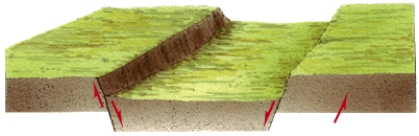
(Multiple Choice)
4.9/5  (76)
(76) Most buildings are not designed to withstand the swaying motion caused by earthquakes.
(True/False)
4.8/5 (64)
(64) The temperature and pressure in the asthenosphere generally keep the rocks there below the melting point.
(True/False)
4.9/5 (74)
(74) A __________ fault is where compressional activity results in a fault in which the block on top of the fault moves up and over the block of rock below.the crust on one side rides up over the other.
(Short Answer)
5.0/5 (88)
(88) __________ lava contains more dissolved gases and tends to be more explosive than __________ lava.
(Short Answer)
4.7/5 (76)
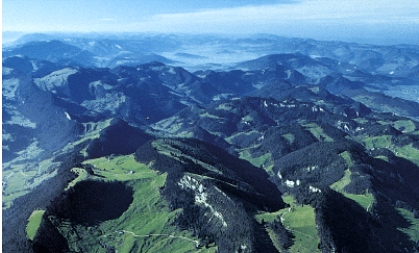
(76) Referencing the figure below from the Jura Mountains, the erosional pattern in an anticline erosion in this ridge and valley system will expose the oldest rocks in the middle.synclinal valleys.
(True/False)
4.8/5 (76)
(76) The 2011 earthquake in Japan was one of the largest (in magnitude)in recorded history.
(True/False)
4.9/5 (82)
(82) Knowledge of previous eruptions of a particular volcano is generally helpful in predicting its future eruptions.
(True/False)
4.9/5 (83)
(83) Folds are said to be plunging when the fold crest remains horizontal. No reference to "plunging" in Ch9 text.
(True/False)
4.8/5 (82)
(82) Which of the following geologic structures has the youngest rocks in the middle?
(Multiple Choice)
4.8/5 (75)
(75) Hawaiian eruptions are extremely violent and produce large pyroclastic flows.
(True/False)
4.7/5 (77)
(77) A __________ fault is a fault in which the block of rock above the fault surface moves down relative to the block below is where extensional activity results in the crust on one side dropping down relative to the other.
(Short Answer)
4.8/5 (79)
(79) An elongated region of the crust that has been deformed by continental collision is known as a(n):
(Multiple Choice)
5.0/5 (74)
(74) Knowledge of previous eruptions of a particular volcano is generally helpful in predicting its future eruptions.
(True/False)
4.7/5 (75)
(75) A type of fault that exist whenwhere slices of rock move over the underlying rock on fault surfaces with gentle inclination angles during folding is known as a(n)is a(n)
(Multiple Choice)
4.9/5 (80)
(80) A fracture in rock along which movement has occurred parallel to the surface is known as a __________. A sharp break in rock associated with a slippage of crustal blocks. Again this 'easy' question should be more associated with the box definition as that is how it would be studied.
(Multiple Choice)
4.8/5 (74)
(74) A fold that forms a trough with the youngest??? rocks in the middle is known as a __________.
(Short Answer)
4.9/5 (83)
(83) Along continental rifts and hot spots, vast amounts of basaltic lava can flow from fissures, forming:
(Multiple Choice)
4.9/5 (80)
(80) 
Filters
- Essay(0)
- Multiple Choice(0)
- Short Answer(0)
- True False(0)
- Matching(0)