



 Chat with AI
Exam 6: Weather Systems

Exam 1: Discovering the Earths Dimensions104 Questions
Exam 2: The Earths Global Energy Balance129 Questions
Exam 3: Air Temperature157 Questions
Exam 4: Atmospheric Moisture and Precipitation132 Questions
Exam 5: Global Atmospheric and Oceanic Circulation138 Questions
Exam 6: Weather Systems130 Questions
Exam 7: Global Climates and Climate Change148 Questions
Exam 8: Earth From the Inside Out79 Questions
Exam 9: Plate Tectonics, Earthquakes, and Volcanoes79 Questions
Exam 10: Weathering and Mass Wasting56 Questions
Exam 11: Fresh Water of the Continents67 Questions
Exam 12: Land-Forms Made by Running Water59 Questions
Exam 13: Landforms Made by Wind and Waves65 Questions
Exam 14: Glacial and Periglacial Landforms105 Questions
Exam 15: Global Soils137 Questions
Exam 16: Biogeographic Processes105 Questions
Exam 17: Global Biogeography142 Questions
Select questions type


In a cyclone, air cools adiabatically as it rises, which can lead to cyclonic precipitation.
(True/False)
4.9/5  (72)
(72) Which front is associated with widespread stratus cloud development?
(Multiple Choice)
4.8/5 (79)
(79) Which of the following is not considered to be a type of traveling cyclone?
(Multiple Choice)
4.8/5 (70)
(70) Polar outbreaks are tongues of exceptionally warm tropical air that occasionally penetrate into the polar latitudes.
(True/False)
4.9/5 (77)
(77) An intense local storm associated with a tall, dense cumulonimbus cloud in which there are very strong updrafts of air is known as a thunderstorm.
(True/False)
4.9/5 (79)
(79) This figure shows the distribution of _______ occurrence in the United States. 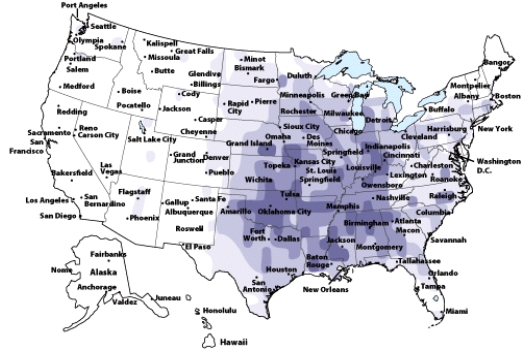
(Multiple Choice)
4.9/5 (72)
(72) Types of cyclones include wave cyclones, tropical cyclones, and tornados.
(True/False)
4.7/5 (87)
(87) The final stage of the life cycle of a wave cyclone is the ________ stage.
(Short Answer)
4.9/5 (99)
(99) Tornados are small but very intense cyclonic flows with extremely low pressure in the center.
(True/False)
4.9/5 (79)
(79) The air mass found in the area labeled 1 would be designated: 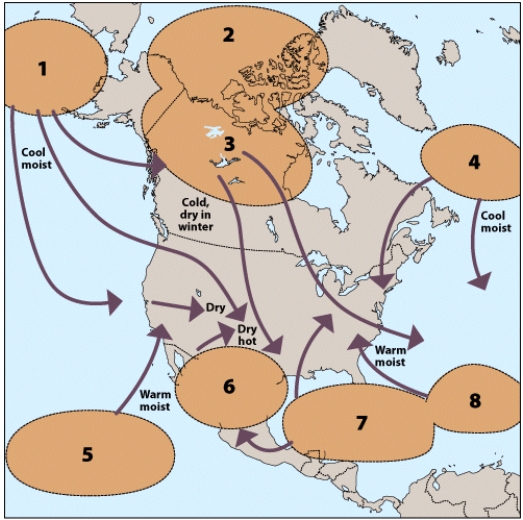
(Multiple Choice)
4.7/5 (85)
(85) The surface of contact between two different air masses is called a front.
(True/False)
4.9/5 (86)
(86) A front that is associated with widespread stratus cloud development is a ________ front.
(Short Answer)
4.8/5 (68)
(68) 
Filters
- Essay(0)
- Multiple Choice(0)
- Short Answer(0)
- True False(0)
- Matching(0)