



 Chat with AI
Exam 15: Neuropsychology

Exam 1: What Is Behavioral Neuroscience?146 Questions
Exam 2: Functional Neuroanatomy and the Evolution of the Nervous System202 Questions
Exam 3: Neurophysiology: The Structure and Functions of the Cells of the Nervous System163 Questions
Exam 4: Psychopharmacology180 Questions
Exam 5: Genetics and the Development of the Human Brain147 Questions
Exam 6: Vision171 Questions
Exam 7: Nonvisual Sensation and Perception165 Questions
Exam 8: Movement164 Questions
Exam 9: Homeostasis, Motivation, and Reward163 Questions
Exam 10: Sexual Behavior159 Questions
Exam 11: Sleep and Waking169 Questions
Exam 12: Learning and Memory168 Questions
Exam 13: Cognition168 Questions
Exam 14: Emotion, Aggression, and Stress160 Questions
Exam 15: Neuropsychology151 Questions
Exam 16: Psychopathology166 Questions
Select questions type


Kuru, a disease found among the Fore people of New Guinea, virtually died out after
(Multiple Choice)
4.8/5  (86)
(86) Which type(s) of multiple sclerosis respond(s) best to current treatments?
(Multiple Choice)
4.9/5 (82)
(82) Secondary encephalitis caused by which of the following produces damage similar to that seen in Alzheimer's disease, leading to hypotheses that the virus might play a causal role in Alzheimer's?
(Multiple Choice)
4.9/5 (88)
(88) In cases of neurocysticercosis, symptoms typically do not occur until
(Multiple Choice)
4.8/5 (82)
(82) Open head injuries are most likely to be fatal when the damage
(Multiple Choice)
4.9/5 (80)
(80) The site of a blow to the head in a closed head injury is known as
(Multiple Choice)
4.8/5 (77)
(77) Thalidomide may be useful in treating tumors due to its ability to
(Multiple Choice)
4.9/5 (92)
(92) It is estimated that half the people over 75 will suffer from Alzheimer's disease.
(True/False)
4.9/5 (82)
(82) Which of the following helps to reduce the severity and frequency of migraine headaches?
(Multiple Choice)
4.9/5 (80)
(80) (see Figure 15.6) In this illustration of a closed head injury, the area indicated by the #2 is known as a(n)
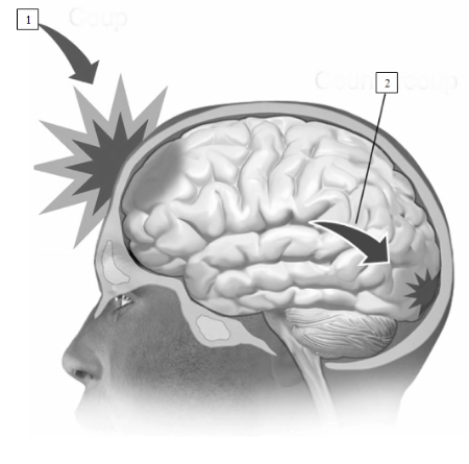
(Multiple Choice)
4.8/5 (71)
(71) Initial symptoms of human immunodeficiency virus (HIV)-associated neurocognitive disorder (HAND) may mimic
(Multiple Choice)
4.9/5 (85)
(85) According to the Kennard Principle, reorganization after brain damage is
(Multiple Choice)
4.7/5 (67)
(67) In which of the following ways does HIV-associated neurocognitive disease (HAND) differ in children versus in adults?
(Multiple Choice)
4.9/5 (74)
(74) 
Filters
- Essay(0)
- Multiple Choice(0)
- Short Answer(0)
- True False(0)
- Matching(0)