



 Chat with AI
Exam 10: Food, Soil, and Pest Management

Exam 1: Environmental Problems, Their Causes, and Sustainability92 Questions
Exam 2: Science, Matter, and Energy113 Questions
Exam 3: Ecosystems: What Are They and How Do They Work172 Questions
Exam 4: Biodiversity and Evolution93 Questions
Exam 5: Biodiversity, Species Interactions, and Population Control92 Questions
Exam 6: The Human Population and Urbanization112 Questions
Exam 7: Climate and Biodiversity145 Questions
Exam 8: Sustaining Biodiversity: the Species Approach104 Questions
Exam 9: Sustaining Biodiversity: the Ecosystem Approach85 Questions
Exam 10: Food, Soil, and Pest Management121 Questions
Exam 11: Water Resources and Water Pollution128 Questions
Exam 12: Geology and Nonrenewable Minerals96 Questions
Exam 13: Energy117 Questions
Exam 14: Environmental Hazards and Human Health97 Questions
Exam 15: Air Pollution, Climate Change, and Ozone Depletion137 Questions
Exam 16: Solid and Hazardous Waste100 Questions
Exam 17: Environmental Economics, Politics, and Worldviews87 Questions
Select questions type


Our economic systems promote unsustainable forms of industrialized agriculture because
(Multiple Choice)
4.9/5  (90)
(90) Indicate whether the processes listed below are used in industrialized agriculture or organic agriculture.
-crop rotation
(Multiple Choice)
4.9/5 (71)
(71) Michael Pollan, in his landmark book The Omnivore's Dilemma, investigates and discussed the practices of meat production in modern, industrialized agriculture in the United States. After his extensive study, he writes that he believes hunting for meat may be the more humane and wise choice. He cites the fact that game animals at least live their lives in a free, uncaged environment, compared with beef cattle that spend much of their lives confined in feedlots, standing in manure and eating grain they are not designed to digest. Additionally, the game animal typically has a relatively quick and painless death.
Discuss this issue. Include in your discussion aspects of animal cruelty, relative availability of the meat to satisfy food needs for a large population, and the relative impacts of farming versus hunting on biodiversity.
(Short Answer)
4.8/5 (83)
(83) Explain how growing corn in the Midwest creates a 'dead zone' in the Gulf of Mexico.
(Essay)
5.0/5 (88)
(88) ____________________ are chemicals emitted by living organisms to send messages to individuals of the same species and can be used as alternatives to pesticides.
(Short Answer)
4.9/5 (89)
(89) How many units of energy are required to produce one unit of grain-fed beef?
(Multiple Choice)
4.9/5 (85)
(85) Which of the following statements is a weakness of using pheromones?
(Multiple Choice)
4.9/5 (70)
(70) Indicate whether the processes listed below are used in industrialized agriculture or organic agriculture.
-no genetically modified seeds
(Multiple Choice)
4.7/5 (65)
(65) The process of ____________________ allows for the raising of marine and freshwater fish in ponds and underwater cages.
(Short Answer)
4.9/5 (79)
(79) One of the problems with genetically modified food crops is that if pollen released from the plants spreads among non-engineered plants it will reduce the natural genetic ____________________ of wild strains.
(Short Answer)
4.7/5 (93)
(93) Today in America, four of the top ten causes of death are diseases related to ____________________.
(Short Answer)
4.8/5 (89)
(89) Perhaps the most important thing about Rachel Carson's investigative work on the environmental effects of pesticides, and her publication "Silent Spring," is
(Multiple Choice)
4.8/5 (82)
(82) Low-input ____________________ produces higher yields than does high-input ____________________.
(Short Answer)
4.8/5 (74)
(74) Indicate whether the processes listed below are used in industrialized agriculture or organic agriculture.
-globally export-oriented
(Multiple Choice)
4.7/5 (77)
(77) 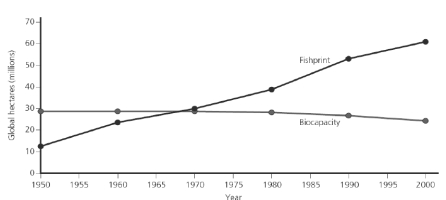 -For a given theoretical country, assume the productivity in metric tons per hectare remains stable, and the weighting factor remains the same, but the metric tons of fish harvested per year is reduced by 50%. How will this affect the fishprint for this country?
 (Short Answer)
4.9/5 (72)
(72) Pesticides have a positive benefit in terms of public health because fungi, insects, and noncrop plants can contaminate crops with many natural toxins.
(True/False)
4.8/5 (77)
(77) 
Filters
- Essay(0)
- Multiple Choice(0)
- Short Answer(0)
- True False(0)
- Matching(0)