



 Chat with AI
Exam 7: Ethnicities

Exam 1: This Is Geography61 Questions
Exam 2: Population and Health76 Questions
Exam 3: Migration56 Questions
Exam 4: Folk and Popular Culture63 Questions
Exam 5: Languages85 Questions
Exam 6: Religions84 Questions
Exam 7: Ethnicities80 Questions
Exam 8: Political Geography81 Questions
Exam 9: Development68 Questions
Exam 10: Food and Agriculture75 Questions
Exam 11: Industry67 Questions
Exam 12: Services and Settlements67 Questions
Exam 13: Urban Patterns67 Questions
Exam 14: Resource Issues77 Questions
Select questions type


Describe the key differences between "separate but equal" in the United States and apartheid in South Africa.
(Essay)
4.8/5  (90)
(90) Which of the following ethnic groups does not share the nationality of the others?
(Multiple Choice)
4.7/5 (74)
(74) African Americans and Hispanics are highly clustered in ________.By the late 20ᵗʰ century,most of the children and grandchildren of European immigrants had moved from the original inner-city enclaves to ________.A suburban area with a cluster of a particular ethnic population is known as a(n)________.
(Multiple Choice)
4.8/5 (78)
(78) ________ is the process when a more powerful group forcibly removes another group for the purposes of creating an ethnically ________ region.
(Multiple Choice)
5.0/5 (78)
(78) A system of racial discrimination in South Africa was called ________.
(Short Answer)
4.7/5 (98)
(98) From 1910 to 1950,population density of African Americans in ghettos
(Multiple Choice)
4.8/5 (84)
(84) Using the maps provided in 7.3.4,describe the patterns of change for the ethnic groups between 1910 and 1990 Chicago.
(Essay)
4.8/5 (76)
(76) The "separate but equal" doctrine was legally established by
(Multiple Choice)
4.8/5 (78)
(78) Western Asia consists of seven nationalities and dozens of ethnicities.The region is characterized by
(Multiple Choice)
5.0/5 (83)
(83) Figure 7.8.3 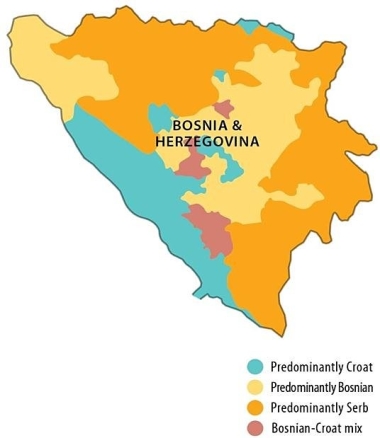 -Examining this map of Bosnia & Herzegovina reveals
 (Multiple Choice)
4.8/5 (81)
(81) 
Filters
- Essay(0)
- Multiple Choice(0)
- Short Answer(0)
- True False(0)
- Matching(0)