



 Chat with AI
Exam 9: Development


Is the WTO the only avenue countries have to settle disputes related to international trade? If not,why is the WTO needed at all? Why don't countries forge ahead,create trade agreements,and settle disputes without the WTO?

 (87)
 Answered by Examlex AI Copilot
No, the WTO is not the only avenue countries have to settle disputes related to international trade. Countries can also settle disputes through bilateral or regional trade agreements, or through arbitration and mediation. However, the WTO is needed because it provides a forum for multilateral negotiations and dispute settlement, which can help to create a more stable and predictable international trading system.
The WTO is also needed because it sets rules and standards for international trade, which can help to prevent trade wars and protect smaller or developing countries from being unfairly treated by larger or more powerful trading partners. Without the WTO, countries might be more likely to engage in protectionist measures, such as imposing tariffs and quotas, which can lead to retaliatory actions and ultimately harm global trade.
Additionally, the WTO provides a mechanism for resolving disputes that arise between countries, which can help to prevent conflicts from escalating and damaging international relations. By having a neutral and impartial body to adjudicate trade disputes, countries can avoid resorting to unilateral actions that could harm the overall stability of the global economy.
In summary, while countries can and do forge ahead and create trade agreements and settle disputes without the WTO, the organization is still needed to provide a framework for multilateral negotiations, set standards and rules for international trade, and offer a forum for resolving disputes in a fair and impartial manner. Without the WTO, the international trading system could be more prone to instability and conflict, which would ultimately be detrimental to all countries involved.
In the self-sufficiency approach to development,countries do all but which of the following?
(90)  Verified
E
During the 1950s,people lived on average more than two decades longer in developed countries than in developing ones.In the twenty-first century,the gap is ________.
(81) VerifiedB
According to the textbook,one-fifth of the world living in the developed world consumes ________ of the world's goods.
(66) Sub-Saharan Africa and South Asia have some of the world's lowest literacy rates,averaging ________ percent.
(79) ________ is trade that protects small businesses and workers.
(83) Figure 9.4.5
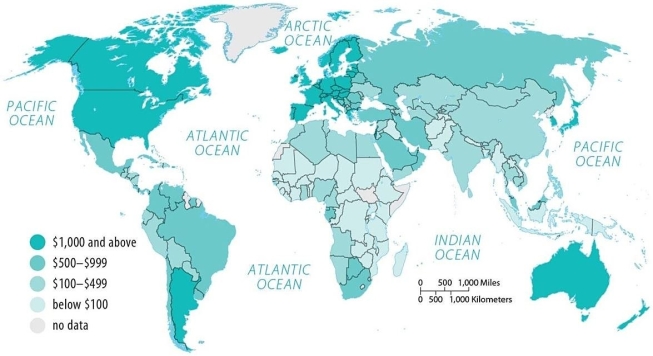 -On average,developed countries spend about $________ annually per capita on health care.
 (77) Which of the following regions has the world's highest per capita income?
(79) According to the textbook,Africans comprise about 14 percent of the world's population but only consume ________ percent of the world's goods.
(81) What is the human development index and how does it differ from the inequality-adjusted HDI?
(91) The following country has a very large population,medium developing HMI ranking,and exhibits considerable inequality in HDI within its country.
(77) The U.S.government allocates approximately ________ percent of its GNI to foreign aid.
(84) Created by the UN in 1980,this is an indicator of the level of development for each country.It combines income,literacy,education,and life expectancy.
(72) What is structural adjustment program and what are some of the criticisms against it?
(76) Referring to Map 9.8.5,which countries would be more likely to be able to pay their loans back?
(77) Which of the following is true of a country with its inequality-adjusted HDI (IHDI)lower than the HDI?
(89) It is important to carefully consider what kind of statistics to use when researching and presenting information.For example,one could claim that great progress has been made in the GNI per capita since 1980 for developing regions by stating that the percent increase is much higher as compared to that of developed countries in the same period.Describe three different statistical ways to present this data (Figure 9.10.3 in the text) and what method you would choose for a research paper.
(85) Globally,what percentage of GNI do developing countries spend on health care?
(73) 
Filters
- Essay(0)
- Multiple Choice(0)
- Short Answer(0)
- True False(0)
- Matching(0)