



 Chat with AI
Exam 19: Exchange Rates and the Balance of Payments

Exam 1: The Nature of Economics346 Questions
Exam 2: Scarcity and the World of Trade-Offs410 Questions
Exam 3: Demand and Supply448 Questions
Exam 4: Extensions of Demand and Supply Analysis398 Questions
Exam 5: Public Spending and Public Choice359 Questions
Exam 6: Funding the Public Sector201 Questions
Exam 7: The Macroeconomy: Unemployment, Inflation, and Deflation412 Questions
Exam 8: Global Economic Growth and Development282 Questions
Exam 9: Real GDP and the Price Level in the Long Run291 Questions
Exam 10: Classical and Keynesian Macro Analyses365 Questions
Exam 11: Consumption, Real GDP, and the Multiplier445 Questions
Exam 12: Fiscal Policy273 Questions
Exam 13: Deficit Spending and the Public Debt145 Questions
Exam 14: Money Banking and Central Banking516 Questions
Exam 15: Domestic and International Dimensions of Monetary Policy356 Questions
Exam 16: Stabilization in an Integrated World Economy305 Questions
Exam 17: Policies and Prospects for Global Economic Growth216 Questions
Exam 18: Comparative Advantage and the Open Economy314 Questions
Exam 19: Exchange Rates and the Balance of Payments300 Questions
Select questions type


In July 2011, $1 was worth 45 Indian rupees and in July 2012, $1 was worth 55 Indian rupees. We can therefore conclude that
(Multiple Choice)
4.9/5  (74)
(74) Suppose the foreign exchange market is in equilibrium. Then, the U.S. government increases borrowing, causing American interest rates to increase. What will happen to the price of the Japanese yen?
Why?
(Essay)
4.9/5 (85)
(85) The total of all economic transactions between a nation and the rest of the world is referred to as the
(Multiple Choice)
5.0/5 (76)
(76) A U.S. family flies from Boston to Shanghai on a China Airlines plane. This transaction is
(Multiple Choice)
4.7/5 (85)
(85) Other things being constant, if the U.S. real rate of interest exceeds that of its trading partners, we expect
(Multiple Choice)
4.8/5 (80)
(80) Suppose the currency price of the U.S. dollar in terms of the Japanese yen starts to fall. To prevent that from occurring, the U.S. central bank should
(Multiple Choice)
4.9/5 (73)
(73) Under the gold standard, when a nation had a deficit in its balance of payments,
(Multiple Choice)
4.7/5 (83)
(83) Which of the following is NOT a deficit item on the international accounts balance sheet for a country?
(Multiple Choice)
4.9/5 (85)
(85) In the balance of payments, if there are no statistical errors or discrepancies, which of the following is TRUE of the sum of the capital account balance, the current account balance, and the official reserve transactions account balance?
(Multiple Choice)
4.8/5 (72)
(72) When a dinner in Bulgaria costs 150 Bulgarian levas, it will cost a U.S. resident ________ dollars, if the exchange rate is 1.5 Bulgarian levas to the dollar.
(Multiple Choice)
4.9/5 (82)
(82)  -Refer to the above figure. Suppose E is the original equilibrium. An increase in the demand for dollars will be reflected in this figure by
 (Multiple Choice)
4.9/5 (78)
(78) The agency which functions as a "lender of last resort" for national governments is the
(Multiple Choice)
4.8/5 (82)
(82)  -Refer to the above table. Suppose the transactions in the table are added to a balance of payments account that is already in balance. What will have to take place to keep the balance of payments in balance?
 (Multiple Choice)
4.9/5 (76)
(76)  -In the above figure, suppose the value of the European euro is P₁ and U.S. demand for French wine declines. The effect on the franc can be shown by
 (Multiple Choice)
4.9/5 (86)
(86) 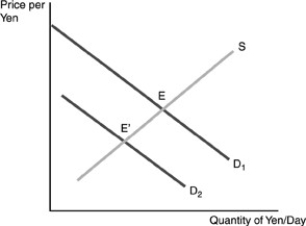 -Refer to the above figure. Suppose the equilibrium moves from E' to point E. An event that could have caused this movement is
 (Multiple Choice)
4.7/5 (61)
(61) 
Filters
- Essay(0)
- Multiple Choice(0)
- Short Answer(0)
- True False(0)
- Matching(0)