



 Chat with AI
Exam 14: Money Banking and Central Banking

Exam 1: The Nature of Economics346 Questions
Exam 2: Scarcity and the World of Trade-Offs410 Questions
Exam 3: Demand and Supply448 Questions
Exam 4: Extensions of Demand and Supply Analysis398 Questions
Exam 5: Public Spending and Public Choice359 Questions
Exam 6: Funding the Public Sector201 Questions
Exam 7: The Macroeconomy: Unemployment, Inflation, and Deflation412 Questions
Exam 8: Global Economic Growth and Development282 Questions
Exam 9: Real GDP and the Price Level in the Long Run291 Questions
Exam 10: Classical and Keynesian Macro Analyses365 Questions
Exam 11: Consumption, Real GDP, and the Multiplier445 Questions
Exam 12: Fiscal Policy273 Questions
Exam 13: Deficit Spending and the Public Debt145 Questions
Exam 14: Money Banking and Central Banking516 Questions
Exam 15: Domestic and International Dimensions of Monetary Policy356 Questions
Exam 16: Stabilization in an Integrated World Economy305 Questions
Exam 17: Policies and Prospects for Global Economic Growth216 Questions
Exam 18: Comparative Advantage and the Open Economy314 Questions
Exam 19: Exchange Rates and the Balance of Payments300 Questions
Select questions type


Of the items in the following lists, which go from most liquid to least liquid?
(Multiple Choice)
4.9/5  (91)
(91) Which of the following actions has no effect on the total money supply?
(Multiple Choice)
4.9/5 (90)
(90) The actual money multiplier multiplied by the change in total reserves is the
(Multiple Choice)
4.7/5 (74)
(74) What is liquidity?
Why is money the most liquid of all assets?
What is the cost of this liquidity?
(Essay)
4.8/5 (74)
(74) If the Federal Reserve buys $500 of government securities when the required reserve ratio is 20 percent, the maximum potential change in the money supply is a(n)
(Multiple Choice)
4.7/5 (74)
(74) In the United States, where do depository institutions hold their reserves?
(Multiple Choice)
4.8/5 (73)
(73) Which of the following is a time deposit with a fixed maturity date offered by banks and other financial institutions?
(Multiple Choice)
4.9/5 (68)
(68) 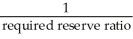
The reserve ratio is 10 percent. If the bank receives a customer deposit of $100,000, then an immediate effect is
(Multiple Choice)
4.8/5 (71)
(71) The level of reserves in the monetary system is determined by
(Multiple Choice)
4.8/5 (71)
(71) If the money multiplier is 2.4 and the Fed buys $8 million in securities on the open market, transaction deposits could potentially
(Multiple Choice)
4.8/5 (75)
(75)  -The potential money multiplier for the banking system in the above table is
 (Multiple Choice)
4.8/5 (75)
(75) 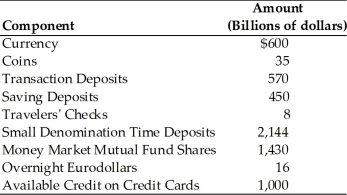 -According to the above table, the value of M2 is
Possession of information by one party in a financial transaction but not by the other party is
(Multiple Choice)
4.9/5 (79)
(79) If a $1 million open market purchase by the Fed generates a new deposit at a bank that immediately causes the bank's reserves held at the Fed to increase by $1 million, then the T-account effects are that the bank's assets and liabilities ________ by $1 million and that the Fed's assets and liabilities ________ by $1 million.
(Multiple Choice)
4.8/5 (86)
(86) 
Filters
- Essay(0)
- Multiple Choice(0)
- Short Answer(0)
- True False(0)
- Matching(0)