



 Chat with AI
Exam 13: Deficit Spending and the Public Debt

Exam 1: The Nature of Economics346 Questions
Exam 2: Scarcity and the World of Trade-Offs410 Questions
Exam 3: Demand and Supply448 Questions
Exam 4: Extensions of Demand and Supply Analysis398 Questions
Exam 5: Public Spending and Public Choice359 Questions
Exam 6: Funding the Public Sector201 Questions
Exam 7: The Macroeconomy: Unemployment, Inflation, and Deflation412 Questions
Exam 8: Global Economic Growth and Development282 Questions
Exam 9: Real GDP and the Price Level in the Long Run291 Questions
Exam 10: Classical and Keynesian Macro Analyses365 Questions
Exam 11: Consumption, Real GDP, and the Multiplier445 Questions
Exam 12: Fiscal Policy273 Questions
Exam 13: Deficit Spending and the Public Debt145 Questions
Exam 14: Money Banking and Central Banking516 Questions
Exam 15: Domestic and International Dimensions of Monetary Policy356 Questions
Exam 16: Stabilization in an Integrated World Economy305 Questions
Exam 17: Policies and Prospects for Global Economic Growth216 Questions
Exam 18: Comparative Advantage and the Open Economy314 Questions
Exam 19: Exchange Rates and the Balance of Payments300 Questions
Select questions type


The difference between net public debt and gross public debt is
(Multiple Choice)
4.9/5  (68)
(68) What are the macroeconomic consequences of a budget deficit when the economy is operating at full employment?
Be sure to discuss the effects in the short-run and in the long-run.
(Essay)
4.7/5 (89)
(89) Media reports often suggest that the increasing public debt is a burden on future generations. What they mean is that
(Multiple Choice)
4.8/5 (79)
(79) The amount of funds the Social Security system has loaned the federal government is
(Multiple Choice)
5.0/5 (88)
(88) To evaluate relative changes in the net public debt, we must
(Multiple Choice)
4.8/5 (86)
(86) Which of the following correctly describes a way in which deficit spending can impose a burden on future generations?
I. Failure to allocate deficit spending to uses that boost future real Gross Domestic Product (GDP)will require taxing future generations at a higher rate to repay the resulting higher public debt.
II. Government deficits that lead to higher employment and real Gross Domestic Product (GDP)in the future will generate increased income taxes for future governments, which will respond by spending the higher tax revenues, creating higher future government budget deficits.
III. Other things being equal, deficit spending fuels increased consumption of goods and services by the current generation that crowds out capital investment, thereby leaving future generations with a smaller stock of capital than otherwise would have existed.
(Multiple Choice)
4.9/5 (78)
(78) One of the long-run effects of higher government budget deficits is
(Multiple Choice)
4.7/5 (78)
(78) 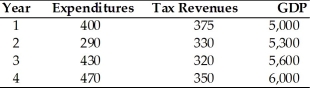 -Suppose that initially there is no public debt. Using the above table, the public debt over this four year period would have
 (Multiple Choice)
4.8/5 (79)
(79) Which of the following will NOT cause the public debt to change?
(Multiple Choice)
4.8/5 (82)
(82) Since the late 1980s, the share of the net public debt owed to foreign interests has
(Multiple Choice)
4.8/5 (83)
(83) Which of the following is TRUE of the relationship between U.S. trade deficits and federal government budget deficits?
(Multiple Choice)
4.9/5 (74)
(74) When government spending is less than the tax revenues during a specific time period, this is known as a
(Multiple Choice)
4.7/5 (78)
(78) Other things being equal, during a period when the federal government issues more Treasury securities to borrow funds
(Multiple Choice)
4.8/5 (73)
(73) When analyzing the effects of the government budget deficit
(Multiple Choice)
4.9/5 (92)
(92) 
Filters
- Essay(0)
- Multiple Choice(0)
- Short Answer(0)
- True False(0)
- Matching(0)