



 Chat with AI
Exam 11: Consumption, Real GDP, and the Multiplier

Exam 1: The Nature of Economics346 Questions
Exam 2: Scarcity and the World of Trade-Offs410 Questions
Exam 3: Demand and Supply448 Questions
Exam 4: Extensions of Demand and Supply Analysis398 Questions
Exam 5: Public Spending and Public Choice359 Questions
Exam 6: Funding the Public Sector201 Questions
Exam 7: The Macroeconomy: Unemployment, Inflation, and Deflation412 Questions
Exam 8: Global Economic Growth and Development282 Questions
Exam 9: Real GDP and the Price Level in the Long Run291 Questions
Exam 10: Classical and Keynesian Macro Analyses365 Questions
Exam 11: Consumption, Real GDP, and the Multiplier445 Questions
Exam 12: Fiscal Policy273 Questions
Exam 13: Deficit Spending and the Public Debt145 Questions
Exam 14: Money Banking and Central Banking516 Questions
Exam 15: Domestic and International Dimensions of Monetary Policy356 Questions
Exam 16: Stabilization in an Integrated World Economy305 Questions
Exam 17: Policies and Prospects for Global Economic Growth216 Questions
Exam 18: Comparative Advantage and the Open Economy314 Questions
Exam 19: Exchange Rates and the Balance of Payments300 Questions
Select questions type


Based on historical data, which of the following tended to be most variable over time?
(Multiple Choice)
4.9/5  (88)
(88) All of the following would cause the investment function relating investment to the interest rate to shift EXCEPT
(Multiple Choice)
4.9/5 (85)
(85) If the marginal propensity to save is 0.4 and disposable income increases from $1,000 to $1,500, saving will increase
(Multiple Choice)
4.9/5 (77)
(77) The saving function shows the relationship between planned real saving and
(Multiple Choice)
5.0/5 (100)
(100) When consumption spending is greater than disposable income, we know with certainty that we have
(Multiple Choice)
4.8/5 (59)
(59) If initial equilibrium real Gross Domestic Product (GDP)is $400 billion, MPC = 0.9, and autonomous investment increases $40 billion, equilibrium real Gross Domestic Product (GDP)will be
(Multiple Choice)
4.9/5 (86)
(86) How does a reduction in the price level affect the position of the C + I + G + X curve and in turn the equilibrium level of real GDP?
(Multiple Choice)
4.9/5 (72)
(72) Suppose marginal propensity to consume (MPC)is 0.7 and there is a $1,000 increase in autonomous consumption. Given this information, real GDP will increase by
(Multiple Choice)
4.9/5 (73)
(73) The relationship that tells us how much a person intends to spend at various levels of income is
(Multiple Choice)
4.9/5 (81)
(81) If an economy saves 20 percent of any increase in real Gross Domestic Product (GDP), then an increase in investment of $2 billion can produce an increase in real Gross Domestic Product (GDP)of as much as
(Multiple Choice)
4.8/5 (64)
(64) 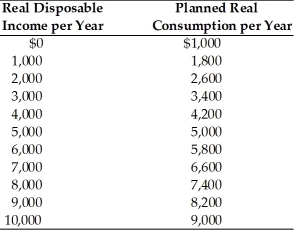 -In the above table, the marginal propensity to save when disposable income changes from $1,000 to $2,000 is
 (Multiple Choice)
4.9/5 (86)
(86) When the average propensity to save (APS)is 0.20, then this means
(Multiple Choice)
4.8/5 (77)
(77) Suppose when real disposable income is $5000, planned real consumption is $4000. When real disposable income increases to $6000, planned real saving increases by $500. The new planned real consumption expenditures is
(Multiple Choice)
4.9/5 (72)
(72) Distinguish between saving and savings. How does investment relate to this distinction, if at all?
(Essay)
4.8/5 (76)
(76) Which of the following represents the relationship between disposable income (DI), consumption (C), and saving (S)?
(Multiple Choice)
4.7/5 (86)
(86) According to Keynes, the primary determinant of a person's saving is NOT
(Multiple Choice)
4.9/5 (94)
(94) As real disposable income increases, consumption expenditures
(Multiple Choice)
4.8/5 (80)
(80) 
Filters
- Essay(0)
- Multiple Choice(0)
- Short Answer(0)
- True False(0)
- Matching(0)