



 Chat with AI
Exam 8: Global Economic Growth and Development

Exam 1: The Nature of Economics346 Questions
Exam 2: Scarcity and the World of Trade-Offs410 Questions
Exam 3: Demand and Supply448 Questions
Exam 4: Extensions of Demand and Supply Analysis398 Questions
Exam 5: Public Spending and Public Choice359 Questions
Exam 6: Funding the Public Sector201 Questions
Exam 7: The Macroeconomy: Unemployment, Inflation, and Deflation412 Questions
Exam 8: Global Economic Growth and Development282 Questions
Exam 9: Real GDP and the Price Level in the Long Run291 Questions
Exam 10: Classical and Keynesian Macro Analyses365 Questions
Exam 11: Consumption, Real GDP, and the Multiplier445 Questions
Exam 12: Fiscal Policy273 Questions
Exam 13: Deficit Spending and the Public Debt145 Questions
Exam 14: Money Banking and Central Banking516 Questions
Exam 15: Domestic and International Dimensions of Monetary Policy356 Questions
Exam 16: Stabilization in an Integrated World Economy305 Questions
Exam 17: Policies and Prospects for Global Economic Growth216 Questions
Exam 18: Comparative Advantage and the Open Economy314 Questions
Exam 19: Exchange Rates and the Balance of Payments300 Questions
Select questions type


The relationship between the rate of saving and per capita real GDP is
(Multiple Choice)
4.8/5  (79)
(79) Which of the following is an obstacle to economic development?
(Multiple Choice)
4.8/5 (77)
(77) Would a new growth theorist expect economic growth to be very rapid in one of the Communist nations before the fall of Communism?
Why or why not?
(Essay)
4.9/5 (85)
(85) 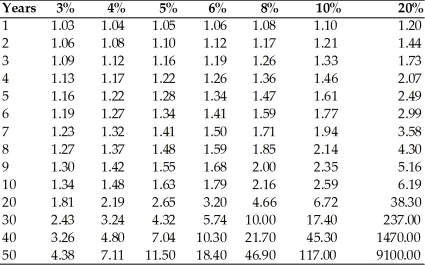 -Refer to the above table. How long would it take for a country to triple its GDP if the GDP grew at a 20 percent rate?
 (Multiple Choice)
4.8/5 (81)
(81) An educated populace contributes to economic growth because
(Multiple Choice)
4.9/5 (83)
(83) According to the text, data supports the conclusion that lower trade barriers
(Multiple Choice)
4.9/5 (92)
(92) Is it possible to see gains in a nation's real standard of living without any positive economic growth?
(Multiple Choice)
4.8/5 (76)
(76)
-Refer to the above table. Suppose one country has a per capita real GDP of $1000 and another has a per capita real GDP of $10,000, or ten times larger. If both countries have a growth rate of 5 percent, how much larger will per capita real GDP be in the second country be than the first after 50 years?
-Refer to the above table. Suppose one country has a per capita real GDP of $1000 and another has a per capita real GDP of $10,000, or ten times larger. If both countries have a growth rate of 5 percent, how much larger will per capita real GDP be in the second country be than the first after 50 years? (Multiple Choice)
4.9/5 (77)
(77) An outward shift of the production possibilities curve demonstrates
(Multiple Choice)
4.9/5 (77)
(77) When analyzing stages of economic development in the United States, it appears that we have entered the "tertiary stage." This is a stage marked by a shift toward
(Multiple Choice)
4.8/5 (95)
(95) It can be argued that Thomas Malthus' An Essay on the Principle of Population statement that population growth will always outstrip food production has been discredited due to
(Multiple Choice)
5.0/5 (90)
(90) An increase in growth rates will cause the production possibilities curve to
(Multiple Choice)
4.8/5 (68)
(68) According to economist Paul Romer, economies that wish to experience growth must
(Multiple Choice)
5.0/5 (77)
(77) Costs associated with economic growth include all of the following EXCEPT
(Multiple Choice)
4.8/5 (74)
(74) 
Filters
- Essay(0)
- Multiple Choice(0)
- Short Answer(0)
- True False(0)
- Matching(0)