



 Chat with AI
Exam 5: Public Spending and Public Choice

Exam 1: The Nature of Economics346 Questions
Exam 2: Scarcity and the World of Trade-Offs410 Questions
Exam 3: Demand and Supply448 Questions
Exam 4: Extensions of Demand and Supply Analysis398 Questions
Exam 5: Public Spending and Public Choice359 Questions
Exam 6: Funding the Public Sector201 Questions
Exam 7: The Macroeconomy: Unemployment, Inflation, and Deflation412 Questions
Exam 8: Global Economic Growth and Development282 Questions
Exam 9: Real GDP and the Price Level in the Long Run291 Questions
Exam 10: Classical and Keynesian Macro Analyses365 Questions
Exam 11: Consumption, Real GDP, and the Multiplier445 Questions
Exam 12: Fiscal Policy273 Questions
Exam 13: Deficit Spending and the Public Debt145 Questions
Exam 14: Money Banking and Central Banking516 Questions
Exam 15: Domestic and International Dimensions of Monetary Policy356 Questions
Exam 16: Stabilization in an Integrated World Economy305 Questions
Exam 17: Policies and Prospects for Global Economic Growth216 Questions
Exam 18: Comparative Advantage and the Open Economy314 Questions
Exam 19: Exchange Rates and the Balance of Payments300 Questions
Select questions type


 -Refer to the above figure. In the absence of a subsidy,

If a corporation were forced to absorb the cost of a spillover from the production of a good, this would likely cause the supply curve for the good to
(Multiple Choice)
4.9/5  (73)
(73) When state and local governments provide public schools with a per-unit subsidy to provide educational services, the price that the schools providing these services receive is
(Multiple Choice)
4.8/5 (77)
(77) Public goods are unlikely to be provided by the private sector because
(Multiple Choice)
4.9/5 (71)
(71) When does a subsidy that benefits consumers result in a more efficient allocation of a resource?
(Multiple Choice)
4.8/5 (98)
(98)  A shift from S₁ to S₂ reflects the change that happens when a negative externality is taken into account. A shift from D₁ to D₂ reflects the change that happens when a positive externality is taken into account.
-Refer to the above figures. An external benefit exists. This will lead to a(n)
A shift from S₁ to S₂ reflects the change that happens when a negative externality is taken into account. A shift from D₁ to D₂ reflects the change that happens when a positive externality is taken into account.
-Refer to the above figures. An external benefit exists. This will lead to a(n) (Multiple Choice)
4.8/5 (73)
(73) What is the consequence of a positive externality in a market?
What is the consequence of a negative externality?
Why those consequences occur?
(Essay)
4.8/5 (85)
(85) Which of the following goods is NOT subject to the free-rider problem?
(Multiple Choice)
4.8/5 (71)
(71) Suppose that the market price of good X equals the firm's cost of producing that good, but it does not reflect any costs imposed on society. Which of the following is FALSE?
(Multiple Choice)
4.7/5 (84)
(84) When misallocation of resources for production of a good results in spillover effects on third parties, there is a
(Multiple Choice)
4.9/5 (80)
(80)  -According to the above figure, if steel mills ignore the cost of pollution, the equilibrium quantity of steel will most likely be
 (Multiple Choice)
4.9/5 (81)
(81) 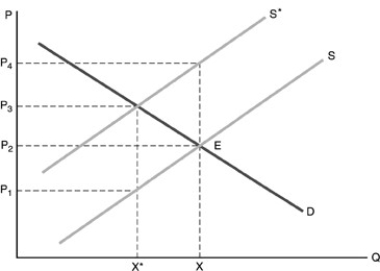 -In the above figure, market equilibrium at point E yields the quantity X. The quantity X* is socially optimal amount. The government can achieve the optimal outcome by
 (Multiple Choice)
4.7/5 (73)
(73) Markets tend to underallocate resources to the production of a good when
(Multiple Choice)
4.7/5 (68)
(68) Compared with the market clearing price of a health care service covered by Medicare, the Medicare program pays a ________ price to health care providers and charges a ________ price to consumers.
(Multiple Choice)
4.8/5 (70)
(70) Which of the following is TRUE about the political and market systems of voting?
(Multiple Choice)
4.7/5 (86)
(86) 
Filters
- Essay(0)
- Multiple Choice(0)
- Short Answer(0)
- True False(0)
- Matching(0)