



 Chat with AI
Exam 15: Allocation of Support-Department Costs, Common Costs, and Revenues

Exam 1: The Manager and Management Accounting195 Questions
Exam 2: An Introduction to Cost Terms and Purposes224 Questions
Exam 3: Cost-Volume-Profit Analysis211 Questions
Exam 4: Job Costing203 Questions
Exam 5: Activity-Based Costing and Activity-Based Management176 Questions
Exam 6: Master Budget and Responsibility Accounting226 Questions
Exam 7: Flexible Budgets, Direct-Cost Variances, and Management Control181 Questions
Exam 8: Flexible Budgets, Overhead Cost Variances, and Management Control176 Questions
Exam 9: Inventory Costing and Capacity Analysis210 Questions
Exam 10: Determining How Costs Behave192 Questions
Exam 11: Decision Making and Relevant Information218 Questions
Exam 12: Strategy, Balanced Scorecard, and Strategic Profitability Analysis172 Questions
Exam 13: Pricing Decisions and Cost Management210 Questions
Exam 14: Cost Allocation, Customer-Profitability Analysis, and Sales-Variance Analysis167 Questions
Exam 15: Allocation of Support-Department Costs, Common Costs, and Revenues150 Questions
Exam 16: Cost Allocation: Joint Products and Byproducts151 Questions
Exam 17: Process Costing149 Questions
Exam 18: Spoilage, Rework, and Scrap153 Questions
Exam 19: Balanced Scorecard: Quality and Time150 Questions
Exam 20: Inventory Management, Just-in-Time, and Simplified Costing Methods150 Questions
Exam 21: Capital Budgeting and Cost Analysis151 Questions
Exam 22: Management Control Systems, Transfer Pricing, and Multinational Considerations151 Questions
Exam 23: Performance Measurement, Compensation, and Multinational Considerations150 Questions
Select questions type


Explain three approaches to determining weights for the the stand-alone revenue-allocation. Which method do managers prefer?
(Essay)
4.9/5  (82)
(82) Consider the following information attributed to the material management department
Budgeted usage of materials-handling labor-hours 3500
Budgeted cost pools:
Fixed costs $154,000
Variable costs $126,000 (3500 hours x $36 per hour)
The company uses the single-rate method to allocate support costs to the Machining and Assembly Departments. Assuming that the actual hours tracked in the Machining and Assembly department are 500 for the month, what would be the allocation rate and how much cost would be allocated to the Machining and Assembly Department for the operations of the month? (Round final answers to the nearest dollar.)
(Multiple Choice)
4.8/5 (96)
(96) Corny Solutions processes various corn related food items. One of its facilities located in Iowa, performs some initial processing of corn on the cob once it arrives from the corn fields. The corn from that facility will be further processed elsewhere into corn for popping and corn meal. The costs incurred at the Iowa plant would be considered ________.
(Multiple Choice)
4.8/5 (75)
(75) Under the step-down method, once a support department's costs have been allocated, all subsequent support-department costs are allocated back to it.
(True/False)
4.8/5 (78)
(78) The Speedjet Aircraft Corporation has a central materials laboratory. The laboratory has only two users, the Large Plane Department and the Small Plane Department. The following data apply to the coming budget year:
 Budgeted amounts are used to calculate the allocation rates.
Actual usage for the year by the Large Plane Department was 60,000 technician hours and by the Small Plane Department was 80,000 technician hours. If a single-rate cost-allocation method is used, what amount of materials laboratory costs will be allocated to the Large Plane Department? Assume actual usage is used to allocate laboratory costs.
Budgeted amounts are used to calculate the allocation rates.
Actual usage for the year by the Large Plane Department was 60,000 technician hours and by the Small Plane Department was 80,000 technician hours. If a single-rate cost-allocation method is used, what amount of materials laboratory costs will be allocated to the Large Plane Department? Assume actual usage is used to allocate laboratory costs. (Multiple Choice)
4.9/5 (83)
(83) To discourage unnecessary use of a support department, management might ________.
(Multiple Choice)
5.0/5 (76)
(76) The single-rate method transforms the direct costs per hour into indirect costs to users of that facility.
(True/False)
4.9/5 (75)
(75) Software For You encounters revenue-allocation decisions with its bundled product sales. Here, two or more units of the software are sold as a single package. Managers at Software For You are keenly interested in individual product-profitability figures. Information pertaining to its three bundled products and the stand-alone selling prices of its individual products is as follows:
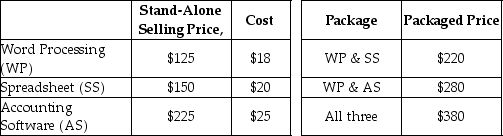 Required:
a.Using the stand-alone revenue-allocation method, allocate the $380 packaged price of "All Three" to the three software products
1.with selling prices as the weights.
2.with individual product costs as the weights.
3.based on physical units.
b.Allocate the $380 packaged price of "All Three" to the three software products using the incremental revenue-allocation method. Assume Word Processing is the primary product, followed by Spreadsheet, and then Accounting Software.
Required:
a.Using the stand-alone revenue-allocation method, allocate the $380 packaged price of "All Three" to the three software products
1.with selling prices as the weights.
2.with individual product costs as the weights.
3.based on physical units.
b.Allocate the $380 packaged price of "All Three" to the three software products using the incremental revenue-allocation method. Assume Word Processing is the primary product, followed by Spreadsheet, and then Accounting Software. (Essay)
4.8/5 (88)
(88) Under the dual-rate cost-allocation method, when fixed costs are allocated based on actual usage then ________.
(Multiple Choice)
4.9/5 (70)
(70) Alfred, owner of Hi-Tech Fiberglass Fabricators, Inc., is interested in using the reciprocal allocation method. The following data from operations were collected for analysis:
 Which of the following linear equations represents the complete reciprocated cost of the Data Processing Department?
 (Multiple Choice)
4.7/5 (72)
(72) 
Filters
- Essay(0)
- Multiple Choice(0)
- Short Answer(0)
- True False(0)
- Matching(0)