



 Chat with AI
Exam 13: Pricing Decisions and Cost Management

Exam 1: The Manager and Management Accounting195 Questions
Exam 2: An Introduction to Cost Terms and Purposes224 Questions
Exam 3: Cost-Volume-Profit Analysis211 Questions
Exam 4: Job Costing203 Questions
Exam 5: Activity-Based Costing and Activity-Based Management176 Questions
Exam 6: Master Budget and Responsibility Accounting226 Questions
Exam 7: Flexible Budgets, Direct-Cost Variances, and Management Control181 Questions
Exam 8: Flexible Budgets, Overhead Cost Variances, and Management Control176 Questions
Exam 9: Inventory Costing and Capacity Analysis210 Questions
Exam 10: Determining How Costs Behave192 Questions
Exam 11: Decision Making and Relevant Information218 Questions
Exam 12: Strategy, Balanced Scorecard, and Strategic Profitability Analysis172 Questions
Exam 13: Pricing Decisions and Cost Management210 Questions
Exam 14: Cost Allocation, Customer-Profitability Analysis, and Sales-Variance Analysis167 Questions
Exam 15: Allocation of Support-Department Costs, Common Costs, and Revenues150 Questions
Exam 16: Cost Allocation: Joint Products and Byproducts151 Questions
Exam 17: Process Costing149 Questions
Exam 18: Spoilage, Rework, and Scrap153 Questions
Exam 19: Balanced Scorecard: Quality and Time150 Questions
Exam 20: Inventory Management, Just-in-Time, and Simplified Costing Methods150 Questions
Exam 21: Capital Budgeting and Cost Analysis151 Questions
Exam 22: Management Control Systems, Transfer Pricing, and Multinational Considerations151 Questions
Exam 23: Performance Measurement, Compensation, and Multinational Considerations150 Questions
Select questions type


What are the undesirable effects of value engineering and target costing? How can these be reduced?
(Essay)
5.0/5  (61)
(61) Value engineering entails improvements in product designs, and changes in materials specifications.
(True/False)
4.9/5 (76)
(76) In a perfectly competitive market, which of the following is a primary factor influencing pricing decisions?
(Multiple Choice)
4.9/5 (81)
(81) Life-cycle budgeting estimates the costs and revenues attributed to a product from its initial R&D through production of a prototype product.
(True/False)
4.8/5 (76)
(76) After conducting a market research study, Magnificent Manufacturing decided to produce a new interior door to complement its exterior door line. It is estimated that the new interior door can be sold at a target price of $240. The annual target sales volume for interior doors is 21,000. Magnificent has target operating income of 20% of sales.
What is the target cost?
(Multiple Choice)
4.9/5 (71)
(71) The product strategy in which companies first determine the price at which they can sell a new product and then design a product that can be produced at a low enough cost to provide adequate operating income is referred to as ________.
(Multiple Choice)
4.8/5 (75)
(75) After conducting a market research study, Magnificent Manufacturing decided to produce a new interior door to complement its exterior door line. It is estimated that the new interior door can be sold at a target price of $260. The annual target sales volume for interior doors is 20,000. Magnificent has target operating income of 40% of sales.
What is the target cost for each interior door?
(Multiple Choice)
5.0/5 (72)
(72) Wilde Corporation budgeted the following costs for the production of its one and only product for the next fiscal year:
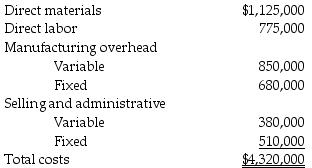 Wilde has an annual target operating income of $920,000.
The markup percentage for setting prices as a percentage of total manufacturing costs is ________.
Wilde has an annual target operating income of $920,000.
The markup percentage for setting prices as a percentage of total manufacturing costs is ________. (Multiple Choice)
4.9/5 (73)
(73) Which of the following is the best description of price discrimination?
(Multiple Choice)
4.8/5 (69)
(69) In case of pricing for special orders, managers include all future costs, variable costs, and costs that are fixed in the short run.
(True/False)
4.8/5 (87)
(87) Which of the following identifies an estimated price customers are willing to pay and then computes the cost to be achieved to earn the desired profit.
(Multiple Choice)
4.8/5 (81)
(81) Samuels Company is considering pricing its 10,000-gallon petroleum tanks using either variable manufacturing or full product costs as the base. The variable cost base provides a prospective price of $6,000 and the full cost base provides a prospective price of $6,100. Which of the following explains the difference in the two prices?
(Multiple Choice)
4.7/5 (81)
(81) A hotel in Orlando, Florida, experiences peak periods and slower times. How should prices be adjusted during peak periods? During slow times? Why?
(Essay)
4.9/5 (85)
(85) Which of the following best describes customer life-cycle costs?
(Multiple Choice)
4.7/5 (85)
(85) Velim Electronics manufactures electric shavers and is considering decreasing the price by $3 a unit for the coming year. With a $3 price decrease, the unit demand is expected to increase by 25%, and a high volume materials discount is expected to decrease the variable costs per unit by $2 per unit.
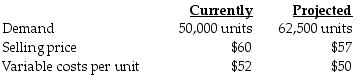 Would you recommend the $3 price decrease?
 (Multiple Choice)
4.8/5 (77)
(77) Monopolists can charge prices without limitations as there is no competition for the product or service the monopolist provides.
(True/False)
4.9/5 (73)
(73) Twenty Technologies, currently sells 17" monitors for $270. It has costs of $230. A competitor is bringing a new 17" monitor to market that will sell for $245. Management believes it must lower the price to $245 to compete in the market for 17" monitors. Twenty Technologies believes that the new price will cause sales to increase by 10%, even with a new competitor in the market. Twenty Technologies's sales are currently 5200 monitors per year.
What is the change in operating income if marketing manager is correct and only the sales price is changed?
(Multiple Choice)
4.9/5 (86)
(86) 
Filters
- Essay(0)
- Multiple Choice(0)
- Short Answer(0)
- True False(0)
- Matching(0)