



 Chat with AI
Exam 12: Banking and the Management of Financial Institutions

Exam 1: Why Study Money, Banking, and Financial Markets111 Questions
Exam 2: An Overview of the Financial System110 Questions
Exam 3: What Is Money110 Questions
Exam 4: Understanding Interest Rates110 Questions
Exam 5: The Behaviour of Interest Rates109 Questions
Exam 6: The Risk and Term Structure of Interest Rates110 Questions
Exam 7: The Stock Market, the Theory of Rational Expectations, and the Efficient Market Hypothesis110 Questions
Exam 8: An Economic Analysis of Financial Structure110 Questions
Exam 9: Financial Crises98 Questions
Exam 10: Economic Analysis of Financial Regulation101 Questions
Exam 11: Banking Industry: Structure and Competition112 Questions
Exam 12: Banking and the Management of Financial Institutions138 Questions
Exam 13: Risk Management With Financial Derivatives110 Questions
Exam 14: Central Banks and the Bank of Canada110 Questions
Exam 15: The Money Supply Process166 Questions
Exam 16: Tools of Monetary Policy109 Questions
Exam 17: The Conduct of Monetary Policy: Strategy and Tactics118 Questions
Exam 18: The Foreign Exchange Market129 Questions
Exam 19: The International Financial System140 Questions
Exam 20: Quantity Theory, Inflation, and the Demand for Money111 Questions
Exam 21: The Is Curve139 Questions
Exam 22: The Monetary Policy and Aggregate Demand Curves108 Questions
Exam 23: Aggregate Demand and Supply Analysis131 Questions
Exam 24: Monetary Policy Theory91 Questions
Exam 25: The Role of Expectations in Monetary Policy110 Questions
Exam 26: Transmission Mechanisms of Monetary Policy108 Questions
Exam 27: Financial Crises in Emerging Markets31 Questions
Exam 28: The ISLM Model107 Questions
Exam 29: Non-Bank Finance109 Questions
Select questions type


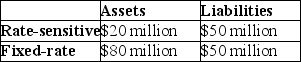 -If interest rates rise by 5 percentage points, say, from 10 to 15 percent, bank profits (measured using basic gap analysis)will ________.
 (Multiple Choice)
4.8/5  (75)
(75) If interest rates increase from 9 percent to 10 percent, a bank with a duration gap of 2 years would experience a decrease in its net worth of ________.
(Multiple Choice)
4.8/5 (86)
(86) To reduce moral hazard problems, banks include restrictive covenants in loan contracts. In order for these restrictive covenants to be effective, banks must also ________.
(Multiple Choice)
4.9/5 (89)
(89) If a bank has $200,000 of demand deposits, a desired reserve ratio of 20 percent, and it holds $80000 in reserves, then the maximum deposit outflow it can sustain without altering its balance sheet is ________.
(Multiple Choice)
4.7/5 (70)
(70) When a $10 cheque written on the First National Bank is deposited in an account at CIBC, then ________.
(Multiple Choice)
4.9/5 (85)
(85) Measuring the sensitivity of bank profits to changes in interest rates by multiplying the gap for several maturity subintervals times the change in the interest rate is called ________.
(Multiple Choice)
4.8/5 (68)
(68) Explain using an example the statement that "given the return on assets, the lower the bank capital, the higher the return for the owners of the bank."
(Essay)
4.9/5 (84)
(84) Bank loans from the Bank of Canada are called ________ and represent a ________ of funds.
(Multiple Choice)
4.8/5 (68)
(68) If a banker expects interest rates to fall in the future, her best strategy for the present is ________.
(Multiple Choice)
4.8/5 (82)
(82) If a bank has $100,000 of demand deposits, a desired reserve ratio of 20 percent, and it holds $40000 in reserves, then the maximum deposit outflow it can sustain without altering its balance sheet is ________.
(Multiple Choice)
4.8/5 (80)
(80) If a bank needs to raise the amount of capital relative to assets, a bank manager might choose to ________.
(Multiple Choice)
4.9/5 (69)
(69) Credit Atlantic Bank has the following balance sheet:
 The bank's desired reserve ratio is 10 percent and there is a withdrawal of cash from chequable deposits equal to $20. Describe what is likely to happen in the bank's balance sheet and produce the new balance sheet for Credit Atlantic Bank.
 (Essay)
4.9/5 (66)
(66) Large-denomination CDs are ________, so that like a bond they can be resold in a ________ market before they mature.
(Multiple Choice)
4.9/5 (80)
(80) Your bank has the following balance sheet:
Assets Liabilities
Reserves $50 million Deposits $200 million
Securities 50 million
Loans 150 million Bank capital 50 million
If the desired reserve ratio is 10 percent, what actions should the bank manager take if there is an unexpected deposit outflow of $50 million?
(Essay)
4.9/5 (71)
(71) When $1 million is deposited at a bank, the desired reserve ratio is 20 percent, and the bank chooses not to hold any excess reserves but makes loans instead, then, in the bank's final balance sheet, ________.
(Multiple Choice)
4.9/5 (83)
(83) All of the following are examples of off-balance sheet activities that generate fee income for banks except ________.
(Multiple Choice)
4.9/5 (85)
(85) If a bank has ________ rate-sensitive assets than liabilities, a ________ in interest rates will reduce bank profits, while a ________ in interest rates will raise bank profits.
(Multiple Choice)
4.7/5 (78)
(78) When you deposit $50 in currency at Old National Bank, ________.
(Multiple Choice)
4.9/5 (63)
(63) Holding all else constant, when a bank receives the funds for a deposited cheque, ________.
(Multiple Choice)
4.9/5 (78)
(78) 
Filters
- Essay(0)
- Multiple Choice(0)
- Short Answer(0)
- True False(0)
- Matching(0)