



 Chat with AI
Exam 24: Monetary Policy Theory


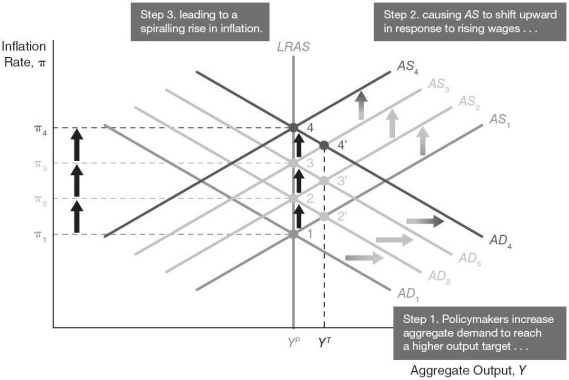
Why a cost-push inflation is a monetary phenomenon? Use the appropriate graph to support your answer.

 (81)
 Verified
Students must use a graph similar to the one below. Initially the economy is on point 1 with an aggregate output equal to the normal rate output. Supposing that workers succeed in seeking higher wages as they want to increase their real wages. The effect of such an increase will be similar to a negative supply shock and will shift the short-term aggregate supply curve to the left so that the economy slides to point 1'. If we have an activist government with a high employment target point 1' is associated with increased unemployment and lower output, so the government will implement policies to raise the aggregate demand and shift the aggregate demand curve to AD₂ so that we will return to the natural rate level of output at point 2 with a higher price level. Workers may be encouraged to seek even higher wages due to the increased price level and if they succeed and the government continues to accommodate this the economy will move from point 2 to 2', 3, 3', and 4 on the graph. But the continuous shift of the demand curve to the right cannot be sustained by fiscal policy as government spending and tax cuts have limits. This policy can only be sustained to create inflation only with an increasing money supply. Thus, a cost-push inflation is a monetary phenomenon because it cannot occur without the monetary authorities pursuing an accommodating policy of a higher rate of money growth.
Nonactivists of the policies believe that ________.
(79) VerifiedD
The MP curve is drawn on a graph with the ________ on the horizontal axis and the ________ on the vertical axis.
(76) VerifiedD
If all wages and prices are perfectly flexible with respect to expected changes in the price level, then an expansionary monetary policy will cause ________.
(87) Figure 27-3
 -In the new classical model in Figure 27-3, an unanticipated expansionary monetary policy ________.
 (79) If a rise in the expected price level results in an immediate and equal rise in wages and prices, then an expansionary monetary policy will cause ________.
(82) The time it takes for policy makers to change policy instruments once they have decided on the new policy is called ________.
(86) A sudden shortage of liquidity during a financial crisis will shift the ________ curve to the ________.
(73) To say that inflation is a monetary phenomenon seems to beg the question: ________.
(71) Complete Milton Friedman's famous proposition: "Inflation is always and everywhere a ________ phenomenon."
(77) In the new classical model, an unanticipated increase in the money supply causes ________.
(84) Non-activists believe that that expectations are ________ formed and that wages and prices are ________ with respect to the expected price level.
(71) The AD curve is drawn on a graph with the ________ on the horizontal axis and the ________ on the vertical axis.
(90) Because policies in Canada were too expansionary from 1965 through 1973, Canada suffered ________.
(86) The time it takes for policy makers to be sure of what the data are signaling about the future course of the economy is called ________.
(81) 
Filters
- Essay(0)
- Multiple Choice(0)
- Short Answer(0)
- True False(0)
- Matching(0)