



 Chat with AI
Exam 13: Quasi-Experiments and Small-N Designs

Exam 1: Psychology Is a Way of Thinking65 Questions
Exam 2: Sources of Information: Why Research Is Best and How to Find It65 Questions
Exam 3: Three Claims, Four Validities: Interrogation Tools for Consumers of Research66 Questions
Exam 4: Ethical Guidelines for Psychology Research65 Questions
Exam 5: Identifying Good Measurement65 Questions
Exam 6: Surveys and Observations: Describing What People Do65 Questions
Exam 7: Sampling: Estimating the Frequency of Behaviors and Beliefs65 Questions
Exam 8: Bivariate Correlational Research65 Questions
Exam 9: Multivariate Correlational Research65 Questions
Exam 10: Introduction to Simple Experiments65 Questions
Exam 11: More on Experiments: Confounding and Obscuring Variables65 Questions
Exam 12: Experiments With More Than One Independent Variable65 Questions
Exam 13: Quasi-Experiments and Small-N Designs65 Questions
Exam 14: Replication, Generalization, and the Real World66 Questions
Select questions type


Which of the following is a difference between participants in small-N designs compared to large-N designs?
(Multiple Choice)
4.7/5  (80)
(80) If a researcher is concerned about external validity, which of the following would you recommend with regard to conducting small-N designs?
(Multiple Choice)
4.8/5 (94)
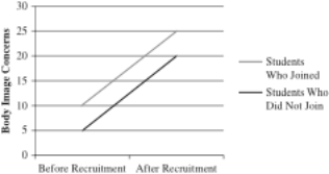
(94) Dr. Fletcher is interested in understanding whether joining a fraternity/sorority causes people to become more concerned about their attractiveness and appearance. He recruits a group of 55 freshmen (25 males, 30 females) who are planning to go through fraternity/sorority recruitment on his campus. After they join, he gives them a measure of attractiveness concern/appearance concern (the Body Concern Scale, where higher scores indicate higher body concerns).
In addition to measuring the group of participants who joined a fraternity/sorority, Dr. Fletcher decides to give the same measure to another group of 55 participants who decided to not join a fraternity/sorority. Based on the results below, explain whether Dr. Fletcher should be concerned about a maturation threat to internal validity.
(Essay)
4.7/5 (82)
(82) Dr. Anderson is a nutritionist who helps clients lose weight prior to surgery. She is working with W. J., a male client who is planning on undergoing a heart transplant. He currently eats more than 3,500 calories a day and has been asked by his doctor to cut the number of calories to about 1,800 (400 for breakfast, 600 for lunch, and 800 for dinner). She is curious as to whether a food journal will help W. J. reduce the number of calories he eats. A food journal is used to record everything a person eats to help patients be more aware of what they're eating. W. J.'s wife also recorded the food he consumed at each meal to have complete data before introducing the journal. Dr. Anderson decides to phase in the food journal gradually, initially only having W. J. record what he ate at breakfast during the first three days after baseline (days 4-6). During days 7-9, the journal is used at lunch, too, and during days 10-12, it also is used during dinner. The data for Dr. Anderson's study are below.
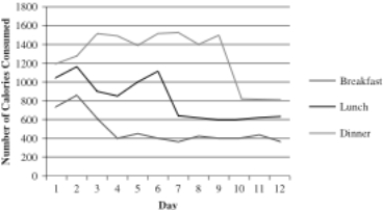 Dr) Natchez, a colleague of Dr. Anderson, questions whether W. J. simply wrote down less in his journal as the study went on because he grew tired of completing this "measure." Dr. Natchez believes he has uncovered which of the following threats to internal validity?
 (Multiple Choice)
4.8/5 (64)
(64) 
Filters
- Essay(0)
- Multiple Choice(0)
- Short Answer(0)
- True False(0)
- Matching(0)