



 Chat with AI
Exam 13: Quasi-Experiments and Small-N Designs

Exam 1: Psychology Is a Way of Thinking65 Questions
Exam 2: Sources of Information: Why Research Is Best and How to Find It65 Questions
Exam 3: Three Claims, Four Validities: Interrogation Tools for Consumers of Research66 Questions
Exam 4: Ethical Guidelines for Psychology Research65 Questions
Exam 5: Identifying Good Measurement65 Questions
Exam 6: Surveys and Observations: Describing What People Do65 Questions
Exam 7: Sampling: Estimating the Frequency of Behaviors and Beliefs65 Questions
Exam 8: Bivariate Correlational Research65 Questions
Exam 9: Multivariate Correlational Research65 Questions
Exam 10: Introduction to Simple Experiments65 Questions
Exam 11: More on Experiments: Confounding and Obscuring Variables65 Questions
Exam 12: Experiments With More Than One Independent Variable65 Questions
Exam 13: Quasi-Experiments and Small-N Designs65 Questions
Exam 14: Replication, Generalization, and the Real World66 Questions
Select questions type


A small-N design that involves providing treatment and then removing treatment is known as a(n):

Free
(Multiple Choice)
4.8/5  (91)
(91) Correct Answer: Verified
D
Dr. Fletcher is interested in whether joining a fraternity/sorority causes people to become more concerned about their attractiveness and appearance. He recruits a group of 55 freshmen (25 males, 30 females) who are planning to go through fraternity/sorority recruitment on his campus. After they join, he gives them a measure of attractiveness concern/appearance concern (the Body Concern Scale).
In addition to measuring the group of participants who joined a fraternity/sorority, Dr. Fletcher decides to give the same measure to another group of 55 participants who decided to not join a fraternity/sorority. This type of design is known as a(n):
Free
(Multiple Choice)
4.7/5 (85)
(85) Correct Answer:Verified
VerifiedB
Which of the following is an independent-groups quasi-experimental design?
Free
(Multiple Choice)
5.0/5 (88)
(88) Correct Answer:Verified
VerifiedB
Dr. Anderson is a nutritionist who helps clients lose weight prior to surgery. She is working with W. J., a male client who is planning on undergoing a heart transplant. He currently eats more than 3,500 calories a day and has been asked by his doctor to cut the number of calories to about 1,800 (400 for breakfast, 600 for lunch, and 800 for dinner). She is curious as to whether a food journal will help W. J. reduce the number of calories he eats. A food journal is used to record everything a person eats to help patients be more aware of what they're eating. W. J.'s wife also recorded the food he consumed at each meal to have complete data before introducing the journal. Dr. Anderson decides to phase in the food journal gradually, initially only having W. J. record what he ate at breakfast during the first three days after baseline (days 4-6). During days 7-9, the journal is used at lunch, too, and during days 10-12, it also is used during dinner. The data for Dr. Anderson's study are below.
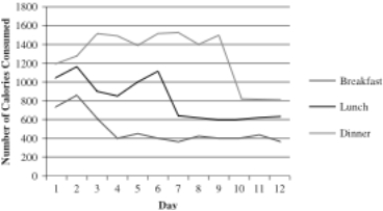 If Dr. Anderson wanted to change the study to a stable-baseline design, which of the following would she change?
 (Multiple Choice)
4.9/5 (77)
(77) Dr. Fletcher is interested in whether joining a fraternity/sorority causes people to become more concerned about their attractiveness and appearance. He recruits a group of 55 freshmen (25 males, 30 females) who are planning to go through fraternity/sorority recruitment on his campus. After they join, he gives them a measure of attractiveness concern/appearance concern (the Body Concern Scale).
Which of the following would Dr. Fletcher need to do to his current study design to make it an interrupted time-series design?
(Multiple Choice)
4.7/5 (97)
(97) A wait-list design is helpful in dealing with which of the following threats to internal validity?
(Multiple Choice)
4.8/5 (85)
(85) Which of the following CANNOT typically be applied to a small-N experiment?
(Multiple Choice)
4.8/5 (89)
(89) Dr. Anderson is a nutritionist who helps clients lose weight prior to surgery. She is working with W. J., a male client who is planning on undergoing a heart transplant. He currently eats more than 3,500 calories a day and has been asked by his doctor to cut the number of calories to about 1,800 (400 for breakfast, 600 for lunch, and 800 for dinner). She is curious as to whether a food journal will help W. J. reduce the number of calories he eats. A food journal is used to record everything a person eats to help patients be more aware of what they're eating. W. J.'s wife also recorded the food he consumed at each meal to have complete data before introducing the journal. Dr. Anderson decides to phase in the food journal gradually, initially only having W. J. record what he ate at breakfast during the first three days after baseline (days 4-6). During days 7-9, the journal is used at lunch, too, and during days 10-12, it also is used during dinner. The data for Dr. Anderson's study are below.
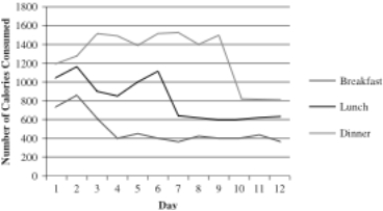 In interrogating the statistical validity of Dr. Anderson's study, which of the following might be asked?
 (Multiple Choice)
4.9/5 (82)
(82) Which of the following people would be of most interest for a small-N design?
(Multiple Choice)
4.7/5 (92)
(92) Dr. LaGuardia is a cognitive neuroscientist who is interested in the effect of brain concussions on the ability to recognize faces. He conducts a quasi-experimental study in which he examines football players before and after the regular season using the Benton Facial Recognition Test (a published, widely used measure of one's ability to recognize faces) to compare those who received concussions to those who did not. He finds that players who had concussions during the regular season performed worse on the Benton Facial Recognition Test than did players who did not experience concussions.
If Dr. LaGuardia had instead been interested in conducting a small-N design, which of the following might he have done?
(Multiple Choice)
4.8/5 (71)
(71) Dr. Fletcher is interested in whether joining a fraternity/sorority causes people to become more concerned about their attractiveness and appearance. He recruits a group of 55 freshmen (25 males, 30 females) who are planning to go through fraternity/sorority recruitment on his campus. After they join, he gives them a measure of attractiveness concern/appearance concern (the Body Concern Scale).
Suppose Dr. Fletcher finds that joining a fraternity/sorority reduces self-esteem about one's appearance. Who could his study generalize to?
(Multiple Choice)
4.7/5 (75)
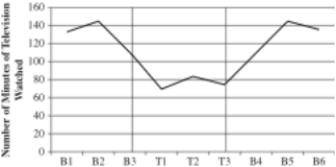
(75) Layne is trying to watch less television. Her friend Ryan is a psychologist who agrees to help her. He creates a treatment plan that involves giving Layne $5 for every day that she watches fewer than 90 minutes of television. He monitors her television watching for 3 days, treats her for 3 days and monitors her, and then just monitors her for 3 more days.
Imagine that Ryan and Layne's study finds the following pattern of results. Explain whether Ryan and Layne should conclude that the $5 treatment is effective at decreasing television viewing and whether they should be concerned by an instrumentation threat. (In the graph, B indicates baseline and T indicates treatment.)
(Essay)
4.8/5 (71)
(71) Seeing stability in a stable-baseline design can help rule out which of the following threats to internal validity?
(Multiple Choice)
4.8/5 (86)
(86) Which of the following is a within-groups quasi-experimental design?
(Multiple Choice)
4.9/5 (78)
(78) Dr. Anderson is a nutritionist who helps clients lose weight prior to surgery. She is working with W. J., a male client who is planning on undergoing a heart transplant. He currently eats more than 3,500 calories a day and has been asked by his doctor to cut the number of calories to about 1,800 (400 for breakfast, 600 for lunch, and 800 for dinner). She is curious as to whether a food journal will help W. J. reduce the number of calories he eats. A food journal is used to record everything a person eats to help patients be more aware of what they're eating. W. J.'s wife also recorded the food he consumed at each meal to have complete data before introducing the journal. Dr. Anderson decides to phase in the food journal gradually, initially only having W. J. record what he ate at breakfast during the first three days after baseline (days 4-6). During days 7-9, the journal is used at lunch, too, and during days 10-12, it also is used during dinner. The data for Dr. Anderson's study are below.
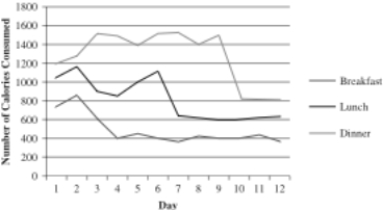 Which of the following is NOT a trade-off of Dr. Anderson's use of a small-N design?
 (Multiple Choice)
4.7/5 (74)
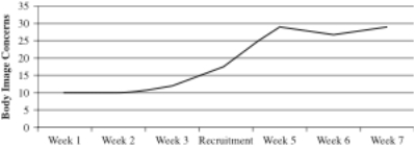
(74) Dr. Fletcher is interested in understanding whether joining a fraternity/sorority causes people to become more concerned about their attractiveness and appearance. He recruits a group of 55 freshmen (25 males, 30 females) who are planning to go through fraternity/sorority recruitment on his campus. After they join, he gives them a measure of attractiveness concern/appearance concern (the Body Concern Scale, where higher scores indicate higher body concerns).
In addition to measuring the body concern of the participants who joined a fraternity/sorority immediately before and immediately after they join, Dr. Fletcher measures them for the 3 weeks before and the 3 weeks after. Based on the results below, explain whether Dr. Fletcher should be concerned about a testing threat to internal validity.
(Essay)
4.7/5 (82)
(82) Dr. Fletcher is interested in whether joining a fraternity/sorority causes people to become more concerned about their attractiveness and appearance. He recruits a group of 55 freshmen (25 males, 30 females) who are planning to go through fraternity/sorority recruitment on his campus. After they join, he gives them a measure of attractiveness concern/appearance concern (the Body Concern Scale).
In addition to measuring the Body Concern of the participants who joined a fraternity/sorority both immediately before and immediately after they join, Dr. Fletcher measures them for the 3 weeks before and the 3 weeks after. This type of design would be able to better address which of the following threats to internal validity?
(Multiple Choice)
4.9/5 (78)
(78) Which of the following designs has elements of both a within-group design and an independent-groups design?
(Multiple Choice)
4.9/5 (87)
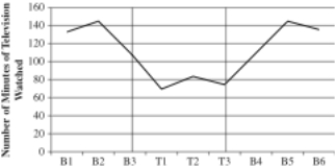
(87) Layne is trying to watch less television. Her friend Ryan is a psychologist who agrees to help her. He creates a treatment plan that involves giving Layne $5 for every day that she watches fewer than 90 minutes of television. He monitors her television watching for 3 days, treats her for 3 days and monitors her, and then just monitors her for 3 more days.
Imagine that Ryan and Layne's study finds the following pattern of results. Explain why the data below are especially convincing because of the second baseline/reversal. Name a specific threat that these data address.
(Essay)
4.8/5 (73)
(73) 
Filters
- Essay(0)
- Multiple Choice(0)
- Short Answer(0)
- True False(0)
- Matching(0)