



 Chat with AI
Exam 18: The Evolution of Invertebrate Diversity

Exam 1: Biology: Exploring Life48 Questions
Exam 2: The Chemical Basis of Life72 Questions
Exam 3: The Molecules of Cells85 Questions
Exam 4: A Tour of the Cell90 Questions
Exam 5: The Working Cell80 Questions
Exam 6: How Cells Harvest Chemical Energy82 Questions
Exam 7: Photosynthesis: Using Light to Make Food81 Questions
Exam 8: The Cellular Basis of Reproduction and Inheritance78 Questions
Exam 9: Patterns of Inheritance77 Questions
Exam 10: Molecular Biology of the Gene82 Questions
Exam 11: How Genes Are Controlled81 Questions
Exam 12: DNA Technology and Genomics78 Questions
Exam 13: How Populations Evolve64 Questions
Exam 14: The Origin of Species58 Questions
Exam 15: Tracing Evolutionary History82 Questions
Exam 16: Microbial Life: Prokaryotes and Protists84 Questions
Exam 17: The Evolution of Plant and Fungal Diversity79 Questions
Exam 18: The Evolution of Invertebrate Diversity72 Questions
Exam 19: The Evolution of Vertebrate Diversity72 Questions
Exam 20: Unifying Concepts of Animal Structure and Function63 Questions
Exam 21: Nutrition and Digestion91 Questions
Exam 22: Gas Exchange66 Questions
Exam 23: Circulation77 Questions
Exam 24: the Immune System79 Questions
Exam 25: Control of Body Temperature and Water Balance63 Questions
Exam 26: Hormones and the Endocrine System60 Questions
Exam 27: Reproduction and Embryonic Development71 Questions
Exam 28: Nervous Systems70 Questions
Exam 29: the Senses60 Questions
Exam 30: How Animals Move69 Questions
Exam 31: Plant Structure, Growth, and Reproduction79 Questions
Exam 32: Plant Nutrition and Transport65 Questions
Exam 33: Control Systems in Plants58 Questions
Exam 34: the Biosphere: an Introduction to Earths Diverse Environments63 Questions
Exam 35: Behavioral Adaptations to the Environment52 Questions
Exam 36: Population Ecology53 Questions
Exam 37: Communities and Ecosystems60 Questions
Exam 38: Conservation Biology57 Questions
Select questions type


While walking in your basement, you hear a crunching noise and notice that you have stepped on an organism. You look closely and see part of a segmented body and a few jointed appendages. What phylum does this animal represent?
(Multiple Choice)
4.9/5  (68)
(68) Which of the following is a typical characteristic of molluscs?
(Multiple Choice)
4.9/5 (90)
(90) Which of the following correctly lists organisms from least complex in overall development to most complex?
(Multiple Choice)
4.8/5 (95)
(95) Traditional animal phylogenetic trees and the most recent molecular phylogenetic trees have many similarities. Which is a feature of the recent trees that was not present in the traditional phylogeny?
(Multiple Choice)
4.9/5 (89)
(89) During the Cambrian explosion approximately 535 to 525 million years ago,
(Multiple Choice)
4.9/5 (78)
(78) Which of the following is considered a likely explanation for the events of the Cambrian explosion?
(Multiple Choice)
4.8/5 (87)
(87) The insect body plan includes many groups of serially repeated units. For example, there are typically three pairs of legs, one on each of the three segments of the thorax. Which of the following options best describes how these pairs of legs develop and evolve?
(Multiple Choice)
4.9/5 (72)
(72) You inflate a balloon and let it go. It shoots away as air exits forcefully through the balloon's narrow opening. This most closely resembles the mode of movement seen in
(Multiple Choice)
4.9/5 (92)
(92) Which of the following statements about tunicates indicates that these animals are chordates?
(Multiple Choice)
5.0/5 (88)
(88) Which mollusc group includes primarily sedentary animals that use mucus-coated gills to trap fine food particles?
(Multiple Choice)
4.8/5 (80)
(80) The locomotive behavior of earthworms is enabled by contraction of their longitudinal and circular muscles; this is seen through their typical burrowing behavior. Nematodes, however, contract their longitudinal muscles against the pressure of fluid in their bodies to produce a whiplike motion that enables them to move. Suppose you place an earthworm and a nematode in a watery solution. Which do you think would be able to move more easily, and why?
(Multiple Choice)
4.9/5 (76)
(76) Use the figure below to answer the questions that follow.
.
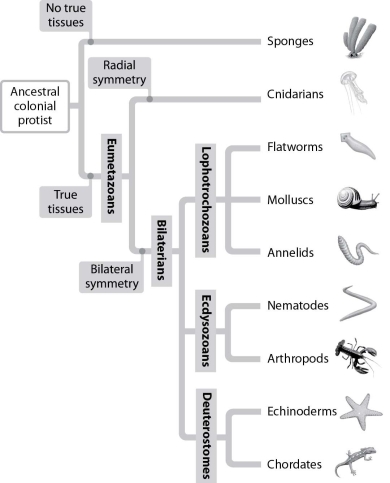 -Which phyla of animals are most closely related?
 (Multiple Choice)
4.9/5 (78)
(78) 
Filters
- Essay(0)
- Multiple Choice(0)
- Short Answer(0)
- True False(0)
- Matching(0)