



 Chat with AI
Exam 38: Conservation Biology

Exam 1: Biology: Exploring Life48 Questions
Exam 2: The Chemical Basis of Life72 Questions
Exam 3: The Molecules of Cells85 Questions
Exam 4: A Tour of the Cell90 Questions
Exam 5: The Working Cell80 Questions
Exam 6: How Cells Harvest Chemical Energy82 Questions
Exam 7: Photosynthesis: Using Light to Make Food81 Questions
Exam 8: The Cellular Basis of Reproduction and Inheritance78 Questions
Exam 9: Patterns of Inheritance77 Questions
Exam 10: Molecular Biology of the Gene82 Questions
Exam 11: How Genes Are Controlled81 Questions
Exam 12: DNA Technology and Genomics78 Questions
Exam 13: How Populations Evolve64 Questions
Exam 14: The Origin of Species58 Questions
Exam 15: Tracing Evolutionary History82 Questions
Exam 16: Microbial Life: Prokaryotes and Protists84 Questions
Exam 17: The Evolution of Plant and Fungal Diversity79 Questions
Exam 18: The Evolution of Invertebrate Diversity72 Questions
Exam 19: The Evolution of Vertebrate Diversity72 Questions
Exam 20: Unifying Concepts of Animal Structure and Function63 Questions
Exam 21: Nutrition and Digestion91 Questions
Exam 22: Gas Exchange66 Questions
Exam 23: Circulation77 Questions
Exam 24: the Immune System79 Questions
Exam 25: Control of Body Temperature and Water Balance63 Questions
Exam 26: Hormones and the Endocrine System60 Questions
Exam 27: Reproduction and Embryonic Development71 Questions
Exam 28: Nervous Systems70 Questions
Exam 29: the Senses60 Questions
Exam 30: How Animals Move69 Questions
Exam 31: Plant Structure, Growth, and Reproduction79 Questions
Exam 32: Plant Nutrition and Transport65 Questions
Exam 33: Control Systems in Plants58 Questions
Exam 34: the Biosphere: an Introduction to Earths Diverse Environments63 Questions
Exam 35: Behavioral Adaptations to the Environment52 Questions
Exam 36: Population Ecology53 Questions
Exam 37: Communities and Ecosystems60 Questions
Exam 38: Conservation Biology57 Questions
Select questions type


You are a climate scientist who wants to investigate climate change. Which of the following measurements would be the least useful?
(Multiple Choice)
4.9/5  (85)
(85) According to this graph of changes in Earth's atmosphere, which of the following took place between the years 1800 and 2000? 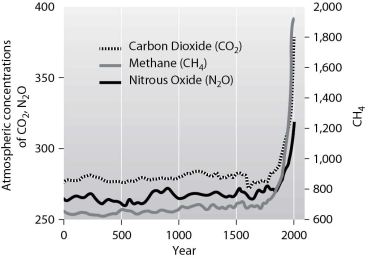
(Multiple Choice)
4.9/5 (76)
(76) The ability to change phenotype in response to local environmental conditions is called
(Multiple Choice)
5.0/5 (75)
(75) Small areas that are home to a large number of threatened species and an exceptional concentration of species found nowhere else on Earth are called
(Multiple Choice)
4.9/5 (78)
(78) After reading the paragraph below, answer the question that follows.
Rice is a staple crop across Asia; it serves as a main nutritional source for Asia's high population. In the 1970s, a pathogen called the grassy-stunt virus greatly decreased cultivated rice plant populations. Scientists found one wild relative of the rice plant in India that was resistant to the grassy-stunt virus, and today hybrid rice plants with that resistant gene are grown across Asia. To find this one rice plant species, approximately 17,000 rice plants samples were tested over the course of four years.
-If you were a scientist working on this project, how would you argue that the results of the research would be worth the time investment?
(Multiple Choice)
4.7/5 (86)
(86) After reading the paragraphs below, answer the questions that follow.
Introduced species are a problem all over the world, and there are many examples in the United States. Several years ago, a fisherman caught a northern snakehead fish in a pond in Crofton, Maryland (a suburb of Washington, DC). Snakeheads are a favorite food of immigrants from China, and live fish can frequently be found in Asian markets. It was suspected that the fish in the Crofton pond were purchased locally and then intentionally released.
Snakeheads are top predators, and 90% of the northern snakeheads' diet consists of other fishes. The northern snakehead can breathe out of water and travel short distances (about 100 feet) across land. They also breed rapidly. Females can lay more than 100,000 eggs per year. Juveniles have also been identified in the Potomac River and other rivers in Pennsylvania.
-When snakeheads enter aquatic ecosystems, biodiversity in these ecosystems would most likely
(Multiple Choice)
4.9/5 (88)
(88) Araschnia levana is a species of butterfly that breeds several times a year. It has two distinctly colored pupae: Those that emerge in spring are orange and those that emerge in summer are brown. The seasonal color variations in pupae mean that the pupae blend into the colors in their environment. This is an example of
(Multiple Choice)
4.7/5 (91)
(91) You spray your lawn with a pesticide. The concentration of the pesticide in the tissues of the grass on your lawn is 10⁻⁶ parts per million (ppm). Grasshoppers eat the grass and are in turn eaten by rats, which are then eaten by owls. At each successive trophic level, the concentration of pesticides increases. The term for this process is
(Multiple Choice)
4.8/5 (77)
(77) The figure below depicts natural fluctuation of ozone levels in Switzerland between 1925 and 1976. Dobson units are a way to measure the total amount of atmospheric ozone above a point on the Earth's surface. 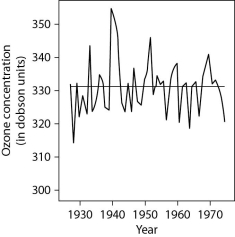 What can you conclude from this figure?
 (Multiple Choice)
4.8/5 (74)
(74) About one-third of all animal and plant species are concentrated on ________ of Earth's land.
(Multiple Choice)
4.9/5 (69)
(69) Which of the following is not an example of a predicted impact of climate change?
(Multiple Choice)
4.8/5 (82)
(82) 
Filters
- Essay(0)
- Multiple Choice(0)
- Short Answer(0)
- True False(0)
- Matching(0)