



 Chat with AI
Exam 14: The Origin of Species

Exam 1: Biology: Exploring Life48 Questions
Exam 2: The Chemical Basis of Life72 Questions
Exam 3: The Molecules of Cells85 Questions
Exam 4: A Tour of the Cell90 Questions
Exam 5: The Working Cell80 Questions
Exam 6: How Cells Harvest Chemical Energy82 Questions
Exam 7: Photosynthesis: Using Light to Make Food81 Questions
Exam 8: The Cellular Basis of Reproduction and Inheritance78 Questions
Exam 9: Patterns of Inheritance77 Questions
Exam 10: Molecular Biology of the Gene82 Questions
Exam 11: How Genes Are Controlled81 Questions
Exam 12: DNA Technology and Genomics78 Questions
Exam 13: How Populations Evolve64 Questions
Exam 14: The Origin of Species58 Questions
Exam 15: Tracing Evolutionary History82 Questions
Exam 16: Microbial Life: Prokaryotes and Protists84 Questions
Exam 17: The Evolution of Plant and Fungal Diversity79 Questions
Exam 18: The Evolution of Invertebrate Diversity72 Questions
Exam 19: The Evolution of Vertebrate Diversity72 Questions
Exam 20: Unifying Concepts of Animal Structure and Function63 Questions
Exam 21: Nutrition and Digestion91 Questions
Exam 22: Gas Exchange66 Questions
Exam 23: Circulation77 Questions
Exam 24: the Immune System79 Questions
Exam 25: Control of Body Temperature and Water Balance63 Questions
Exam 26: Hormones and the Endocrine System60 Questions
Exam 27: Reproduction and Embryonic Development71 Questions
Exam 28: Nervous Systems70 Questions
Exam 29: the Senses60 Questions
Exam 30: How Animals Move69 Questions
Exam 31: Plant Structure, Growth, and Reproduction79 Questions
Exam 32: Plant Nutrition and Transport65 Questions
Exam 33: Control Systems in Plants58 Questions
Exam 34: the Biosphere: an Introduction to Earths Diverse Environments63 Questions
Exam 35: Behavioral Adaptations to the Environment52 Questions
Exam 36: Population Ecology53 Questions
Exam 37: Communities and Ecosystems60 Questions
Exam 38: Conservation Biology57 Questions
Select questions type


After reading the paragraphs below, answer the questions that follow.
In 2004, scientists announced the discovery of the fossil remains of some extremely short early humans on the Indonesian island of Flores. The new species has been named Homo floresiensis. One hypothesis is that H. floresiensis evolved from Homo erectus, another early human species. How did a population of H. erectus become isolated on this remote island? Early humans constructed boats and rafts, so perhaps they were blown far off course by strong winds during a storm.
H. erectus averaged almost 6 feet in height, but the remains show that adults of H. floresiensis were only about 3 feet tall. It is hypothesized that limited resources on this hot and humid island (only 31 square miles) exerted selection pressure, and succeeding generations began to shrink in size. Small bodies require less food, use less energy, and are easier to cool than larger bodies. Evolution of small size in similar circumstances has been observed in many other species, but never before in humans. This find demonstrates that evolutionary forces operate on humans in the same way as on all other organisms.
-If H. floresiensis were reunited with H. erectus at a much later date, but the two populations could no longer interbreed, it would be correct to conclude that
(Multiple Choice)
4.7/5  (96)
(96) Which of the following types of reproductive barriers separates a pair of species that could interbreed but for the fact that one mates at dusk and the other at dawn?
(Multiple Choice)
5.0/5 (77)
(77) Under the biological species concept, a species is a group of organisms that
(Multiple Choice)
4.9/5 (86)
(86) Speciation often occurs when a habitat becomes more heterogeneous. In Lake Victoria different species of cichlids are found in different areas of the lake. The best explanation for this speciation is that
(Multiple Choice)
4.9/5 (73)
(73) In bowerbirds, the divergence illustrated in the figure is based on 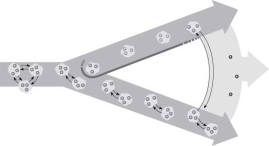
(Multiple Choice)
4.9/5 (69)
(69) After reading the paragraphs below, answer the questions that follow.
In 2004, scientists announced the discovery of the fossil remains of some extremely short early humans on the Indonesian island of Flores. The new species has been named Homo floresiensis. One hypothesis is that H. floresiensis evolved from Homo erectus, another early human species. How did a population of H. erectus become isolated on this remote island? Early humans constructed boats and rafts, so perhaps they were blown far off course by strong winds during a storm.
H. erectus averaged almost 6 feet in height, but the remains show that adults of H. floresiensis were only about 3 feet tall. It is hypothesized that limited resources on this hot and humid island (only 31 square miles) exerted selection pressure, and succeeding generations began to shrink in size. Small bodies require less food, use less energy, and are easier to cool than larger bodies. Evolution of small size in similar circumstances has been observed in many other species, but never before in humans. This find demonstrates that evolutionary forces operate on humans in the same way as on all other organisms.
-The evolution of H. floresiensis is an example of
(Multiple Choice)
4.7/5 (80)
(80) In a population of plants with a diploid number of 12, a new individual appeared with a chromosome number of 24. If this organism could self-fertilize, forming offspring with the same number of chromosomes (24), scientists would consider this an example of
(Multiple Choice)
4.9/5 (74)
(74) Two bird species overlap in a hybrid zone. They are isolated by a slight difference in the male songs and by the females' tendency to select males with the "correct" song. Hybrid offspring tend to have reduced fertility compared to either of the parent species. What effect might natural selection have in this situation?
(Multiple Choice)
4.9/5 (86)
(86) Diane Dodd raised different fruit fly populations on different food sources. She found that after about 40 generations the evolution of reproductive isolation was under way. The mechanism of evolution responsible for this was
(Multiple Choice)
4.9/5 (80)
(80) Sympatric speciation commonly occurs through ________ in plants but is more likely to occur through ________ in animals.
(Multiple Choice)
4.9/5 (88)
(88) Diane Dodd's experiments using fruit flies demonstrated that
(Multiple Choice)
4.7/5 (74)
(74) Two populations of organisms belong to the same biological species when they
(Multiple Choice)
5.0/5 (82)
(82) The Monterey pine and the Bishop's pine inhabit some of the same areas of central California. The Monterey pine releases pollen in February, while the Bishop's pine does so in April. This is an example of ________ isolation.
(Multiple Choice)
4.9/5 (72)
(72) After reading the paragraph below, answer the questions that follow.
In the North Pacific Ocean, two groups of the same species of killer whales (Orcinus orca) appear to be forming two different species based on what they eat. One group eats fish and the other eats mammals such as seals. Scientists can tell what they eat based on their teeth, because whales that feed on fish have significantly different wear patterns.
-One of the finest available sequences of fossils shows how horses have changed slowly and by subtle steps from small shrub-browsing ancestors to the large, grass-grazing modern horse. A large number of fossil species have been named, and it is often difficult to decide on the identity of a fossil horse because transitional forms are common. The species concept most applicable to these organisms would be
(Multiple Choice)
4.8/5 (83)
(83) Which of the following types of reproductive barriers separates a pair of moth species that could interbreed but for the fact that the females' mating pheromones are not attractive to the males of the other species?
(Multiple Choice)
4.9/5 (77)
(77) Which of the following statements about plant speciation and hybridization is false?
(Multiple Choice)
4.9/5 (81)
(81) 
Filters
- Essay(0)
- Multiple Choice(0)
- Short Answer(0)
- True False(0)
- Matching(0)