



 Chat with AI
Exam 34: the Biosphere: an Introduction to Earths Diverse Environments

Exam 1: Biology: Exploring Life48 Questions
Exam 2: The Chemical Basis of Life72 Questions
Exam 3: The Molecules of Cells85 Questions
Exam 4: A Tour of the Cell90 Questions
Exam 5: The Working Cell80 Questions
Exam 6: How Cells Harvest Chemical Energy82 Questions
Exam 7: Photosynthesis: Using Light to Make Food81 Questions
Exam 8: The Cellular Basis of Reproduction and Inheritance78 Questions
Exam 9: Patterns of Inheritance77 Questions
Exam 10: Molecular Biology of the Gene82 Questions
Exam 11: How Genes Are Controlled81 Questions
Exam 12: DNA Technology and Genomics78 Questions
Exam 13: How Populations Evolve64 Questions
Exam 14: The Origin of Species58 Questions
Exam 15: Tracing Evolutionary History82 Questions
Exam 16: Microbial Life: Prokaryotes and Protists84 Questions
Exam 17: The Evolution of Plant and Fungal Diversity79 Questions
Exam 18: The Evolution of Invertebrate Diversity72 Questions
Exam 19: The Evolution of Vertebrate Diversity72 Questions
Exam 20: Unifying Concepts of Animal Structure and Function63 Questions
Exam 21: Nutrition and Digestion91 Questions
Exam 22: Gas Exchange66 Questions
Exam 23: Circulation77 Questions
Exam 24: the Immune System79 Questions
Exam 25: Control of Body Temperature and Water Balance63 Questions
Exam 26: Hormones and the Endocrine System60 Questions
Exam 27: Reproduction and Embryonic Development71 Questions
Exam 28: Nervous Systems70 Questions
Exam 29: the Senses60 Questions
Exam 30: How Animals Move69 Questions
Exam 31: Plant Structure, Growth, and Reproduction79 Questions
Exam 32: Plant Nutrition and Transport65 Questions
Exam 33: Control Systems in Plants58 Questions
Exam 34: the Biosphere: an Introduction to Earths Diverse Environments63 Questions
Exam 35: Behavioral Adaptations to the Environment52 Questions
Exam 36: Population Ecology53 Questions
Exam 37: Communities and Ecosystems60 Questions
Exam 38: Conservation Biology57 Questions
Select questions type


If you travel through Ecuador from west to east, you will pass through tundra, taiga, temperate forest, and tropical forest. Which of the following climatic factors remains constant on such a trip?
(Multiple Choice)
4.8/5  (71)
(71) 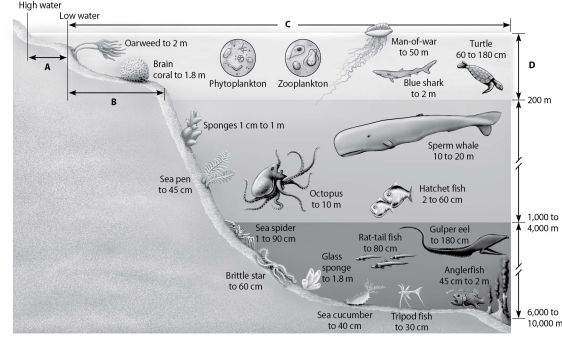 -In what ways are zones A and C similar to other biomes?
Pronghorn antelopes are well adapted for dry conditions with extremes of temperature, especially cold. As global climate change causes the area where the pronghorn live to change, not only in temperature but also in what plants grow there and what predators and prey live there, what is likely to happen to the pronghorn?
(Multiple Choice)
4.8/5 (78)
(78) 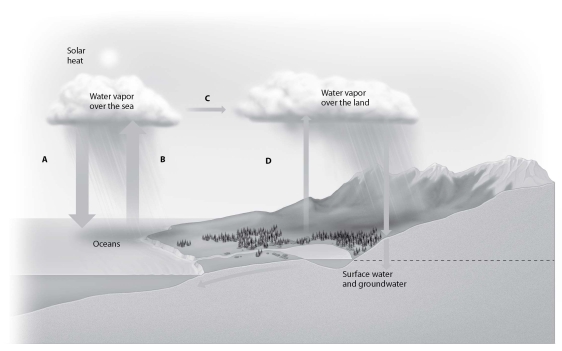 -Forest destruction would have the greatest impact on which arrow?
 (Multiple Choice)
4.9/5 (82)
(82) Which of these is an example of natural selection acting on genetic variation resulting in evolutionary adaptation?
(Multiple Choice)
4.9/5 (70)
(70) Which of the following biomes is dominated by coniferous trees adapted to surviving long, harsh winters and short, wet summers?
(Multiple Choice)
4.9/5 (77)
(77) Which of the following statements about temperate broadleaf forests is true?
(Multiple Choice)
4.8/5 (64)
(64) The primary source of energy for hydrothermal vent communities is
(Multiple Choice)
4.9/5 (83)
(83) Species in widely separated but similar biomes often appear to display similar characteristics because of
(Multiple Choice)
4.9/5 (81)
(81) After reading the paragraph below, answer the questions that follow.
California condors, large, predatory birds that were previously on the edge of extinction, have benefited from a program that raises birds in captivity and then releases them into the wild. The reintroduction program, however, is having variable success.
-Which of the following provides the best evidence to help develop a hypothesis about what is causing the difficulties faced by a coastal condor population?
(Multiple Choice)
4.9/5 (79)
(79)
-Which arrow in this image of the global water cycle includes transpiration?
-Which arrow in this image of the global water cycle includes transpiration? (Multiple Choice)
5.0/5 (84)
(84) In which of the following biomes would you expect to find the highest abundance of large, grazing mammals?
(Multiple Choice)
4.9/5 (74)
(74) Which of the following is characteristic of the chaparral biome?
(Multiple Choice)
4.9/5 (90)
(90) When people speak of the "rain shadow" of the Himalayan mountains, where the Gobi desert is, they are referring to the
(Multiple Choice)
4.9/5 (80)
(80) Why is the runoff from fertilized agricultural fields, even if free of pesticides, often harmful to the ecosystems of temperate lakes?
(Multiple Choice)
4.9/5 (93)
(93) The greatest annual input and least seasonal variation in solar radiation occurs in the
(Multiple Choice)
4.8/5 (85)
(85) After reading the paragraph below, answer the questions that follow.
The largest estuary in the United States is the Chesapeake Bay, which extends through six states, including Maryland, Virginia, and Pennsylvania. The bay is one of the most productive natural areas in the world. It is home to thousands of plants and animals, including many commercially important species. The water of the bay is relatively shallow. Many areas are no more than 10 feet deep, with an average depth of 30 feet. Light penetrates the shallow water and supports the submerged plants that provide food and shelter for the many species living in the bay ecosystem. However, like many estuaries, the bay receives large amounts of fertilizer runoff from farms, lawns, and wastewater treatment facilities.
-Which of the following is the most probable sequence of events when fertilizer runoff reaches the bay?
(Multiple Choice)
4.8/5 (66)
(66) After reading the paragraph below, answer the questions that follow.
The largest estuary in the United States is the Chesapeake Bay, which extends through six states, including Maryland, Virginia, and Pennsylvania. The bay is one of the most productive natural areas in the world. It is home to thousands of plants and animals, including many commercially important species. The water of the bay is relatively shallow. Many areas are no more than 10 feet deep, with an average depth of 30 feet. Light penetrates the shallow water and supports the submerged plants that provide food and shelter for the many species living in the bay ecosystem. However, like many estuaries, the bay receives large amounts of fertilizer runoff from farms, lawns, and wastewater treatment facilities.
-Fertilizer runoff contains ________, which are the most important limiting factors for phytoplankton growth.
(Multiple Choice)
4.7/5 (72)
(72) Most of the best agricultural soils in the United States are found in areas that were formerly
(Multiple Choice)
4.9/5 (80)
(80) 
Filters
- Essay(0)
- Multiple Choice(0)
- Short Answer(0)
- True False(0)
- Matching(0)