



 Chat with AI
Exam 8: The Cellular Basis of Reproduction and Inheritance

Exam 1: Biology: Exploring Life48 Questions
Exam 2: The Chemical Basis of Life72 Questions
Exam 3: The Molecules of Cells85 Questions
Exam 4: A Tour of the Cell90 Questions
Exam 5: The Working Cell80 Questions
Exam 6: How Cells Harvest Chemical Energy82 Questions
Exam 7: Photosynthesis: Using Light to Make Food81 Questions
Exam 8: The Cellular Basis of Reproduction and Inheritance78 Questions
Exam 9: Patterns of Inheritance77 Questions
Exam 10: Molecular Biology of the Gene82 Questions
Exam 11: How Genes Are Controlled81 Questions
Exam 12: DNA Technology and Genomics78 Questions
Exam 13: How Populations Evolve64 Questions
Exam 14: The Origin of Species58 Questions
Exam 15: Tracing Evolutionary History82 Questions
Exam 16: Microbial Life: Prokaryotes and Protists84 Questions
Exam 17: The Evolution of Plant and Fungal Diversity79 Questions
Exam 18: The Evolution of Invertebrate Diversity72 Questions
Exam 19: The Evolution of Vertebrate Diversity72 Questions
Exam 20: Unifying Concepts of Animal Structure and Function63 Questions
Exam 21: Nutrition and Digestion91 Questions
Exam 22: Gas Exchange66 Questions
Exam 23: Circulation77 Questions
Exam 24: the Immune System79 Questions
Exam 25: Control of Body Temperature and Water Balance63 Questions
Exam 26: Hormones and the Endocrine System60 Questions
Exam 27: Reproduction and Embryonic Development71 Questions
Exam 28: Nervous Systems70 Questions
Exam 29: the Senses60 Questions
Exam 30: How Animals Move69 Questions
Exam 31: Plant Structure, Growth, and Reproduction79 Questions
Exam 32: Plant Nutrition and Transport65 Questions
Exam 33: Control Systems in Plants58 Questions
Exam 34: the Biosphere: an Introduction to Earths Diverse Environments63 Questions
Exam 35: Behavioral Adaptations to the Environment52 Questions
Exam 36: Population Ecology53 Questions
Exam 37: Communities and Ecosystems60 Questions
Exam 38: Conservation Biology57 Questions
Select questions type


If a chromosome fragment breaks off and then reattaches to the original chromosome but in the reverse direction, the resulting chromosomal abnormality is called a(n)
(Multiple Choice)
4.8/5  (72)
(72) The creation of genetically identical offspring by a single parent, without the participation of sperm and egg, is called
(Multiple Choice)
4.8/5 (89)
(89) Two chromosomes in a nucleus that carry genes controlling the same inherited characteristics are
(Multiple Choice)
4.9/5 (72)
(72) Which of the following must occur for a plant or animal to grow and develop normally?
(Multiple Choice)
5.0/5 (77)
(77) According to the graph, at what maternal age is the incidence of Down syndrome equal to five times the incidence at age 40? 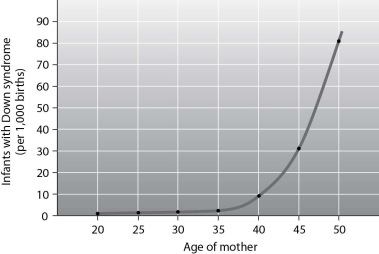
(Multiple Choice)
4.9/5 (79)
(79) Which of the following statements regarding the function of mitosis is false?
(Multiple Choice)
4.9/5 (86)
(86) Which of the following statements regarding mitosis and meiosis is false?
(Multiple Choice)
4.9/5 (87)
(87) Which of the following statements regarding sexual and asexual reproduction is true?
(Multiple Choice)
4.8/5 (72)
(72) After reading the paragraphs below, answer the questions that follow.
A technique called flow cytometry is used by scientists and researchers to count or sort cells based on specific properties. By labeling cellular DNA with a fluorescent dye, flow cytometry can sort cells based on the amount of DNA present, thereby making it possible to distinguish between cells that are in different stages of the cell cycle. Flow cytometry is especially useful to the medical community because it can help with the diagnosis of certain types of cancers.
Below is a typical set of data that you might obtain when running a flow cytometry experiment using a sample of healthy skin cells. Use this figure to help you answer the following questions.
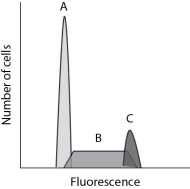 -In this sample of cells, what stage of the cell cycle are most of the cells in?
 (Multiple Choice)
4.9/5 (78)
(78) After reading the paragraphs below, answer the questions that follow.
Mr. and Mrs. Smith have three sons in elementary school. Two of their children are progressing normally, but their youngest son, Charles, has been much slower than his siblings in developing speech and language skills. His parents are concerned that he has a learning disability and decide to investigate further. Since some learning disabilities can be genetically based, their pediatrician recommends a chromosomal analysis.
The results show that Charles has a trisomy of the sex chromosomes, diagnosed as XYY, which is caused by nondisjunction in the formation of the father's sperm. The nondisjunction resulted in an extra copy of the Y chromosome. The extra copy was passed on to Charles during fertilization. Most often, this chromosomal change causes no unusual physical features or medical problems, but those with trisomy of the sex chromosomes do have a higher than normal risk of delays in learning development.
-During which stage of meiosis could this nondisjunction have occurred?
(Multiple Choice)
5.0/5 (75)
(75) Looking into your microscope, you spot an unusual cell. Instead of the typical rounded cell shape, the cell has a very narrow middle separating two bulging ends. It sort of looks like the number 8! You realize that this cell is
(Multiple Choice)
4.8/5 (64)
(64) The phase of mitosis during which the mitotic spindle begins to form is
(Multiple Choice)
4.9/5 (62)
(62) Which of the following statements regarding genetic diversity is false?
(Multiple Choice)
4.7/5 (75)
(75) As a patch of scraped skin heals, the cells fill in the injured area but do not grow beyond that. This is an example of
(Multiple Choice)
4.9/5 (74)
(74) Asexual reproduction requires ________ individual(s), whereas sexual reproduction requires _______ individual(s).
(Multiple Choice)
4.8/5 (85)
(85) A skin cell of a red fox has 34 chromosomes. You look at the cell under a microscope and see that it has 34 chromosomes and one nucleus. Several hours later, you look at the same cell again and see that it has double the amount of DNA and one nucleus. A little while later, you see that it has 68 chromosomes and two nuclei. What stage of the cell cycle was this cell in when you viewed it at each time point?
(Multiple Choice)
4.8/5 (80)
(80) 
Filters
- Essay(0)
- Multiple Choice(0)
- Short Answer(0)
- True False(0)
- Matching(0)