



 Chat with AI
Exam 29: the Senses

Exam 1: Biology: Exploring Life48 Questions
Exam 2: The Chemical Basis of Life72 Questions
Exam 3: The Molecules of Cells85 Questions
Exam 4: A Tour of the Cell90 Questions
Exam 5: The Working Cell80 Questions
Exam 6: How Cells Harvest Chemical Energy82 Questions
Exam 7: Photosynthesis: Using Light to Make Food81 Questions
Exam 8: The Cellular Basis of Reproduction and Inheritance78 Questions
Exam 9: Patterns of Inheritance77 Questions
Exam 10: Molecular Biology of the Gene82 Questions
Exam 11: How Genes Are Controlled81 Questions
Exam 12: DNA Technology and Genomics78 Questions
Exam 13: How Populations Evolve64 Questions
Exam 14: The Origin of Species58 Questions
Exam 15: Tracing Evolutionary History82 Questions
Exam 16: Microbial Life: Prokaryotes and Protists84 Questions
Exam 17: The Evolution of Plant and Fungal Diversity79 Questions
Exam 18: The Evolution of Invertebrate Diversity72 Questions
Exam 19: The Evolution of Vertebrate Diversity72 Questions
Exam 20: Unifying Concepts of Animal Structure and Function63 Questions
Exam 21: Nutrition and Digestion91 Questions
Exam 22: Gas Exchange66 Questions
Exam 23: Circulation77 Questions
Exam 24: the Immune System79 Questions
Exam 25: Control of Body Temperature and Water Balance63 Questions
Exam 26: Hormones and the Endocrine System60 Questions
Exam 27: Reproduction and Embryonic Development71 Questions
Exam 28: Nervous Systems70 Questions
Exam 29: the Senses60 Questions
Exam 30: How Animals Move69 Questions
Exam 31: Plant Structure, Growth, and Reproduction79 Questions
Exam 32: Plant Nutrition and Transport65 Questions
Exam 33: Control Systems in Plants58 Questions
Exam 34: the Biosphere: an Introduction to Earths Diverse Environments63 Questions
Exam 35: Behavioral Adaptations to the Environment52 Questions
Exam 36: Population Ecology53 Questions
Exam 37: Communities and Ecosystems60 Questions
Exam 38: Conservation Biology57 Questions
Select questions type


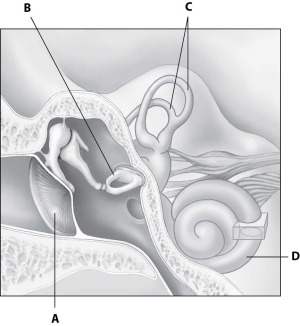
Which of the following correctly lists the order in which structures within the ear transfer a sound wave during hearing?
(Multiple Choice)
4.9/5  (73)
(73) After reading the paragraphs below, answer the questions that follow.
Bats and marine mammals are well-known examples of animals that produce high-frequency sound waves beyond the range of human hearing. The high-frequency waves are used for echolocation, the process of emitting high-frequency sound waves and using both the time it takes for the waves to bounce back to the caller and the direction from which the waves return to the caller to locate distant objects. Research has shown that bats can send and receive sounds as high as 100,000 Hertz (Hz).
On the other hand, several mammals, such as elephants and whales, produce extremely low-frequency sounds. Elephant calls range from 5 to 50 Hz. Low-frequency sounds have long wavelengths, which means they are less likely to be distorted or interrupted by features in the environment. In favorable weather conditions, low-frequency sound waves can be transmitted over several kilometers.
-What advantage does the extended hearing range of elephants provide?
(Multiple Choice)
4.7/5 (92)
(92) Mechanoreceptors (touch)are not evenly spaced on your body. What part of the body might be expected to have mechanoreceptors located closer together?
(Multiple Choice)
4.8/5 (78)
(78) Individuals medically diagnosed with "dry eyes" experience feelings of dryness, itchiness, burning, and general irritation in their eyes. Dry eyes can be caused by a decreased production of tears by the tear-producing glands in the eyes. Which of the following would help alleviate dry eyes?
(Multiple Choice)
4.9/5 (89)
(89) Which type of sensory receptors becomes more sensitive when damaged tissues produce prostaglandins?
(Multiple Choice)
4.8/5 (75)
(75) You are driving at night and decide to pass a slow-moving car. As you look at the car as you pass, it dawns on you that although you can see the car, you can't tell what color it is. This is due to
(Multiple Choice)
5.0/5 (78)
(78) Honeybees are able to discriminate between different flowers using
(Multiple Choice)
4.9/5 (82)
(82) In stimulus detection, sensory receptor cells convert a stimulus
(Multiple Choice)
4.9/5 (81)
(81) After reading the paragraphs below, answer the questions that follow.
Bats and marine mammals are well-known examples of animals that produce high-frequency sound waves beyond the range of human hearing. The high-frequency waves are used for echolocation, the process of emitting high-frequency sound waves and using both the time it takes for the waves to bounce back to the caller and the direction from which the waves return to the caller to locate distant objects. Research has shown that bats can send and receive sounds as high as 100,000 Hertz (Hz).
On the other hand, several mammals, such as elephants and whales, produce extremely low-frequency sounds. Elephant calls range from 5 to 50 Hz. Low-frequency sounds have long wavelengths, which means they are less likely to be distorted or interrupted by features in the environment. In favorable weather conditions, low-frequency sound waves can be transmitted over several kilometers.
-If you were observing two elephants separated by a distance of four miles, could the sensory receptors of your ear receive signals passing between them?
(Multiple Choice)
4.9/5 (83)
(83) 
You arrive at your office and are startled by the sounds of building construction outside your window. As you settle in to your work for the day, you forget about the construction noises. When a visitor comes to your office later that day, the first thing she comments on is how disruptive the construction noise must be to your concentration. You realize that you have not even noticed it for over an hour. This is due to
(Multiple Choice)
4.9/5 (83)
(83) A person who has blurred vision caused by a misshapen lens or cornea has
(Multiple Choice)
4.8/5 (79)
(79) Which of the following statements regarding rods and cones is true?
(Multiple Choice)
4.8/5 (91)
(91) Mechanoreceptors (touch and pressure)are not evenly spaced on your body. What is an advantage of having mechanoreceptors located farther apart?
(Multiple Choice)
4.7/5 (83)
(83) Our sense of taste results from receptors organized into taste buds
(Multiple Choice)
4.9/5 (92)
(92) 
Filters
- Essay(0)
- Multiple Choice(0)
- Short Answer(0)
- True False(0)
- Matching(0)