



 Chat with AI
Exam 21: Solid and Hazardous Waste

Exam 1: Environmental Problems, Their Causes, and Sustainability100 Questions
Exam 2: Science, Matter, Energy, and Systems102 Questions
Exam 3: Ecosystems: What Are They and How Do They Work110 Questions
Exam 4: Biodiversity and Evolution104 Questions
Exam 5: Biodiversity, Species Interactions, and Population Control100 Questions
Exam 6: The Human Population and Its Impact111 Questions
Exam 7: Climate and Biodiversity100 Questions
Exam 8: Aquatic Biodiversity109 Questions
Exam 9: Sustaining Biodiversity: the Species Approach100 Questions
Exam 10: Sustaining Terrestrial Biodiversity: the Ecosystem Approach108 Questions
Exam 11: Sustaining Aquatic Biodiversity122 Questions
Exam 12: Food, Soil, and Pest Management118 Questions
Exam 13: Water Resources115 Questions
Exam 14: Geology and Nonrenewable Mineral Resources115 Questions
Exam 15: Nonrenewable Energy102 Questions
Exam 16: Energy Efficiency and Renewable Energy103 Questions
Exam 17: Environmental Hazards and Human Health103 Questions
Exam 18: Air Pollution112 Questions
Exam 19: Climate Disruption and Ozone Depletion111 Questions
Exam 20: Water Pollution114 Questions
Exam 21: Solid and Hazardous Waste108 Questions
Exam 22: Cities and Sustainability99 Questions
Exam 23: Economics, Environment, and Sustainability104 Questions
Exam 24: Politics, Environment, and Sustainability90 Questions
Exam 25: Environmental Worldviews, Ethics, and Sustainability55 Questions
Select questions type


Much of the e-waste in the United States not buried or burned is
(Multiple Choice)
4.8/5  (81)
(81) Which of the following industrialized nations has not signed the International Basel Convention to reduce and/or control movement of hazardous e-waste across international boundaries?
(Multiple Choice)
4.8/5 (82)
(82) At sanitary landfills, consideration of leachate is of most importance as far as environmental preservation is concerned.
(True/False)
4.8/5 (72)
(72) Which of the following is something each person can do to save resources?
(Multiple Choice)
4.8/5 (84)
(84) Using a combination of strategies, as much as ____ of solid and hazardous waste could be eliminated through reduction, reuse, and recycling.
(Multiple Choice)
5.0/5 (65)
(65) Despite recycling 49% of its paper, the U.S.throws away more paper than all of the paper used in __________.
(Short Answer)
4.9/5 (96)
(96) Municipal composting facilities in the United States recycle approximately ____% percent of the country's yard wastes, which is approximately ____% percent of the total Municipal Solid Waste.
(Multiple Choice)
4.9/5 (73)
(73) Consumers of recycled products are most effective when they maximize the amount of ____ waste in the products they buy.
(Multiple Choice)
4.7/5 (88)
(88) 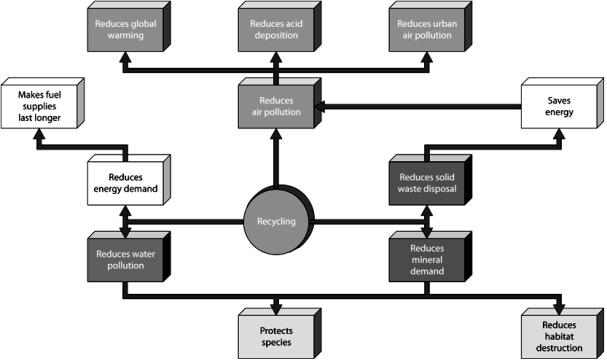 Use the Figure above to answer the following question(s).
-Explain how recycling reduces energy demand and makes fuel supplies last longer.
Use the Figure above to answer the following question(s).
-Explain how recycling reduces energy demand and makes fuel supplies last longer. (Essay)
4.8/5 (82)
(82) ____________________ are inefficient because they are expensive to build, discharge toxic emissions, and can produce a toxic ash.
(Short Answer)
4.9/5 (74)
(74) All of the following are means of detoxifying hazardous and toxic wastes, except
(Multiple Choice)
5.0/5 (78)
(78) Some scientists and economists doubt that much solid waste could be eliminated by prioritizing strategies in a coordinated effort.
(True/False)
4.8/5 (82)
(82) About 54% by weight of MSW in the U.S.is buried in ____________________ which have liner containment systems on the sides and bottom.
(Short Answer)
4.9/5 (84)
(84) In an integrated waste management approach to solid waste, which of the following would be given last priority?
(Multiple Choice)
4.9/5 (72)
(72) ____________________ occurs when waste is made into new products of the same type.
(Short Answer)
4.8/5 (81)
(81) The best and cheapest ways to deal with solid and hazardous wastes are waste reduction and pollution prevention.
(True/False)
4.9/5 (82)
(82) It is currently impossible to separate plastics from each other by type and grade in a mixed waste stream.
(True/False)
4.9/5 (83)
(83) Large companies make more money by producing and shipping throwaway beverage and food containers from centralized facilities.
(True/False)
4.9/5 (86)
(86) From an environmental standpoint, the first two Rs, ____________________ and ____________________, are better alternatives because they are input or prevention approaches.
(Short Answer)
4.8/5 (81)
(81) About 98.5% of all solid waste in the United States is industrial solid waste.
(True/False)
4.8/5 (70)
(70) 
Filters
- Essay(0)
- Multiple Choice(0)
- Short Answer(0)
- True False(0)
- Matching(0)