



 Chat with AI
Exam 15: Nonrenewable Energy

Exam 1: Environmental Problems, Their Causes, and Sustainability100 Questions
Exam 2: Science, Matter, Energy, and Systems102 Questions
Exam 3: Ecosystems: What Are They and How Do They Work110 Questions
Exam 4: Biodiversity and Evolution104 Questions
Exam 5: Biodiversity, Species Interactions, and Population Control100 Questions
Exam 6: The Human Population and Its Impact111 Questions
Exam 7: Climate and Biodiversity100 Questions
Exam 8: Aquatic Biodiversity109 Questions
Exam 9: Sustaining Biodiversity: the Species Approach100 Questions
Exam 10: Sustaining Terrestrial Biodiversity: the Ecosystem Approach108 Questions
Exam 11: Sustaining Aquatic Biodiversity122 Questions
Exam 12: Food, Soil, and Pest Management118 Questions
Exam 13: Water Resources115 Questions
Exam 14: Geology and Nonrenewable Mineral Resources115 Questions
Exam 15: Nonrenewable Energy102 Questions
Exam 16: Energy Efficiency and Renewable Energy103 Questions
Exam 17: Environmental Hazards and Human Health103 Questions
Exam 18: Air Pollution112 Questions
Exam 19: Climate Disruption and Ozone Depletion111 Questions
Exam 20: Water Pollution114 Questions
Exam 21: Solid and Hazardous Waste108 Questions
Exam 22: Cities and Sustainability99 Questions
Exam 23: Economics, Environment, and Sustainability104 Questions
Exam 24: Politics, Environment, and Sustainability90 Questions
Exam 25: Environmental Worldviews, Ethics, and Sustainability55 Questions
Select questions type


Digging up and processing shale oil releases more carbon dioxide and has a higher environmental impact than does producing crude oil.
(True/False)
4.9/5  (91)
(91) The total amount of high-quality energy available after the energy needed to make it available is subtracted, is called
(Multiple Choice)
4.8/5 (84)
(84) When compared to burning coal directly, producing synfuels has all of the following disadvantages, except
(Multiple Choice)
4.8/5 (72)
(72) _______________ countries started the industrial revolution about 275 years ago.
(Short Answer)
4.9/5 (78)
(78) 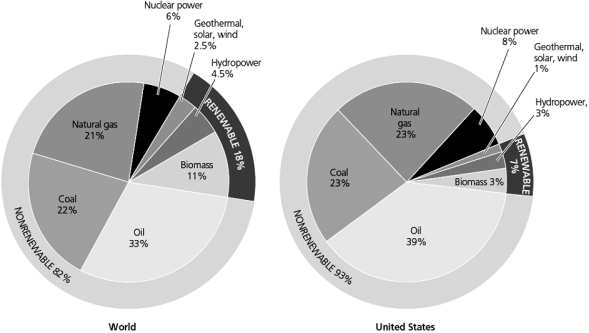 Use the Figure above to answer the following question(s).
-From where does the majority of that difference come?
Use the Figure above to answer the following question(s).
-From where does the majority of that difference come? (Short Answer)
4.9/5 (97)
(97)
Use the Figure above to answer the following question(s).
-Is the U.S.more or less dependent on fossil fuels than the rest of the world?
Use the Figure above to answer the following question(s).
-Is the U.S.more or less dependent on fossil fuels than the rest of the world? (Short Answer)
4.8/5 (84)
(84) Any energy resource with a low or negative net energy yield cannot compete in the open marketplace with other energy alternatives with higher net energy yields unless it is subsidized by the government.
(True/False)
4.9/5 (83)
(83) Seventy two percent of the world's estimated oil shale reserves are in the western part of ____________________ .
(Short Answer)
4.8/5 (88)
(88) Political discussions about global climate change and greenhouse gases have taken up the phrase "a balanced approach" to environmental problems.The balanced approach usually includes the use of nuclear power to generate electricity.Given what the author has said about nuclear energy, should our approach to addressing global climate change include building new nuclear power plants? Explain.
(Essay)
4.9/5 (66)
(66) About 33% of commercial energy is wasted because of the second law of thermodynamics.
(True/False)
4.9/5 (84)
(84) Fossil fuels are considered can be renewed in a few decades or centuries.
(True/False)
4.8/5 (81)
(81) Net energy is the amount of useful energy available from a source minus the energy necessary to get it to the consumer.
(True/False)
4.8/5 (66)
(66) Proponents of nuclear power proclaim nuclear power releases no carbon dioxide. Critics point out that carbon dioxide is released at all of the following points except
(Multiple Choice)
4.9/5 (90)
(90) Cutting ____________________ is the fastest, cheapest, and most environmentally beneficial source of energy.
(Short Answer)
4.9/5 (79)
(79) The long-term global outlook for conventional natural gas supplies is ____________________ than for conventional oil.
(Short Answer)
4.8/5 (79)
(79) 
Filters
- Essay(0)
- Multiple Choice(0)
- Short Answer(0)
- True False(0)
- Matching(0)