



 Chat with AI
Exam 13: Water Resources

Exam 1: Environmental Problems, Their Causes, and Sustainability100 Questions
Exam 2: Science, Matter, Energy, and Systems102 Questions
Exam 3: Ecosystems: What Are They and How Do They Work110 Questions
Exam 4: Biodiversity and Evolution104 Questions
Exam 5: Biodiversity, Species Interactions, and Population Control100 Questions
Exam 6: The Human Population and Its Impact111 Questions
Exam 7: Climate and Biodiversity100 Questions
Exam 8: Aquatic Biodiversity109 Questions
Exam 9: Sustaining Biodiversity: the Species Approach100 Questions
Exam 10: Sustaining Terrestrial Biodiversity: the Ecosystem Approach108 Questions
Exam 11: Sustaining Aquatic Biodiversity122 Questions
Exam 12: Food, Soil, and Pest Management118 Questions
Exam 13: Water Resources115 Questions
Exam 14: Geology and Nonrenewable Mineral Resources115 Questions
Exam 15: Nonrenewable Energy102 Questions
Exam 16: Energy Efficiency and Renewable Energy103 Questions
Exam 17: Environmental Hazards and Human Health103 Questions
Exam 18: Air Pollution112 Questions
Exam 19: Climate Disruption and Ozone Depletion111 Questions
Exam 20: Water Pollution114 Questions
Exam 21: Solid and Hazardous Waste108 Questions
Exam 22: Cities and Sustainability99 Questions
Exam 23: Economics, Environment, and Sustainability104 Questions
Exam 24: Politics, Environment, and Sustainability90 Questions
Exam 25: Environmental Worldviews, Ethics, and Sustainability55 Questions
Select questions type


To address the water supply problems in the Colorado River basin, experts call for the 7 states using the river water to do all of the following except
(Multiple Choice)
4.9/5  (75)
(75) Currently more than 400 million people are being fed grains produced by ____________________ water use.
(Short Answer)
4.8/5 (76)
(76) The three most serious environmental problems the world faces this century are water shortages, biodiversity loss, and climate change.Some analysts believe water shortages could lead to war between countries that need to share water.Do you think this is possible? Why or why not?
(Essay)
4.9/5 (78)
(78) Even though rises in sea level during this century may result in millions of Bangladeshi environmental refugees, the government of Bangladesh is not preparing for this possibility.
(True/False)
4.8/5 (85)
(85) Withdrawing water from a nonrenewable aquifer is similar to mining a nonrenewable mineral resource.
(True/False)
5.0/5 (77)
(77) Unless depletion of aquifers is slowed, an increasing number of the world's people will have to live on water from the oceans.
(True/False)
4.9/5 (77)
(77) About one of every _____ people in the United States is dependent on the Colorado River for water and electricity.
(Short Answer)
4.9/5 (85)
(85) What percentage of water withdrawn from lakes, streams, and rivers is used by cities and residences?
(Multiple Choice)
4.9/5 (68)
(68) Water in the spaces between soil, rock, and gravel, called ____________________, is one of the most important sources of freshwater and a key component of the earth's natural capital.
(Short Answer)
4.9/5 (90)
(90) In 2005, one of every ____________________ people lacked access to enough clean water to drink, cook, and wash.
(Short Answer)
4.9/5 (76)
(76) Government subsidies designed to increase crop production have discouraged depletion of the Ogallala aquifer.
(True/False)
5.0/5 (77)
(77) The gigantic Ogallala aquifer supplies about ____________________ of all the groundwater used in the United States.
(Short Answer)
4.8/5 (86)
(86) Because there is so little freshwater, most of humanity manages what water they have in an efficient and helpful way.
(True/False)
4.9/5 (88)
(88) The low cost of water to users due to government subsidies is a major cause of water waste.
(True/False)
5.0/5 (82)
(82) 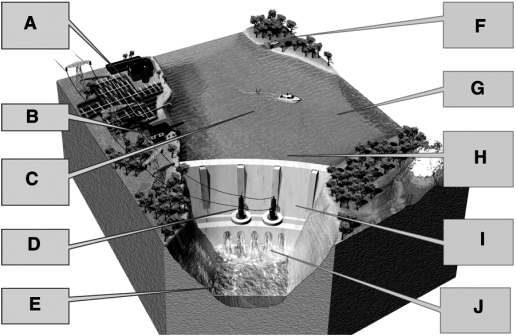 The above diagram points to the advantages (A─E) and the disadvantages (F─J) of large dams and reservoirs.Correctly identify and each of the five advantages (A─E) and disadvantages (F─J) of such large dams and reservoirs as indicated on the diagram.
-Provides water for drinking.
The above diagram points to the advantages (A─E) and the disadvantages (F─J) of large dams and reservoirs.Correctly identify and each of the five advantages (A─E) and disadvantages (F─J) of such large dams and reservoirs as indicated on the diagram.
-Provides water for drinking. (Short Answer)
4.9/5 (83)
(83) Farmers could not grow lettuce in the arid interior of California without which of the following?
(Multiple Choice)
5.0/5 (91)
(91) The geological layer, consisting of underground caverns and porous layers of sand, gravel, or bedrock, where groundwater flows, is called
(Multiple Choice)
4.9/5 (80)
(80)
The above diagram points to the advantages (A─E) and the disadvantages (F─J) of large dams and reservoirs.Correctly identify and each of the five advantages (A─E) and disadvantages (F─J) of such large dams and reservoirs as indicated on the diagram.
-Can produce cheap electricity (hydropower).
The above diagram points to the advantages (A─E) and the disadvantages (F─J) of large dams and reservoirs.Correctly identify and each of the five advantages (A─E) and disadvantages (F─J) of such large dams and reservoirs as indicated on the diagram.
-Can produce cheap electricity (hydropower). (Short Answer)
4.8/5 (80)
(80) 
Filters
- Essay(0)
- Multiple Choice(0)
- Short Answer(0)
- True False(0)
- Matching(0)