



 Chat with AI
Exam 7: Climate and Biodiversity

Exam 1: Environmental Problems, Their Causes, and Sustainability100 Questions
Exam 2: Science, Matter, Energy, and Systems102 Questions
Exam 3: Ecosystems: What Are They and How Do They Work110 Questions
Exam 4: Biodiversity and Evolution104 Questions
Exam 5: Biodiversity, Species Interactions, and Population Control100 Questions
Exam 6: The Human Population and Its Impact111 Questions
Exam 7: Climate and Biodiversity100 Questions
Exam 8: Aquatic Biodiversity109 Questions
Exam 9: Sustaining Biodiversity: the Species Approach100 Questions
Exam 10: Sustaining Terrestrial Biodiversity: the Ecosystem Approach108 Questions
Exam 11: Sustaining Aquatic Biodiversity122 Questions
Exam 12: Food, Soil, and Pest Management118 Questions
Exam 13: Water Resources115 Questions
Exam 14: Geology and Nonrenewable Mineral Resources115 Questions
Exam 15: Nonrenewable Energy102 Questions
Exam 16: Energy Efficiency and Renewable Energy103 Questions
Exam 17: Environmental Hazards and Human Health103 Questions
Exam 18: Air Pollution112 Questions
Exam 19: Climate Disruption and Ozone Depletion111 Questions
Exam 20: Water Pollution114 Questions
Exam 21: Solid and Hazardous Waste108 Questions
Exam 22: Cities and Sustainability99 Questions
Exam 23: Economics, Environment, and Sustainability104 Questions
Exam 24: Politics, Environment, and Sustainability90 Questions
Exam 25: Environmental Worldviews, Ethics, and Sustainability55 Questions
Select questions type


Global warming has caused the melting of ____________________ in the tundra, with the release of methane and carbon dioxide, both greenhouse gases.
(Short Answer)
4.8/5  (85)
(85) Briefly summarize the component parts (e.g., heat from the tropics, dense salt water, melting ice, etc.) of the ocean currents as they travel from the North Atlantic to the Pacific and back.
(Essay)
5.0/5 (74)
(74) Mountains, forests, deserts, and grasslands are all negatively affected by off-road vehicles.
(True/False)
4.9/5 (83)
(83) A large body of evidence indicates that human activities are enhancing the earth's natural greenhouse effect and changing the earth's climate.
(True/False)
4.9/5 (88)
(88) Climate determines where humans and other species can live and thrive.
(True/False)
4.8/5 (84)
(84) 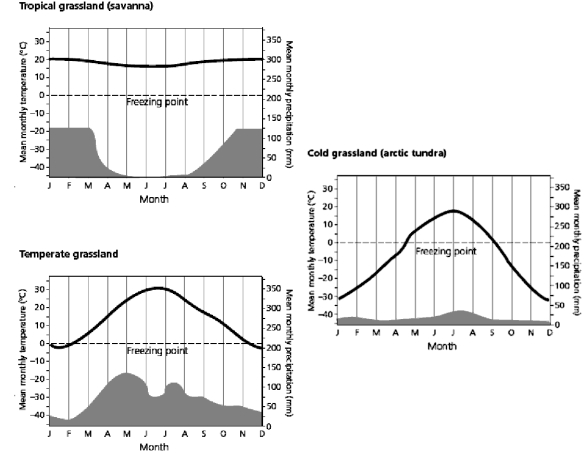 Use the Figure above to answer the following question(s).
-How much of the year is the Arctic tundra below the freezing point?
Use the Figure above to answer the following question(s).
-How much of the year is the Arctic tundra below the freezing point? (Short Answer)
4.8/5 (73)
(73)  Use the Figure above to answer the following question(s).
-Choose the letter(s) that represent(s) temperate deciduous forest.
Use the Figure above to answer the following question(s).
-Choose the letter(s) that represent(s) temperate deciduous forest. (Short Answer)
4.8/5 (87)
(87) Climate and vegetation vary with both latitude and _______________.
(Short Answer)
4.7/5 (74)
(74) Treeless, bitterly cold most of the year, winters are long and dark, low-growing plants, and permafrost are the characteristics of which of the following?
(Multiple Choice)
4.8/5 (97)
(97) About ____________________ percent of the world's major terrestrial ecosystems are either being used unsustainably or are being degraded.
(Short Answer)
4.8/5 (93)
(93) The rain shadow effect means deserts are likely to form on the ____________________ side of mountains.
(Short Answer)
4.8/5 (86)
(86) Most of the nutrients in the tropical rain forests are found in the
(Multiple Choice)
4.7/5 (61)
(61) The greenhouse effect is a completely human-made or artificial feature.
(True/False)
4.9/5 (84)
(84) Which of the following is the primary limiting factor that controls the vegetative character of a biome?
(Multiple Choice)
4.7/5 (81)
(81) Which of the following would not be true of a tropical rain forest?
(Multiple Choice)
4.8/5 (71)
(71) Use the Figure above to answer the following question(s).
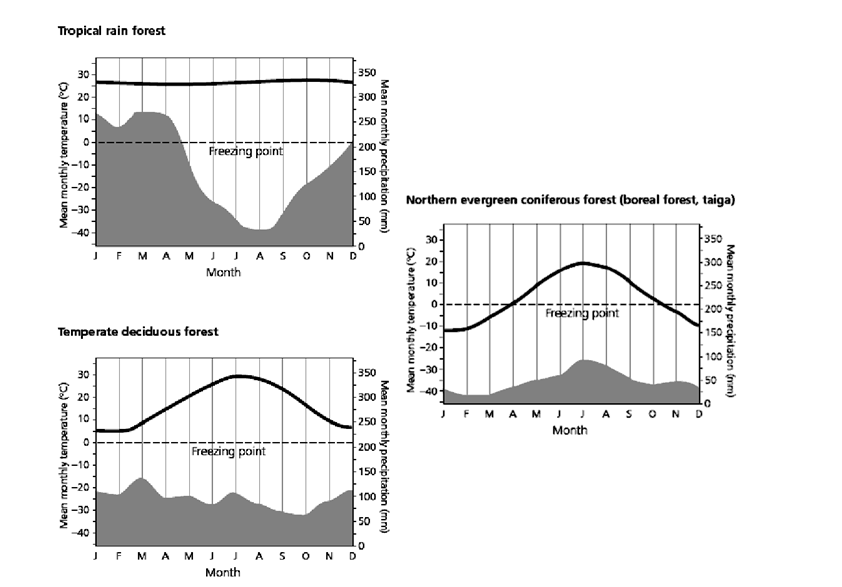 -When is the dry season in the tropical rain forest?
 (Short Answer)
4.8/5 (65)
(65) _______________ is the average atmospheric or weather conditions in a given region during a time frame of several decades to thousands of years.
(Short Answer)
4.8/5 (92)
(92) 
Filters
- Essay(0)
- Multiple Choice(0)
- Short Answer(0)
- True False(0)
- Matching(0)