



 Chat with AI
Exam 3: Ecosystems: What Are They and How Do They Work

Exam 1: Environmental Problems, Their Causes, and Sustainability100 Questions
Exam 2: Science, Matter, Energy, and Systems102 Questions
Exam 3: Ecosystems: What Are They and How Do They Work110 Questions
Exam 4: Biodiversity and Evolution104 Questions
Exam 5: Biodiversity, Species Interactions, and Population Control100 Questions
Exam 6: The Human Population and Its Impact111 Questions
Exam 7: Climate and Biodiversity100 Questions
Exam 8: Aquatic Biodiversity109 Questions
Exam 9: Sustaining Biodiversity: the Species Approach100 Questions
Exam 10: Sustaining Terrestrial Biodiversity: the Ecosystem Approach108 Questions
Exam 11: Sustaining Aquatic Biodiversity122 Questions
Exam 12: Food, Soil, and Pest Management118 Questions
Exam 13: Water Resources115 Questions
Exam 14: Geology and Nonrenewable Mineral Resources115 Questions
Exam 15: Nonrenewable Energy102 Questions
Exam 16: Energy Efficiency and Renewable Energy103 Questions
Exam 17: Environmental Hazards and Human Health103 Questions
Exam 18: Air Pollution112 Questions
Exam 19: Climate Disruption and Ozone Depletion111 Questions
Exam 20: Water Pollution114 Questions
Exam 21: Solid and Hazardous Waste108 Questions
Exam 22: Cities and Sustainability99 Questions
Exam 23: Economics, Environment, and Sustainability104 Questions
Exam 24: Politics, Environment, and Sustainability90 Questions
Exam 25: Environmental Worldviews, Ethics, and Sustainability55 Questions
Select questions type


Organisms that cannot produce their own food and, therefore, must eat other organisms, are called ____________________.
(Short Answer)
5.0/5  (69)
(69) Organisms that convert simple inorganic compounds into nutrients, without sunlight, are called ____________________ organisms.
(Short Answer)
4.8/5 (78)
(78) Sulfur is added to the atmosphere in all the following ways except
(Multiple Choice)
4.7/5 (87)
(87) Which of the following is not an abiotic component of an ecosystem?
(Multiple Choice)
4.8/5 (79)
(79) Agricultural runoffs containing phosphates cause huge blooms of algae in streams and lakes.
(True/False)
4.8/5 (89)
(89) Although tropical rain forests are only about 2% of the earth's land surface, they contain at least 50% of the world's land plant and animal species.
(True/False)
4.8/5 (78)
(78) Greenhouse gases, including methane, CO₂, and water vapor, make up about 30% of the earth's troposphere.
(True/False)
4.8/5 (83)
(83) Vitousek, Rojstaczer, and others estimate humans now use, waste, or destroy what percentage of the earth's total potential NPP?
(Multiple Choice)
4.8/5 (77)
(77) Which of the following is not a part of the phosphorus cycle?
(Multiple Choice)
4.9/5 (64)
(64) Nitrogen gas, the major component of the atmosphere, cannot directly be used by plants and animals.
(True/False)
4.9/5 (85)
(85) Which of the following is not one of the major processes of the water cycle?
(Multiple Choice)
4.9/5 (91)
(91) ____________________ can help scientists understand large and very complex systems by allowing them to change variables and project possible changes.
(Short Answer)
4.7/5 (82)
(82) Although tropical rain forests are only 2% of the earth's land surface, they contain what percentage of the earth's land plants and animal species?
(Multiple Choice)
4.8/5 (74)
(74) Precipitation can take several paths when it reaches the earth's surface.Which of the following is not one of those paths?
(Multiple Choice)
4.9/5 (88)
(88) Only about 14% of the tropical rain forests have been destroyed or disturbed at this point.
(True/False)
4.8/5 (78)
(78) The very necessary process of breaking down the dead bodies of organisms is a function of
(Multiple Choice)
4.8/5 (64)
(64) 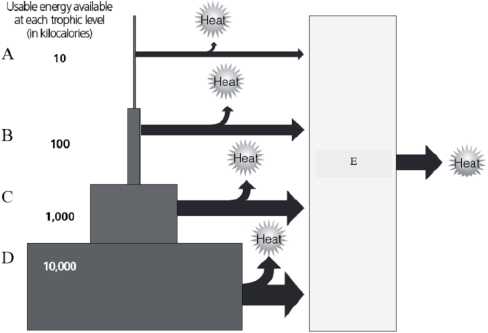 Use the Figure above to answer the following question(s).
-Why is heat shown as being lost to the environment?
Use the Figure above to answer the following question(s).
-Why is heat shown as being lost to the environment? (Short Answer)
4.9/5 (85)
(85) An ecosystem is defined as a community of different populations of species interacting with one another and their nonliving environment.
(True/False)
5.0/5 (84)
(84) 
Filters
- Essay(0)
- Multiple Choice(0)
- Short Answer(0)
- True False(0)
- Matching(0)