



 Chat with AI
Exam 2: Science, Matter, Energy, and Systems

Exam 1: Environmental Problems, Their Causes, and Sustainability100 Questions
Exam 2: Science, Matter, Energy, and Systems102 Questions
Exam 3: Ecosystems: What Are They and How Do They Work110 Questions
Exam 4: Biodiversity and Evolution104 Questions
Exam 5: Biodiversity, Species Interactions, and Population Control100 Questions
Exam 6: The Human Population and Its Impact111 Questions
Exam 7: Climate and Biodiversity100 Questions
Exam 8: Aquatic Biodiversity109 Questions
Exam 9: Sustaining Biodiversity: the Species Approach100 Questions
Exam 10: Sustaining Terrestrial Biodiversity: the Ecosystem Approach108 Questions
Exam 11: Sustaining Aquatic Biodiversity122 Questions
Exam 12: Food, Soil, and Pest Management118 Questions
Exam 13: Water Resources115 Questions
Exam 14: Geology and Nonrenewable Mineral Resources115 Questions
Exam 15: Nonrenewable Energy102 Questions
Exam 16: Energy Efficiency and Renewable Energy103 Questions
Exam 17: Environmental Hazards and Human Health103 Questions
Exam 18: Air Pollution112 Questions
Exam 19: Climate Disruption and Ozone Depletion111 Questions
Exam 20: Water Pollution114 Questions
Exam 21: Solid and Hazardous Waste108 Questions
Exam 22: Cities and Sustainability99 Questions
Exam 23: Economics, Environment, and Sustainability104 Questions
Exam 24: Politics, Environment, and Sustainability90 Questions
Exam 25: Environmental Worldviews, Ethics, and Sustainability55 Questions
Select questions type


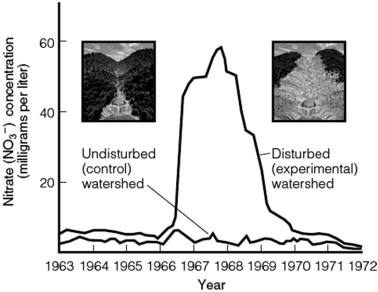 -After looking at the figure above, explain the significant difference that occurred between 1966 and 1970 in terms of the two lines representing the control watershed and the experimental watershed.
 (Essay)
5.0/5  (73)
(73) In an experiment, which of the following would not change the chosen variable?
(Multiple Choice)
4.8/5 (69)
(69) If a macromolecule was a brick wall it would be called a(n) ____________________ made up of repeating units called ____________________.
(Short Answer)
5.0/5 (92)
(92) Which of the following is supported by data, hypotheses, models, theories, and laws that are widely accepted by scientists considered experts in the field under study?
(Multiple Choice)
4.8/5 (78)
(78) Methane, a hydrocarbon, is considered an organic molecule even though it contains only one carbon atom.
(True/False)
4.7/5 (63)
(63) Which one of the following does not illustrate a time delay?
(Multiple Choice)
4.8/5 (75)
(75) According to the law of conservation of matter, once trash decomposes in a landfill we have completely gotten rid of the matter which made up the trash.
(True/False)
5.0/5 (73)
(73) Scientists use the statistical concept of probability to evaluate the results of experimentation.
(True/False)
4.9/5 (83)
(83) Which of the following is not an example of an environmental threshold having been crossed?
(Multiple Choice)
4.7/5 (83)
(83) Science has limitations, including all of the following, except
(Multiple Choice)
4.9/5 (66)
(66) ____________________ happens when scientists report details of their research and other scientists evaluate it.
(Short Answer)
4.7/5 (91)
(91) Two or more processes interacting such that the combined effect is greater than the sum of the individual effects is called
(Multiple Choice)
4.8/5 (74)
(74) Which of the following is not one of the nuclear changes matter can undergo?
(Multiple Choice)
4.7/5 (66)
(66) Which of the following statements is not an example of a physical change?
(Multiple Choice)
4.9/5 (84)
(84) Scientists can disprove things but they cannot prove anything absolutely, which means there is always some uncertainty in science.
(True/False)
4.8/5 (87)
(87) 
Filters
- Essay(0)
- Multiple Choice(0)
- Short Answer(0)
- True False(0)
- Matching(0)