



 Chat with AI
Exam 9: Articulations

Exam 1: An Introduction to Anatomy and Physiology81 Questions
Exam 2: The Chemical Level of Organization167 Questions
Exam 3: The Cellular Level of Organization186 Questions
Exam 4: The Tissue Level of Organization122 Questions
Exam 5: The Integumentary System111 Questions
Exam 6: Osseous Tissue and Bone Structure143 Questions
Exam 7: The Axial Skeleton148 Questions
Exam 8: The Appendicular Skeleton113 Questions
Exam 9: Articulations126 Questions
Exam 10: Muscle Tissue135 Questions
Exam 11: The Muscular System164 Questions
Exam 12: Neural Tissue168 Questions
Exam 13: The Spinal Cord, spinal Nerves, and Spinal Reflexes111 Questions
Exam 14: The Brain and Cranial Nerves179 Questions
Exam 15: Neural Integration I: Sensory Pathways and the Somatic Nervous System120 Questions
Exam 16: Neural Integration Ii: the Autonomic Nervous System and127 Questions
Exam 17: The Special Senses166 Questions
Exam 18: The Endocrine System179 Questions
Exam 19: Blood146 Questions
Exam 20: The Heart172 Questions
Exam 21: Blood Vessels and Circulation223 Questions
Exam 22: The Lymphatic System and Immunity161 Questions
Exam 23: The Respiratory System193 Questions
Exam 24: The Digestive System208 Questions
Exam 25: Metabolism and Energetics135 Questions
Exam 26: The Urinary System123 Questions
Exam 27: Fluid, electrolyte, and Acid-Base Balance59 Questions
Exam 28: The Reproductive System196 Questions
Exam 29: Development and Inheritance140 Questions
Select questions type


The back of the knee joint is reinforced by ________ ligaments.
(Multiple Choice)
4.9/5  (92)
(92) The medial surface of the knee joint is reinforced by the ________ ligament.
(Multiple Choice)
4.7/5 (81)
(81) Which of the following ligaments is not associated with the hip joint?
(Multiple Choice)
4.7/5 (93)
(93) A ligamentous connection such as an interosseous ligament is termed a
(Multiple Choice)
4.9/5 (78)
(78) The coxal bones articulate with the sacrum at the ________ joint.
(Short Answer)
4.9/5 (70)
(70) 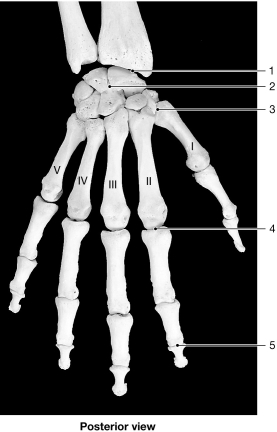 Figure 9-1 Bones of the Wrist and Hand
Use Figure 9-1 to answer the following questions:
-Identify the type of joint at label "1."
Figure 9-1 Bones of the Wrist and Hand
Use Figure 9-1 to answer the following questions:
-Identify the type of joint at label "1." (Multiple Choice)
4.8/5 (79)
(79) Which of the following types of joints is monaxial,but capable of only rotation?
(Multiple Choice)
4.9/5 (68)
(68) To pinch with a thumb and finger involves a movement called
(Multiple Choice)
4.7/5 (81)
(81) Arthritis always involves damage to the ________ cartilages,but the specific cause can vary.
(Short Answer)
4.9/5 (76)
(76) Why is the inferior region of the shoulder joint most vulnerable to dislocation?
(Essay)
4.7/5 (88)
(88) 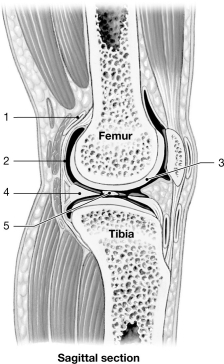 Figure 9-2 A Simplified Sectional View of the Knee Joint
Use Figure 9-2 to answer the following questions:
-Identify the structure labeled "2."
Figure 9-2 A Simplified Sectional View of the Knee Joint
Use Figure 9-2 to answer the following questions:
-Identify the structure labeled "2." (Multiple Choice)
4.8/5 (86)
(86) The location where two bones meet is called a joint or an ________.
(Short Answer)
4.8/5 (77)
(77) Curling into the "fetal position" ________ the intervertebral joints.
(Multiple Choice)
4.8/5 (84)
(84) Match the term with the correct definition.
1.synarthrosis
A)slightly movable joint
2.amphiarthrosis
B)immovable joint
3.diarthrosis
C)freely moving joint
(Short Answer)
4.9/5 (66)
(66) A ________ occurs when articulating surfaces are forced out of position.
(Short Answer)
4.9/5 (83)
(83) 
Filters
- Essay(0)
- Multiple Choice(0)
- Short Answer(0)
- True False(0)
- Matching(0)