



 Chat with AI
Exam 9: Articulations

Exam 1: An Introduction to Anatomy and Physiology81 Questions
Exam 2: The Chemical Level of Organization167 Questions
Exam 3: The Cellular Level of Organization186 Questions
Exam 4: The Tissue Level of Organization122 Questions
Exam 5: The Integumentary System111 Questions
Exam 6: Osseous Tissue and Bone Structure143 Questions
Exam 7: The Axial Skeleton148 Questions
Exam 8: The Appendicular Skeleton113 Questions
Exam 9: Articulations126 Questions
Exam 10: Muscle Tissue135 Questions
Exam 11: The Muscular System164 Questions
Exam 12: Neural Tissue168 Questions
Exam 13: The Spinal Cord, spinal Nerves, and Spinal Reflexes111 Questions
Exam 14: The Brain and Cranial Nerves179 Questions
Exam 15: Neural Integration I: Sensory Pathways and the Somatic Nervous System120 Questions
Exam 16: Neural Integration Ii: the Autonomic Nervous System and127 Questions
Exam 17: The Special Senses166 Questions
Exam 18: The Endocrine System179 Questions
Exam 19: Blood146 Questions
Exam 20: The Heart172 Questions
Exam 21: Blood Vessels and Circulation223 Questions
Exam 22: The Lymphatic System and Immunity161 Questions
Exam 23: The Respiratory System193 Questions
Exam 24: The Digestive System208 Questions
Exam 25: Metabolism and Energetics135 Questions
Exam 26: The Urinary System123 Questions
Exam 27: Fluid, electrolyte, and Acid-Base Balance59 Questions
Exam 28: The Reproductive System196 Questions
Exam 29: Development and Inheritance140 Questions
Select questions type


A common injury to the ankle occurs by excessive turning of the sole inward,termed
(Multiple Choice)
4.8/5  (79)
(79) The joint that permits the greatest range of mobility of any joint in the body is the ________ joint.
(Multiple Choice)
4.8/5 (74)
(74) The shoulder joint,or ________ joint,permits the greatest range of motion of any joint.
(Short Answer)
4.7/5 (74)
(74) The ligament that provides support to the front of the knee joint is the ________ ligament.
(Multiple Choice)
4.8/5 (78)
(78) 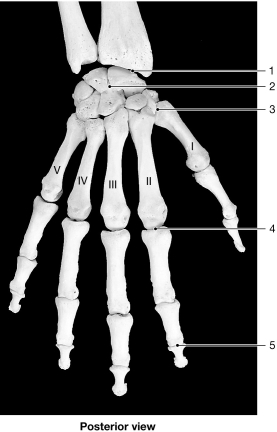 Figure 9-1 Bones of the Wrist and Hand
Use Figure 9-1 to answer the following questions:
-Identify the type of joint at label "2."
Figure 9-1 Bones of the Wrist and Hand
Use Figure 9-1 to answer the following questions:
-Identify the type of joint at label "2." (Multiple Choice)
4.8/5 (79)
(79) The ligaments that limit the anterior-posterior movement of the femur and maintain the alignment of the femoral and tibial condyles are the ________ ligaments.
(Multiple Choice)
4.9/5 (82)
(82) Which of the following movements would you associate with chewing food?
(Multiple Choice)
4.9/5 (76)
(76) The joints that are subjected to the greatest load are found in the
(Multiple Choice)
4.9/5 (89)
(89) When the triceps brachii muscle contracts,what movements does it produce?
(Essay)
4.8/5 (83)
(83) ________ subdivide synovial cavities,channel the flow of synovial fluid,and allow for variations in the shapes of the articular surfaces. (Note: Be sure to capitalize the first letter of your answer).
(Short Answer)
4.8/5 (87)
(87) Small pockets of synovial fluid that reduce friction and act as a shock absorber where ligaments and tendons rub against other tissues are called ________.
(Short Answer)
4.9/5 (79)
(79) The movements known as dorsiflexion and plantar flexion involve moving the
(Multiple Choice)
4.9/5 (83)
(83) 
Filters
- Essay(0)
- Multiple Choice(0)
- Short Answer(0)
- True False(0)
- Matching(0)