



 Chat with AI
Exam 18: Prognosis and Results After Periodontal Therapy

Exam 1: Historical Perspectives on Dental Hygiene and Periodontology43 Questions
Exam 2: Periodontium: Anatomic Characteristics and Host Response36 Questions
Exam 3: Epidemiology of Periodontal Diseases36 Questions
Exam 4: Microbiology of Periodontal Diseases35 Questions
Exam 5: Calculus and Other Disease-Associated Factors41 Questions
Exam 6: Gingival Diseases50 Questions
Exam 7: Periodontal Diseases46 Questions
Exam 8: Clinical Assessment49 Questions
Exam 9: Systemic Factors Influencing Periodontal Diseases45 Questions
Exam 10: Treatment Planning for the Periodontal Patient40 Questions
Exam 11: Occlusion and Temporomandibular Disorders39 Questions
Exam 12: Plaque Biofilm and Disease Control for the Periodontal Patient50 Questions
Exam 13: Nonsurgical Periodontal Therapy50 Questions
Exam 14: Periodontal Surgery46 Questions
Exam 15: Dental Implants39 Questions
Exam 16: Periodontal Emergencies50 Questions
Exam 17: Periodontal Maintenance and Prevention56 Questions
Exam 18: Prognosis and Results After Periodontal Therapy36 Questions
Select questions type


Sometimes,individual teeth that can be successfully treated for periodontal disease cannot be restored.The prognosis for the individual tooth would be:

Free
(Multiple Choice)
4.8/5  (71)
(71) Correct Answer: Verified
C
The patient ultimately decides the treatment plan that will be followed.This judgment is made,in part,by the patient being fully informed of the prognosis,which is the expected outcome of the case.
Free
(Multiple Choice)
5.0/5 (83)
(83) Correct Answer:Verified
VerifiedA
A 58-year-old woman is postmenopausal and in good health.She takes one 5-mg aspirin tablet per day to control the pain from the osteoarthritis in her hands and has recently stopped taking 1 mg of estrogen per day.She has 4- to 5-mm probing depths,minimal recession,and moderate subgingival calculus throughout her mouth.Plaque control is poor,and generalized gingival and interproximal plaque are observed.The treatment plan includes oral hygiene instructions,including improved brushing,flossing with a tool,and quadrant scaling and root planing.Although the patient has not regularly visited the dentist during her life,she is cooperative and eager to improve her oral health.The overall prognosis for this patient is likely to be: 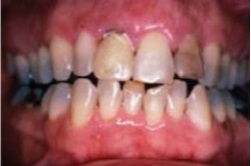
Free
(Multiple Choice)
4.8/5 (81)
(81) Correct Answer:Verified
VerifiedB
Advanced bone loss,inadequate attachment,uncontrolled environmental and systemic factors,and tooth extraction all describe which one of the following categories of individual tooth prognoses?
(Multiple Choice)
4.9/5 (77)
(77) Attachment loss and furcation involvement that can only be maintained with difficulty (Class II or III),tooth mobility,and the presence of systemic factors all describe which one of the following categories of individual tooth prognoses?
(Multiple Choice)
4.9/5 (73)
(73) After periodontal treatment is complete and the patient has been placed on maintenance,persistent bleeding:
(Multiple Choice)
4.9/5 (75)
(75) The prognosis is not a major consideration when treatment planning.
(True/False)
4.9/5 (64)
(64) If periodontal therapy is going to be attempted but may not be successful,then the prognosis would be:
(Multiple Choice)
4.7/5 (79)
(79) Persistent deep pockets would alter the overall prognosis of the patient by making it move from:
(Multiple Choice)
5.0/5 (66)
(66) Attachment loss and furcation involvement (Class I),likely patient cooperation,and controlled systemic factors all describe which one of the following categories of individual tooth prognoses?
(Multiple Choice)
4.8/5 (80)
(80) Mr.CAA is 37 years old and has had repeated episodes of both nonsurgical and surgical periodontal therapy.He is conscientious about his oral hygiene and follows all treatment recommendations.He has also been on a 1-year course of low-dose doxycycline as an adjunct to periodontal therapy.Mr.CAA is in good health and takes no other medications but smokes two packs of cigarettes a day and has been unable to quit.The overall prognosis for Mr.CAA is most likely: 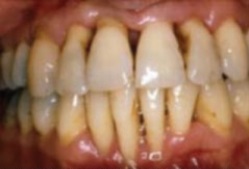
(Multiple Choice)
4.8/5 (67)
(67) The overall prognosis for a patient's treatment relies on several important factors.What are three of the six factors that require consideration for developing an overall prognosis?
____________________________________
____________________________________
____________________________________
(Essay)
5.0/5 (59)
(59) Enamel projections are common on molar teeth.They are only significant when periodontal tissues become detached from them through the disease process.
(Multiple Choice)
4.8/5 (81)
(81) A 68-year-old man has never been a regular visitor to the dentist.He is generally uncooperative but came to the appointment because his "gums bleed" and he has "bad breath." He is in good health and takes no medications.He has 4- to 6-mm pocket depths,little recession,heavy deposits of subgingival calculus,and heavy supragingival plaque biofilm throughout.The treatment plan consists of oral hygiene instructions,quadrant scaling and root planing,and re-evaluation for referral to a periodontist.The global prognosis for this patient is most likely: 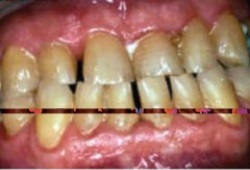
(Multiple Choice)
4.8/5 (79)
(79) Younger patients exhibit greater periodontal destruction than older patients.
(True/False)
4.9/5 (82)
(82) The prediction or forecast of the extent and duration of disease and its response to treatment is called ______________________.
(Short Answer)
4.8/5 (85)
(85) A 23-year-old woman came to see the periodontist because she was concerned that her teeth have become extremely sensitive after using a home bleaching kit.The periodontist assured her that the sensitivity would be transient and would resolve itself without intervention in a few weeks and referred her for dental hygiene care.The patient is in excellent health,not pregnant,and takes no medications.Slight gingivitis in the posterior interproximal areas,light supragingival calculus on the lingual surfaces of the lower anterior teeth,and generalized interproximal plaque biofilm are observed on examination.The dental hygienist's treatment plan is to provide oral hygiene instructions,scale the teeth,polish selectively,and encourage a 6-month recall.The overall prognosis for the patient's response is likely to be: 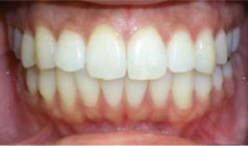
(Multiple Choice)
4.7/5 (69)
(69) No bone loss,excellent gingival condition,no systemic considerations,and good patient cooperation all describe which one of the following categories of individual tooth prognoses?
(Multiple Choice)
4.8/5 (69)
(69) 
Filters
- Essay(0)
- Multiple Choice(0)
- Short Answer(0)
- True False(0)
- Matching(0)