



 Chat with AI
Exam 18: International Trade and Public Policy

Exam 1: Introduction: What Is Economics163 Questions
Exam 2: The Key Principles of Economics199 Questions
Exam 3: Exchange and Markets133 Questions
Exam 4: Demand,supply,and Market Equilibrium279 Questions
Exam 5: Elasticity: a Measure of Responsiveness170 Questions
Exam 6: Market Efficiency and Government Intervention120 Questions
Exam 7: Consumer Choice: Utility Theory and Insights From Neuroscience114 Questions
Exam 8: Production Technology and Cost163 Questions
Exam 9: Perfect Competition167 Questions
Exam 10: Monopoly and Price Discrimination127 Questions
Exam 11: Market Entry and Monopolistic Competition112 Questions
Exam 12: Oligopoly and Strategic Behavior116 Questions
Exam 13: Controlling Market Power: Antitrust and Regulation81 Questions
Exam 14: Imperfect Information: Adverse Selection and Moral Hazard98 Questions
Exam 15: Public Goods and Public Choice95 Questions
Exam 16: External Costs and Environmental Policy100 Questions
Exam 17: The Labor Market and the Distribution of Income177 Questions
Exam 18: International Trade and Public Policy224 Questions
Select questions type


Daily Output of Japan and United States
 Table 18.2
-Refer to Table 18.2.After trade begins,________ will specialize in the production of stereos and ________ will specialize in the production of tractors.
Table 18.2
-Refer to Table 18.2.After trade begins,________ will specialize in the production of stereos and ________ will specialize in the production of tractors. (Multiple Choice)
4.9/5  (84)
(84) The Asian Pacific Economic Cooperation (APEC)was modeled after NAFTA.
(True/False)
4.8/5 (90)
(90) Suppose the United States produces only two goods,grapes and tractors.If the United States has a comparative advantage in tractors,a move toward free trade will
(Multiple Choice)
4.8/5 (74)
(74)  Figure 18.2
-Refer to Figure 18.2.After trade and specialization begin,the maximum amount of cheese that Pizzaland can consume is
Figure 18.2
-Refer to Figure 18.2.After trade and specialization begin,the maximum amount of cheese that Pizzaland can consume is (Multiple Choice)
5.0/5 (75)
(75) Consider the following daily production possibilities of apples and bananas in Ireland and Scotland:
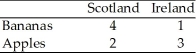 Suppose the production of apples requires skilled workers while banana production requires unskilled workers.If Scotland and Ireland choose to trade with each other in order to take advantage of their opportunity costs:
a)Who will sell bananas? Who will sell Apples?
b)Which worker will gain in Scotland? Which worker will be hurt?
Suppose the production of apples requires skilled workers while banana production requires unskilled workers.If Scotland and Ireland choose to trade with each other in order to take advantage of their opportunity costs:
a)Who will sell bananas? Who will sell Apples?
b)Which worker will gain in Scotland? Which worker will be hurt? (Essay)
4.9/5 (80)
(80)
Figure 18.2
-Refer to Figure 18.2.The opportunity cost of producing cheese in Pizzaland is
Figure 18.2
-Refer to Figure 18.2.The opportunity cost of producing cheese in Pizzaland is (Multiple Choice)
4.8/5 (85)
(85) Environmental regulations increase trade and economic well-being.
(True/False)
4.9/5 (97)
(97)  Figure 18.4
-Refer to Figure 18.4.With free trade,how many artichokes are produced domestically in Duckland?
Figure 18.4
-Refer to Figure 18.4.With free trade,how many artichokes are produced domestically in Duckland? (Multiple Choice)
4.8/5 (76)
(76) If the production possibilities curve is drawn as a straight line it means that
(Multiple Choice)
4.9/5 (64)
(64)  Figure 18.1
-Refer to Figure 18.1.Duckland has a comparative advantage in the production of
Figure 18.1
-Refer to Figure 18.1.Duckland has a comparative advantage in the production of (Multiple Choice)
4.9/5 (76)
(76)  Figure 18.5
-For the good in Figure 18.5,with the tariff,the people in the country will buy
Figure 18.5
-For the good in Figure 18.5,with the tariff,the people in the country will buy (Multiple Choice)
4.9/5 (69)
(69)  Figure 18.3
-Refer to Figure 18.3.With free trade,domestic production is
Figure 18.3
-Refer to Figure 18.3.With free trade,domestic production is (Multiple Choice)
4.8/5 (76)
(76) Which of the following trade policies raises prices for domestic consumers?
(Multiple Choice)
4.9/5 (63)
(63) A possible reason to impose a protectionist policy such as a tariff is to
(Multiple Choice)
4.9/5 (74)
(74) 
Filters
- Essay(0)
- Multiple Choice(0)
- Short Answer(0)
- True False(0)
- Matching(0)