



 Chat with AI
Exam 18: International Trade and Public Policy

Exam 1: Introduction: What Is Economics163 Questions
Exam 2: The Key Principles of Economics199 Questions
Exam 3: Exchange and Markets133 Questions
Exam 4: Demand,supply,and Market Equilibrium279 Questions
Exam 5: Elasticity: a Measure of Responsiveness170 Questions
Exam 6: Market Efficiency and Government Intervention120 Questions
Exam 7: Consumer Choice: Utility Theory and Insights From Neuroscience114 Questions
Exam 8: Production Technology and Cost163 Questions
Exam 9: Perfect Competition167 Questions
Exam 10: Monopoly and Price Discrimination127 Questions
Exam 11: Market Entry and Monopolistic Competition112 Questions
Exam 12: Oligopoly and Strategic Behavior116 Questions
Exam 13: Controlling Market Power: Antitrust and Regulation81 Questions
Exam 14: Imperfect Information: Adverse Selection and Moral Hazard98 Questions
Exam 15: Public Goods and Public Choice95 Questions
Exam 16: External Costs and Environmental Policy100 Questions
Exam 17: The Labor Market and the Distribution of Income177 Questions
Exam 18: International Trade and Public Policy224 Questions
Select questions type


The rate at which nations will exchange goods and service is known as the
(Multiple Choice)
4.8/5  (66)
(66) The consumption possibilities curve shows the combinations of goods that can be
(Multiple Choice)
4.9/5 (84)
(84) Daily Output of Japan and United States
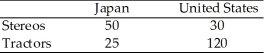 Table 18.2
-Refer to Table 18.2.The United States has a comparative advantage in the production of
Table 18.2
-Refer to Table 18.2.The United States has a comparative advantage in the production of (Multiple Choice)
4.9/5 (92)
(92) Which of the following is NOT a reason to follow protectionist trade policies?
(Multiple Choice)
4.8/5 (80)
(80) The combinations of goods a nation can consume after trade and specialization begin are illustrated by the ________ curve.
(Multiple Choice)
4.8/5 (91)
(91) Recall the Application about the impact Chinese imports have on U.S. labor markets to answer the following question(s).
-According to the Application,Chinese Imports have only been disadvantageous to U.S.local communities.
(True/False)
4.8/5 (93)
(93) Which of the following groups of countries are members of NAFTA?
(Multiple Choice)
5.0/5 (80)
(80) The equilibrium price under an import quota is above the price that occurs with free trade.
(True/False)
4.8/5 (88)
(88) Which of the following trade agreements provides for the development of a single market among its members?
(Multiple Choice)
4.8/5 (80)
(80) Suppose Canada produces only two goods,corn and automobiles.If Canada has a comparative advantage in automobiles,a move toward free trade will
(Multiple Choice)
4.8/5 (78)
(78)  Figure 18.4
-Refer to Figure 18.4.With an import ban,how many artichokes are produced domestically in Duckland?
Figure 18.4
-Refer to Figure 18.4.With an import ban,how many artichokes are produced domestically in Duckland? (Multiple Choice)
4.9/5 (95)
(95)  Figure 18.3
-Refer to Figure 18.3.With free trade,the equilibrium price is
Figure 18.3
-Refer to Figure 18.3.With free trade,the equilibrium price is (Multiple Choice)
4.7/5 (71)
(71) If we eliminated our textile tariffs,the dislocated workers could easily switch to other jobs.
(True/False)
4.9/5 (76)
(76) Which of the following explains why the world market may support only one or two firms worldwide?
(Multiple Choice)
4.9/5 (79)
(79) A limit on the amount of a good that can be imported is known as
(Multiple Choice)
4.9/5 (78)
(78)
Figure 18.3
-Refer to Figure 18.3.With a tariff or quota,the equilibrium price is
Figure 18.3
-Refer to Figure 18.3.With a tariff or quota,the equilibrium price is (Multiple Choice)
4.7/5 (73)
(73) National policy always overrides free trade in matters of environmental concern.
(True/False)
4.9/5 (70)
(70) The United States has a lot of both skilled and unskilled workers in the economy.Suppose that the United States' comparative advantage is in industries that require more skilled workers.Instead of using protectionist policies,what other policy can the government use to dampen the negative effects unskilled workers may face a result of free trade?
(Essay)
4.9/5 (83)
(83) 
Filters
- Essay(0)
- Multiple Choice(0)
- Short Answer(0)
- True False(0)
- Matching(0)