



 Chat with AI
Exam 25: Sustainable Cities

Exam 1: Environmental Problems: an Introduction and Overview85 Questions
Exam 2: Environmental History: Learning From the Past83 Questions
Exam 3: Science, systems, matter, and Energy126 Questions
Exam 4: Ecosystems: What Are They, and How Do They Work201 Questions
Exam 5: Evolution and Biodiversity80 Questions
Exam 6: Climate and Terrestrial Biodiversity156 Questions
Exam 7: Aquatic Biodiversity99 Questions
Exam 8: Community Ecology104 Questions
Exam 9: Population Ecology90 Questions
Exam 10: Applying Population Ecology: the Human Population119 Questions
Exam 11: Sustaining Terrestrial Biodiversity: Managing and Protecting Ecosystems93 Questions
Exam 12: Sustaining Biodiversity: the Species Approach106 Questions
Exam 13: Sustaining Aquatic Biodiversity77 Questions
Exam 14: Food and Soil Resources113 Questions
Exam 15: Water Resources86 Questions
Exam 16: Geology and Nonrenewable Mineral Resources91 Questions
Exam 17: Nonrenewable Energy Resources105 Questions
Exam 18: Energy Efficiency and Renewable Energy106 Questions
Exam 19: Risk,toxicology,and Human Health116 Questions
Exam 20: Air Pollution120 Questions
Exam 21: Climate Change and Ozone Loss99 Questions
Exam 22: Water Pollution110 Questions
Exam 23: Pest Management91 Questions
Exam 24: Solid and Hazardous Waste91 Questions
Exam 25: Sustainable Cities85 Questions
Exam 26: Economics, environment, and Sustainability71 Questions
Exam 27: Politics, environment, and Sustainability65 Questions
Exam 28: Environmental World-views, ethics, and Sustainability78 Questions
Select questions type


Low-cost gasoline and government-funded highways did NOT contribute to urban sprawl.
(True/False)
4.9/5  (69)
(69) The attractive and commercially successful waterfront park in North Bay,Ontario,was reclaimed by rehabilitating a lakeside expanse of contaminated rail land.
(True/False)
4.7/5 (71)
(71) Although services are often easier to provide to urban residents than to rural ones,urban areas foster more people and,consequently,more poverty.
(True/False)
4.8/5 (75)
(75) What is the general population trend for the Maritime provinces?
(Multiple Choice)
4.8/5 (87)
(87) _________________________ are the world's largest source of air pollutants.
(Short Answer)
4.9/5 (83)
(83) ________________________________________ is the development of urban growth to minimize environmental impact.
(Short Answer)
4.8/5 (79)
(79) IN/OUT
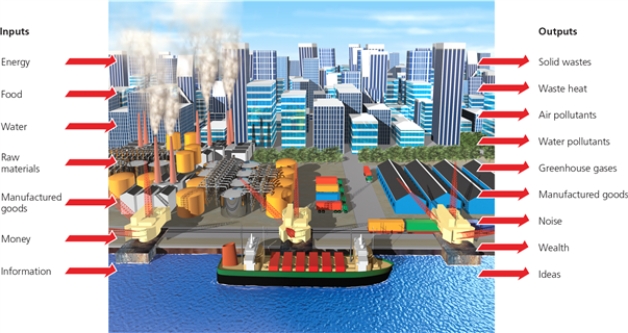 -According to the diagram,which outputs are not causing problems for people and the environment?
 (Short Answer)
4.8/5 (80)
(80) Women who live in rural areas have a lower total fertility rate than those who live in urban areas.
(True/False)
4.8/5 (63)
(63) ____________________ pollution can affect various plant and animal species,such as sea turtles.
(Short Answer)
4.9/5 (75)
(75) What is one advantage that a train might have over a bus in terms of mass transportation trade-offs.
(Multiple Choice)
4.8/5 (85)
(85) Which of the following is NOT true of city life compared to rural life? In a city:
(Multiple Choice)
4.8/5 (76)
(76) A high population density in urban areas can increase the spread of ______________________________ if the infrastructure is inadequate and fails to provide sufficient drinking water and sewage treatment.
(Short Answer)
4.8/5 (75)
(75) Walking to work and using solar energy are two concepts pertinent to a(n)____________________.
(Short Answer)
4.9/5 (79)
(79) Whereas many city centres have stagnated,____________________ has the fastest growing downtown core in North America.
(Short Answer)
5.0/5 (70)
(70) Megacities have improved significantly over the last decade due to better public water supplies and sanitation.
(True/False)
4.9/5 (77)
(77) Why do raw materials brought to cities require a large amount of resources in order to be converted to a final product?
(Essay)
4.9/5 (62)
(62) 
Filters
- Essay(0)
- Multiple Choice(0)
- Short Answer(0)
- True False(0)
- Matching(0)