



 Chat with AI
Exam 25: Sustainable Cities

Exam 1: Environmental Problems: an Introduction and Overview85 Questions
Exam 2: Environmental History: Learning From the Past83 Questions
Exam 3: Science, systems, matter, and Energy126 Questions
Exam 4: Ecosystems: What Are They, and How Do They Work201 Questions
Exam 5: Evolution and Biodiversity80 Questions
Exam 6: Climate and Terrestrial Biodiversity156 Questions
Exam 7: Aquatic Biodiversity99 Questions
Exam 8: Community Ecology104 Questions
Exam 9: Population Ecology90 Questions
Exam 10: Applying Population Ecology: the Human Population119 Questions
Exam 11: Sustaining Terrestrial Biodiversity: Managing and Protecting Ecosystems93 Questions
Exam 12: Sustaining Biodiversity: the Species Approach106 Questions
Exam 13: Sustaining Aquatic Biodiversity77 Questions
Exam 14: Food and Soil Resources113 Questions
Exam 15: Water Resources86 Questions
Exam 16: Geology and Nonrenewable Mineral Resources91 Questions
Exam 17: Nonrenewable Energy Resources105 Questions
Exam 18: Energy Efficiency and Renewable Energy106 Questions
Exam 19: Risk,toxicology,and Human Health116 Questions
Exam 20: Air Pollution120 Questions
Exam 21: Climate Change and Ozone Loss99 Questions
Exam 22: Water Pollution110 Questions
Exam 23: Pest Management91 Questions
Exam 24: Solid and Hazardous Waste91 Questions
Exam 25: Sustainable Cities85 Questions
Exam 26: Economics, environment, and Sustainability71 Questions
Exam 27: Politics, environment, and Sustainability65 Questions
Exam 28: Environmental World-views, ethics, and Sustainability78 Questions
Select questions type


Is it true that inputs in the form of energy,food,water,etc.are much more expensive in terms of supporting a city than a small town or a rural area?
(Short Answer)
4.7/5  (82)
(82) ____________________ are the most widely used form of mass transit.
(Short Answer)
4.8/5 (72)
(72) Which statement best characterizes the squatter settlement populations of most cities in developing countries?
(Multiple Choice)
4.9/5 (86)
(86) Which one of the following characterizes a city area compared to the rural area?
(Multiple Choice)
4.9/5 (77)
(77) What is a problem in Canada,as well as in other countries with lots of room for expansion?
(Multiple Choice)
5.0/5 (67)
(67) IN/OUT
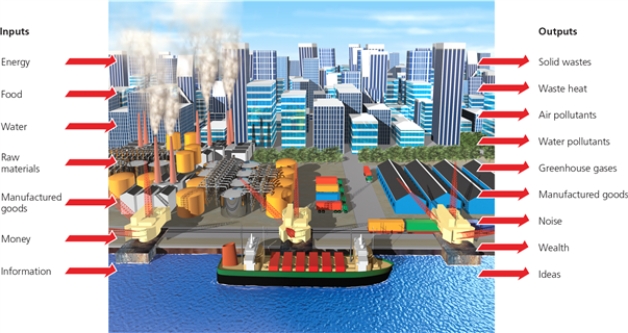 -According to the diagram,which outputs are causing the greatest problems for people and the environment?
 (Essay)
4.9/5 (76)
(76) One of the causes of urban sprawl is the fact that numerous political jurisdictions may have influence over one area,but with little effective management.
(True/False)
4.8/5 (76)
(76) By what percentage did the urban population increase between 1850 and 2009 due to the global urban revolution?
(Multiple Choice)
4.8/5 (78)
(78) What percentage of travel in the world occurs by foot,bicycle,motor scooter,and bus?
(Multiple Choice)
4.8/5 (80)
(80) The Growth Plan for the Greater Golden Horseshoe calls for all but one of the following.Which point is NOT supported by the plan?
(Multiple Choice)
4.7/5 (69)
(69) The declining economic health of cities often leads to reductions in services-i.e.,water,electricity,open spaces,timely garbage collection,etc.-to their residents.
(True/False)
4.8/5 (83)
(83) Growth of low-density development at the edge of cities and towns that causes a decrease in farmland or forests is referred to as _________________________.
(Short Answer)
4.8/5 (77)
(77) Three-fourths of North Americans live in _________________________,or cities and towns with populations of at least 50 000 people.
(Short Answer)
4.8/5 (91)
(91) Tax laws that encourage home ownership do NOT contribute to urban sprawl.
(True/False)
4.7/5 (78)
(78) 
Filters
- Essay(0)
- Multiple Choice(0)
- Short Answer(0)
- True False(0)
- Matching(0)