



 Chat with AI
Exam 19: Risk,toxicology,and Human Health

Exam 1: Environmental Problems: an Introduction and Overview85 Questions
Exam 2: Environmental History: Learning From the Past83 Questions
Exam 3: Science, systems, matter, and Energy126 Questions
Exam 4: Ecosystems: What Are They, and How Do They Work201 Questions
Exam 5: Evolution and Biodiversity80 Questions
Exam 6: Climate and Terrestrial Biodiversity156 Questions
Exam 7: Aquatic Biodiversity99 Questions
Exam 8: Community Ecology104 Questions
Exam 9: Population Ecology90 Questions
Exam 10: Applying Population Ecology: the Human Population119 Questions
Exam 11: Sustaining Terrestrial Biodiversity: Managing and Protecting Ecosystems93 Questions
Exam 12: Sustaining Biodiversity: the Species Approach106 Questions
Exam 13: Sustaining Aquatic Biodiversity77 Questions
Exam 14: Food and Soil Resources113 Questions
Exam 15: Water Resources86 Questions
Exam 16: Geology and Nonrenewable Mineral Resources91 Questions
Exam 17: Nonrenewable Energy Resources105 Questions
Exam 18: Energy Efficiency and Renewable Energy106 Questions
Exam 19: Risk,toxicology,and Human Health116 Questions
Exam 20: Air Pollution120 Questions
Exam 21: Climate Change and Ozone Loss99 Questions
Exam 22: Water Pollution110 Questions
Exam 23: Pest Management91 Questions
Exam 24: Solid and Hazardous Waste91 Questions
Exam 25: Sustainable Cities85 Questions
Exam 26: Economics, environment, and Sustainability71 Questions
Exam 27: Politics, environment, and Sustainability65 Questions
Exam 28: Environmental World-views, ethics, and Sustainability78 Questions
Select questions type


Although the threat of infectious diseases has decreased,human health is still threatened by pesticide-resistant insects and antibiotic-resistant bacteria.
(True/False)
4.9/5  (91)
(91) What type of exposure would have been experienced by a person who received a lifetime of background radiation from a low-level radioactive dump site?
(Multiple Choice)
4.9/5 (76)
(76) The ____________________ is a complex network of glands that release hormones into the bloodstream.
(Short Answer)
4.9/5 (74)
(74) What would be most effective for improving healthcare in developing countries?
(Multiple Choice)
4.9/5 (78)
(78) The three most pervasive viral diseases are influenza,hepatitis B,and SARS.
(True/False)
4.9/5 (88)
(88) Which pricing approach is being used if a further tax is added to the price of a pack of cigarettes?
(Multiple Choice)
4.8/5 (84)
(84) The widespread use of vaccines could improve human health and decrease death rates more than any other type of effort.
(True/False)
4.8/5 (77)
(77) AIDS
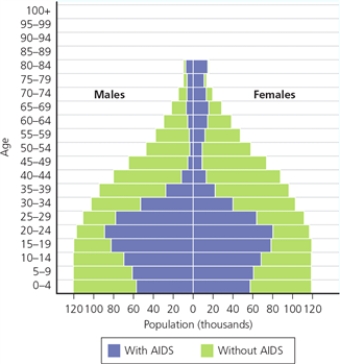 -At which age are females more likely to die from AIDS than males?
 (Short Answer)
4.9/5 (94)
(94) A(n)______________________________ can be spread by air,water,food,body fluids,and some vectors.
(Short Answer)
4.9/5 (82)
(82) What would people most likely have experienced if they flew over the Chernobyl site two days after the explosion?
(Multiple Choice)
4.9/5 (85)
(85) The ________________________________________ of the human immunodeficiency virus makes the virus hard to detect and makes it easy for the virus to spread.
(Short Answer)
4.7/5 (79)
(79) What presents the greatest risk to humans,in terms of the number of deaths per year and reduced life span?
(Multiple Choice)
4.7/5 (74)
(74) AIDS
-At which age are males more likely to die from AIDS than females?
-At which age are males more likely to die from AIDS than females? (Short Answer)
4.7/5 (85)
(85) 
Filters
- Essay(0)
- Multiple Choice(0)
- Short Answer(0)
- True False(0)
- Matching(0)