



 Chat with AI
Exam 10: Applying Population Ecology: the Human Population

Exam 1: Environmental Problems: an Introduction and Overview85 Questions
Exam 2: Environmental History: Learning From the Past83 Questions
Exam 3: Science, systems, matter, and Energy126 Questions
Exam 4: Ecosystems: What Are They, and How Do They Work201 Questions
Exam 5: Evolution and Biodiversity80 Questions
Exam 6: Climate and Terrestrial Biodiversity156 Questions
Exam 7: Aquatic Biodiversity99 Questions
Exam 8: Community Ecology104 Questions
Exam 9: Population Ecology90 Questions
Exam 10: Applying Population Ecology: the Human Population119 Questions
Exam 11: Sustaining Terrestrial Biodiversity: Managing and Protecting Ecosystems93 Questions
Exam 12: Sustaining Biodiversity: the Species Approach106 Questions
Exam 13: Sustaining Aquatic Biodiversity77 Questions
Exam 14: Food and Soil Resources113 Questions
Exam 15: Water Resources86 Questions
Exam 16: Geology and Nonrenewable Mineral Resources91 Questions
Exam 17: Nonrenewable Energy Resources105 Questions
Exam 18: Energy Efficiency and Renewable Energy106 Questions
Exam 19: Risk,toxicology,and Human Health116 Questions
Exam 20: Air Pollution120 Questions
Exam 21: Climate Change and Ozone Loss99 Questions
Exam 22: Water Pollution110 Questions
Exam 23: Pest Management91 Questions
Exam 24: Solid and Hazardous Waste91 Questions
Exam 25: Sustainable Cities85 Questions
Exam 26: Economics, environment, and Sustainability71 Questions
Exam 27: Politics, environment, and Sustainability65 Questions
Exam 28: Environmental World-views, ethics, and Sustainability78 Questions
Select questions type


At which stage is a country likely to experience zero population growth,according to the demographic transition model?
(Multiple Choice)
4.7/5  (78)
(78) The ______________________________ population of Canada now exceeds one million people and is growing twice as fast as the rest of the population.
(Short Answer)
4.8/5 (78)
(78) Canada's infant mortality rate is lower than that of the United States.
(True/False)
4.9/5 (75)
(75) BAR GRAPH OF DEMOGRAPHIC DATA FOR CANADA, THE U.S., AND MEXICO
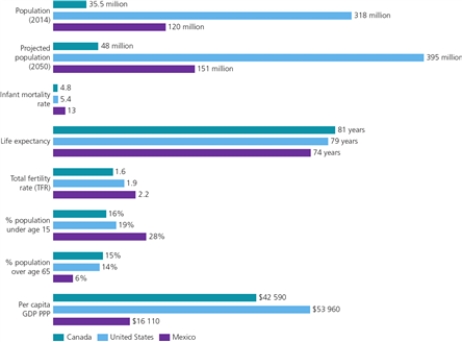 -According to the graph,which country has the youngest population?
 (Short Answer)
4.8/5 (76)
(76) What is one reason why India's family planning has yielded disappointing results?
(Multiple Choice)
4.9/5 (83)
(83) One factor affecting a country's total fertility rate is the cost of raising and educating children.
(True/False)
4.9/5 (74)
(74) BAR GRAPH OF DEMOGRAPHIC DATA FOR INDIA AND CHINA
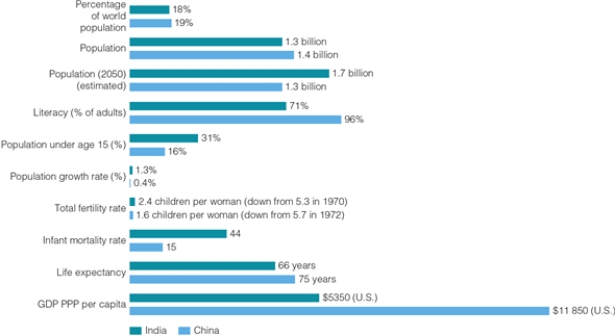 -According to the graph,is it true that higher GDP PPP per capita is related to greater infant mortality?
 (Short Answer)
4.9/5 (80)
(80) The ______________________________ is viewed as the best single measure of a society's quality of life because it reflects a country's general health.
(Short Answer)
4.8/5 (84)
(84) Which statement reflects the views of many of the world's leading population scientists and analysts?
(Multiple Choice)
4.9/5 (82)
(82) Which of the following countries has the highest teenage pregnancy rate?
(Multiple Choice)
4.8/5 (80)
(80) BAR GRAPH OF DEMOGRAPHIC DATA FOR INDIA AND CHINA
-Briefly explain your answer to the question: is it true that high adult illiteracy is related to greater infant mortality.
-Briefly explain your answer to the question: is it true that high adult illiteracy is related to greater infant mortality. (Essay)
4.9/5 (86)
(86) When does the use of economic rewards and penalties for controlling population work optimally?
(Multiple Choice)
4.9/5 (73)
(73) A low infant mortality rate would increase a country's replacement-level fertility.
(True/False)
4.7/5 (83)
(83) If the replacement-level fertility rate of a population is higher than the total fertility rate,the population may have a negative growth rate.
(True/False)
4.9/5 (74)
(74) BAR GRAPH OF DEMOGRAPHIC DATA FOR INDIA AND CHINA
-Briefly explain your answer to the question: Is it true that higher GDP PPP per capita is related to greater infant mortality.
-Briefly explain your answer to the question: Is it true that higher GDP PPP per capita is related to greater infant mortality. (Essay)
4.9/5 (78)
(78) 
Filters
- Essay(0)
- Multiple Choice(0)
- Short Answer(0)
- True False(0)
- Matching(0)