



 Chat with AI
Exam 10: Applying Population Ecology: the Human Population

Exam 1: Environmental Problems: an Introduction and Overview85 Questions
Exam 2: Environmental History: Learning From the Past83 Questions
Exam 3: Science, systems, matter, and Energy126 Questions
Exam 4: Ecosystems: What Are They, and How Do They Work201 Questions
Exam 5: Evolution and Biodiversity80 Questions
Exam 6: Climate and Terrestrial Biodiversity156 Questions
Exam 7: Aquatic Biodiversity99 Questions
Exam 8: Community Ecology104 Questions
Exam 9: Population Ecology90 Questions
Exam 10: Applying Population Ecology: the Human Population119 Questions
Exam 11: Sustaining Terrestrial Biodiversity: Managing and Protecting Ecosystems93 Questions
Exam 12: Sustaining Biodiversity: the Species Approach106 Questions
Exam 13: Sustaining Aquatic Biodiversity77 Questions
Exam 14: Food and Soil Resources113 Questions
Exam 15: Water Resources86 Questions
Exam 16: Geology and Nonrenewable Mineral Resources91 Questions
Exam 17: Nonrenewable Energy Resources105 Questions
Exam 18: Energy Efficiency and Renewable Energy106 Questions
Exam 19: Risk,toxicology,and Human Health116 Questions
Exam 20: Air Pollution120 Questions
Exam 21: Climate Change and Ozone Loss99 Questions
Exam 22: Water Pollution110 Questions
Exam 23: Pest Management91 Questions
Exam 24: Solid and Hazardous Waste91 Questions
Exam 25: Sustainable Cities85 Questions
Exam 26: Economics, environment, and Sustainability71 Questions
Exam 27: Politics, environment, and Sustainability65 Questions
Exam 28: Environmental World-views, ethics, and Sustainability78 Questions
Select questions type


Which sector would experience a rise in population in a country undergoing a rapid population decline?
(Multiple Choice)
4.8/5  (89)
(89) THE DEMOGRAPHIC TRANSITION
 -According to the diagram,at which stage do death rates decrease but birth rates remain high?
 (Short Answer)
4.8/5 (90)
(90) Which of the following would be omitted in a government's attempts to reduce population growth?
(Multiple Choice)
4.8/5 (76)
(76) The _________________________ has declined because of food supply,better nutrition,advances in medicine,and improved sanitization.
(Short Answer)
4.9/5 (90)
(90) BAR GRAPH OF DEMOGRAPHIC DATA FOR CANADA, THE U.S., AND MEXICO
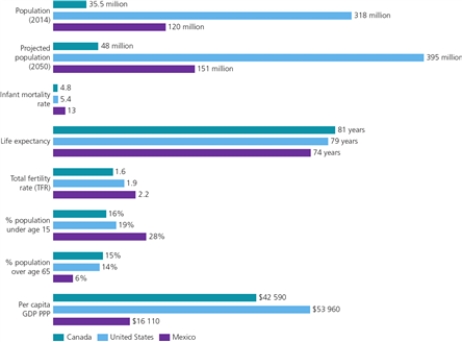 -According to the graph,how much higher is the total fertility rate in Mexico than in Canada?
 (Short Answer)
4.8/5 (71)
(71) What is the correct way to calculate change in human population in a particular year?
(Multiple Choice)
4.9/5 (89)
(89) What annual rate of change (natural increase)was seen in the world's population between 1963 and 2014? The rate of change:
(Multiple Choice)
4.8/5 (65)
(65) BAR GRAPH OF DEMOGRAPHIC DATA FOR INDIA AND CHINA
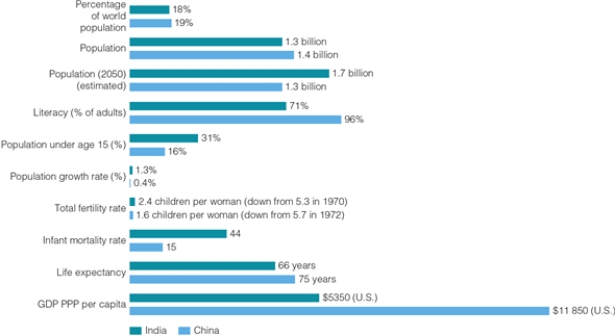 -According to the graph,is it true that high adult illiteracy is related to greater infant mortality?
 (Short Answer)
4.8/5 (71)
(71) What is omitted in the basic family planning policy of most countries?
(Multiple Choice)
4.8/5 (73)
(73) BAR GRAPH OF DEMOGRAPHIC DATA FOR CANADA, THE U.S., AND MEXICO
-According to the graph,is Mexico's total fertility higher than that of the United States and Canada?
-According to the graph,is Mexico's total fertility higher than that of the United States and Canada? (Short Answer)
4.8/5 (76)
(76) A region's life expectancy is inversely related to its crude death rate.
(True/False)
4.8/5 (74)
(74) Death rates are very high during the preindustrial stage because of a lack of knowledge about disease prevention and medical cures,and due to food shortages.
(True/False)
4.9/5 (78)
(78) One measurement of population growth is doubling time,which is the time it takes for a population growing at an unspecified rate to double its size.
(True/False)
4.8/5 (74)
(74) Relative to the rest of Canada,the population trend in the Maritimes has exhibited a general ____________________.
(Short Answer)
4.7/5 (82)
(82) ________________________________________ can lower a country's population size if it is higher than the total fertility rate.
(Short Answer)
4.9/5 (75)
(75) Which category is lacking in population age structure diagrams?
(Multiple Choice)
4.8/5 (79)
(79) AVERAGE CRUDE BIRTH AND DEATH RATES FOR VARIOUS COUNTRIES IN 2013
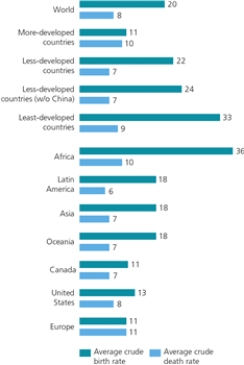 -According to the graph,in what part of the world does the average crude death rate exceed the average birth rate?
 (Short Answer)
4.8/5 (80)
(80) In areas with a low ________________________________________,people usually have fewer children because of an increase in life expectancy.
(Short Answer)
4.7/5 (84)
(84) Which of the following describes the employment/economic status of women?
(Multiple Choice)
4.8/5 (82)
(82) 
Filters
- Essay(0)
- Multiple Choice(0)
- Short Answer(0)
- True False(0)
- Matching(0)