



 Chat with AI
Exam 9: Population Ecology

Exam 1: Environmental Problems: an Introduction and Overview85 Questions
Exam 2: Environmental History: Learning From the Past83 Questions
Exam 3: Science, systems, matter, and Energy126 Questions
Exam 4: Ecosystems: What Are They, and How Do They Work201 Questions
Exam 5: Evolution and Biodiversity80 Questions
Exam 6: Climate and Terrestrial Biodiversity156 Questions
Exam 7: Aquatic Biodiversity99 Questions
Exam 8: Community Ecology104 Questions
Exam 9: Population Ecology90 Questions
Exam 10: Applying Population Ecology: the Human Population119 Questions
Exam 11: Sustaining Terrestrial Biodiversity: Managing and Protecting Ecosystems93 Questions
Exam 12: Sustaining Biodiversity: the Species Approach106 Questions
Exam 13: Sustaining Aquatic Biodiversity77 Questions
Exam 14: Food and Soil Resources113 Questions
Exam 15: Water Resources86 Questions
Exam 16: Geology and Nonrenewable Mineral Resources91 Questions
Exam 17: Nonrenewable Energy Resources105 Questions
Exam 18: Energy Efficiency and Renewable Energy106 Questions
Exam 19: Risk,toxicology,and Human Health116 Questions
Exam 20: Air Pollution120 Questions
Exam 21: Climate Change and Ozone Loss99 Questions
Exam 22: Water Pollution110 Questions
Exam 23: Pest Management91 Questions
Exam 24: Solid and Hazardous Waste91 Questions
Exam 25: Sustainable Cities85 Questions
Exam 26: Economics, environment, and Sustainability71 Questions
Exam 27: Politics, environment, and Sustainability65 Questions
Exam 28: Environmental World-views, ethics, and Sustainability78 Questions
Select questions type


POPULATION
 -Which letter in the diagram represents limiting abiotic factors?
 (Short Answer)
4.7/5  (95)
(95) Which natural pattern of population dispersion is associated with the majority of species?
(Multiple Choice)
4.9/5 (77)
(77) Which term is not used to describe a type of population change curve?
(Multiple Choice)
4.8/5 (83)
(83) Why did the World Health Organization initiate pesticide spraying in Borneo (Brunei)?
(Multiple Choice)
4.7/5 (95)
(95) Infectious disease is a classic type of ____________________-dependent population control.
(Short Answer)
4.9/5 (76)
(76) What type of population change would you expect to occur for beavers in a province that has just outlawed trapping?
(Multiple Choice)
4.9/5 (87)
(87) REINDEER
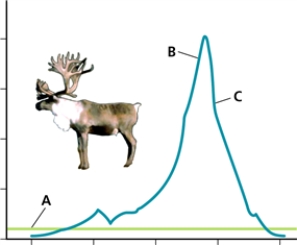 -Which letter in the graph corresponds to the portion of the graph representing the number of reindeer that exceeded the capacity of their environment?
 (Short Answer)
5.0/5 (74)
(74) Which of the following is a density-dependent population control?
(Multiple Choice)
4.9/5 (86)
(86) Which of the following is a density-independent population control?
(Multiple Choice)
4.9/5 (72)
(72) SHEEP
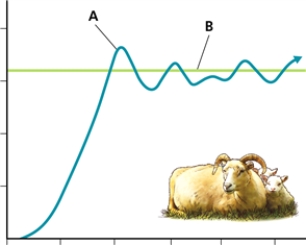 -Which letter in the graph corresponds to the portion of the curve that results from biotic potential and environmental resistance?
 (Short Answer)
4.9/5 (75)
(75) A life table shows the number of individuals at each age on a survivorship curve.
(True/False)
4.8/5 (86)
(86) The intrinsic rate of increase (r)is the rate at which a population would grow if it had unlimited resources.
(True/False)
4.9/5 (76)
(76) Most large mammals and birds of prey are ____________________ -selected species.
(Short Answer)
4.9/5 (66)
(66) Which statement is a general description of an r-selected species?
(Multiple Choice)
4.8/5 (69)
(69) A key theme of thisCHAPTER is that we can make our economies and our societies more sustainable though the application of lessons learned by studying ____________________ .
(Short Answer)
4.7/5 (77)
(77) REINDEER
-Which letter in the graph corresponds to the portion of the graph representing the number of reindeer that can be sustained indefinitely in a given area?
-Which letter in the graph corresponds to the portion of the graph representing the number of reindeer that can be sustained indefinitely in a given area? (Short Answer)
4.9/5 (92)
(92) Which population pattern is likely for hares and lynx living in an undisturbed habitat?
(Multiple Choice)
4.8/5 (70)
(70) 
Filters
- Essay(0)
- Multiple Choice(0)
- Short Answer(0)
- True False(0)
- Matching(0)