



 Chat with AI
Exam 9: Population Ecology

Exam 1: Environmental Problems: an Introduction and Overview85 Questions
Exam 2: Environmental History: Learning From the Past83 Questions
Exam 3: Science, systems, matter, and Energy126 Questions
Exam 4: Ecosystems: What Are They, and How Do They Work201 Questions
Exam 5: Evolution and Biodiversity80 Questions
Exam 6: Climate and Terrestrial Biodiversity156 Questions
Exam 7: Aquatic Biodiversity99 Questions
Exam 8: Community Ecology104 Questions
Exam 9: Population Ecology90 Questions
Exam 10: Applying Population Ecology: the Human Population119 Questions
Exam 11: Sustaining Terrestrial Biodiversity: Managing and Protecting Ecosystems93 Questions
Exam 12: Sustaining Biodiversity: the Species Approach106 Questions
Exam 13: Sustaining Aquatic Biodiversity77 Questions
Exam 14: Food and Soil Resources113 Questions
Exam 15: Water Resources86 Questions
Exam 16: Geology and Nonrenewable Mineral Resources91 Questions
Exam 17: Nonrenewable Energy Resources105 Questions
Exam 18: Energy Efficiency and Renewable Energy106 Questions
Exam 19: Risk,toxicology,and Human Health116 Questions
Exam 20: Air Pollution120 Questions
Exam 21: Climate Change and Ozone Loss99 Questions
Exam 22: Water Pollution110 Questions
Exam 23: Pest Management91 Questions
Exam 24: Solid and Hazardous Waste91 Questions
Exam 25: Sustainable Cities85 Questions
Exam 26: Economics, environment, and Sustainability71 Questions
Exam 27: Politics, environment, and Sustainability65 Questions
Exam 28: Environmental World-views, ethics, and Sustainability78 Questions
Select questions type


One lesson biologists have learned from nature is that everything is connected to and interdependent with everything else.
(True/False)
4.7/5  (79)
(79) The human population is likely to continue increasing at exponential rates indefinitely because of advances in our technology.
(True/False)
4.9/5 (79)
(79) Which letter has the shape of a logistic growth curve that depicts a population limited by a definite carrying capacity?
(Multiple Choice)
4.7/5 (76)
(76) SHEEP
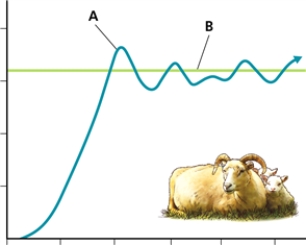 -Which letter in the graph corresponds to the portion of the curve that results from reproductive time lag?
 (Short Answer)
4.9/5 (74)
(74) Populations which have individuals evenly spaced throughout the environment have a(n)____________________ dispersal pattern.
(Short Answer)
4.8/5 (74)
(74) Many large mammal species that have long generation times and low reproductive rates are prone to ____________________.
(Short Answer)
4.8/5 (69)
(69) A population's ____________________ structure can have a strong effect on how rapidly its size increases or decreases.
(Short Answer)
4.7/5 (90)
(90) How have humans extended Earth's carrying capacity for the human species?
(Multiple Choice)
4.7/5 (93)
(93) Metapopulations are spatially separated populations that may continue to exchange genes with each other through dispersal of individuals.
(True/False)
5.0/5 (85)
(85) POPULATION
 -Which letter in the diagram corresponds to the point at which resources are not limiting and a population can grow at its intrinsic rate of increase?
 (Short Answer)
4.8/5 (76)
(76) A species whose population size fluctuates slightly above and below its carrying capacity is said to have a fairly ____________________ population size.
(Short Answer)
4.9/5 (74)
(74) Which connections would likely occur among population cycles,survival strategies,and survivorship curves?
(Multiple Choice)
4.9/5 (90)
(90) A mammal reaches maturity after 10 years and bears only one or two young every two years.The parents and the rest of the herd protect the young.The type of survivorship curve that this animal would have is a(n)_________________________ curve.
(Short Answer)
4.9/5 (92)
(92) The biotic potential and the population size modified by the environmental resistance determine the _________________________.
(Short Answer)
4.8/5 (83)
(83) All K-selected species have fewer,larger offspring than most other species.
(True/False)
4.9/5 (74)
(74) What is a typical means by which humans interfere in the development of natural ecosystems?
(Multiple Choice)
4.9/5 (79)
(79) 
Filters
- Essay(0)
- Multiple Choice(0)
- Short Answer(0)
- True False(0)
- Matching(0)