



 Chat with AI
Exam 22: Our Neighborhood in Space

Exam 1: The Earth in Context60 Questions
Exam 2: The Way the Earth Works: Plate Tectonics59 Questions
Exam 3: Patterns in Nature: Minerals59 Questions
Exam 4: Up From the Inferno: Magma and Igneous Rocks60 Questions
Exam 5: A Surface Veneer: Sediments and Sedimentary Rocks60 Questions
Exam 6: A Process of Change: Metamorphism and the Rock Cycle60 Questions
Exam 7: Crags, Cracks, and Crumples: Crustal Deformation and Mountain Building59 Questions
Exam 8: A Violent Pulse: Earthquakes60 Questions
Exam 9: Deep Time: How Old Is Old59 Questions
Exam 10: A Biography of Earth60 Questions
Exam 11: Riches in Rock: Energy and Mineral Resources60 Questions
Exam 12: Shaping the Earths Surface: Landscapes, the Hydrologic Cycle, and Mass Wasting60 Questions
Exam 13: Freshwater: Streams, Lakes, and Groundwater60 Questions
Exam 14: Extreme Realms: Desert and Glacial Landscapes61 Questions
Exam 15: Ocean Waters: the Blue of the Blue Marble61 Questions
Exam 16: Marine Geology: the Study of Ocean Basins and Coasts60 Questions
Exam 17: The Air We Breathe: Introducing Earths Atmosphere60 Questions
Exam 18: Winds of the World: the Earths Major Weather Systems60 Questions
Exam 19: Thunderstorms, Tornadoes, and Local Weather Systems60 Questions
Exam 20: Climate and Climate Change60 Questions
Exam 21: Our Solar System and Beyond60 Questions
Exam 22: Our Neighborhood in Space60 Questions
Exam 23: The Sun, Stars, and Deep Space60 Questions
Exam 24: Prelude: Welcome to Earth Science30 Questions
Select questions type


Contrast the terrestrial and Jovian planets. Include three differences in your discussion.
(Essay)
4.8/5  (77)
(77) There are so many more craters on the Moon than on Earth because
(Multiple Choice)
4.8/5 (73)
(73) Which of the following does NOT lie within our solar system?
(Multiple Choice)
4.9/5 (71)
(71) Which of the following is MOST true about Jupiter's moon(s)?
(Multiple Choice)
4.9/5 (76)
(76) The regions of the Moon that are of higher elevation are known as the ___________. These regions have a high albedo and display a whitish glow when viewed from Earth.
(Multiple Choice)
4.8/5 (90)
(90) Contrast volatile and refractory materials. Provide an example of each.
(Essay)
4.9/5 (76)
(76) The pictures below show the near side of the moon and the far side of the moon. Why does the near side appear darker than the far side? 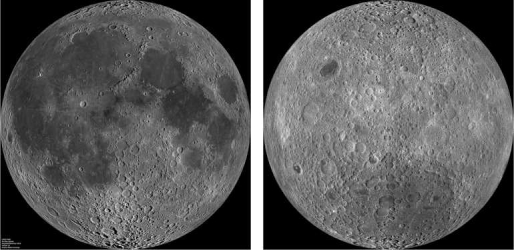
(Multiple Choice)
4.9/5 (86)
(86) A(n) ___________ is a streak of light and an atmospheric phenomenon, also known as a shooting star.
(Multiple Choice)
4.8/5 (90)
(90) Which planet's atmosphere exhibits a runaway greenhouse effect?
(Multiple Choice)
4.8/5 (85)
(85) Most of the planets spin counterclockwise on their axes, in the prograde direction. The exception is ___________, which spins in the retrograde direction.
(Multiple Choice)
4.8/5 (77)
(77) Observe the image of the moon below. What feature is indicated? 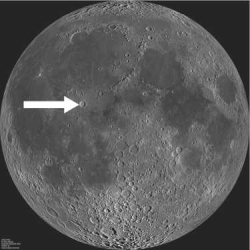
(Multiple Choice)
4.9/5 (79)
(79) The dust and debris that covers the Moon's surface is known as
(Multiple Choice)
4.7/5 (67)
(67) How is the condensation theory for the formation of the solar system different from the nebular theory?
(Essay)
4.9/5 (74)
(74) Olympus Mons, the largest volcano in the solar system, is found on
(Multiple Choice)
4.8/5 (83)
(83) 
Filters
- Essay(0)
- Multiple Choice(0)
- Short Answer(0)
- True False(0)
- Matching(0)