



 Chat with AI
Exam 10: A Biography of Earth

Exam 1: The Earth in Context60 Questions
Exam 2: The Way the Earth Works: Plate Tectonics59 Questions
Exam 3: Patterns in Nature: Minerals59 Questions
Exam 4: Up From the Inferno: Magma and Igneous Rocks60 Questions
Exam 5: A Surface Veneer: Sediments and Sedimentary Rocks60 Questions
Exam 6: A Process of Change: Metamorphism and the Rock Cycle60 Questions
Exam 7: Crags, Cracks, and Crumples: Crustal Deformation and Mountain Building59 Questions
Exam 8: A Violent Pulse: Earthquakes60 Questions
Exam 9: Deep Time: How Old Is Old59 Questions
Exam 10: A Biography of Earth60 Questions
Exam 11: Riches in Rock: Energy and Mineral Resources60 Questions
Exam 12: Shaping the Earths Surface: Landscapes, the Hydrologic Cycle, and Mass Wasting60 Questions
Exam 13: Freshwater: Streams, Lakes, and Groundwater60 Questions
Exam 14: Extreme Realms: Desert and Glacial Landscapes61 Questions
Exam 15: Ocean Waters: the Blue of the Blue Marble61 Questions
Exam 16: Marine Geology: the Study of Ocean Basins and Coasts60 Questions
Exam 17: The Air We Breathe: Introducing Earths Atmosphere60 Questions
Exam 18: Winds of the World: the Earths Major Weather Systems60 Questions
Exam 19: Thunderstorms, Tornadoes, and Local Weather Systems60 Questions
Exam 20: Climate and Climate Change60 Questions
Exam 21: Our Solar System and Beyond60 Questions
Exam 22: Our Neighborhood in Space60 Questions
Exam 23: The Sun, Stars, and Deep Space60 Questions
Exam 24: Prelude: Welcome to Earth Science30 Questions
Select questions type


What is an epicontinental sea? Why might an epicontinental sea form and retreat?
(Essay)
4.8/5  (91)
(91) Fossil succession is the idea that life evolves over time and that once a species goes extinct, it does not reappear. Is this an example of unidirectional change or cyclic change? Why?
(Essay)
4.9/5 (82)
(82) Stromatolites are layered structures produced by the activity of 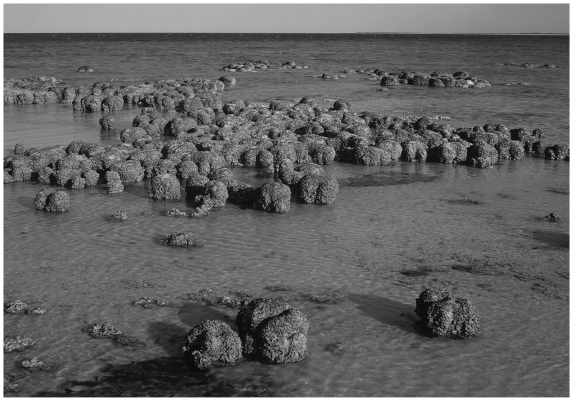
(Multiple Choice)
4.9/5 (91)
(91) Using the chart of transgressions and regressions below, when was sea level the highest? 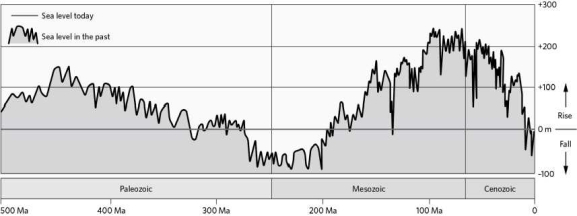
(Multiple Choice)
4.9/5 (69)
(69) What caused the buildup of oxygen in the atmosphere at roughly 2.5 Ga?
(Essay)
4.7/5 (66)
(66) Chalk rock contains many tiny plankton shells. This is evidence of which depositional environment?
(Multiple Choice)
4.9/5 (88)
(88) Which of the following would be considered evidence for an orogeny?
(Multiple Choice)
4.9/5 (86)
(86) The fossil fish Tiktaalik made headlines in 2005 because it 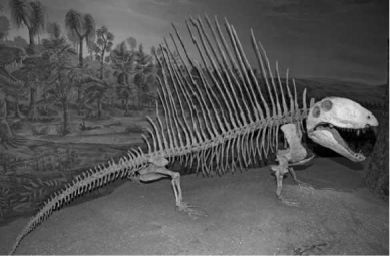
(Multiple Choice)
5.0/5 (64)
(64) At times in Earth's history, large regions of continental interiors became flooded with shallow seas, known as __________ seas.
(Multiple Choice)
4.9/5 (98)
(98) Continental crust was only able to form once Earth's temperature had cooled enough for partial melting of the mantle to occur and produce basalt that was buoyant enough to stay afloat. Before this point, small rafts of thin crust formed and remelted in a continuous cycle. What was the composition of these rafts?
(Multiple Choice)
4.8/5 (81)
(81) The supercontinent Rodinia assembled during the __________ , and the supercontinent Pangaea assembled during the __________ .
(Multiple Choice)
4.8/5 (94)
(94) A __________ change in the Earth system repeats the same steps over and over, though not necessarily with the same results or at the same rate.
(Multiple Choice)
4.9/5 (77)
(77) Why have some researchers suggested the use of the term Anthropocene?
(Essay)
5.0/5 (80)
(80) Where would you be most likely to see a piece of the earliest continental crust?
(Multiple Choice)
4.9/5 (71)
(71) According to the graph below, continental crust was mostly done forming by 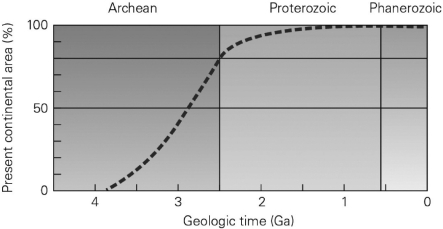
(Multiple Choice)
4.9/5 (88)
(88) 
Filters
- Essay(0)
- Multiple Choice(0)
- Short Answer(0)
- True False(0)
- Matching(0)