



 Chat with AI
Exam 8: A Violent Pulse: Earthquakes

Exam 1: The Earth in Context60 Questions
Exam 2: The Way the Earth Works: Plate Tectonics59 Questions
Exam 3: Patterns in Nature: Minerals59 Questions
Exam 4: Up From the Inferno: Magma and Igneous Rocks60 Questions
Exam 5: A Surface Veneer: Sediments and Sedimentary Rocks60 Questions
Exam 6: A Process of Change: Metamorphism and the Rock Cycle60 Questions
Exam 7: Crags, Cracks, and Crumples: Crustal Deformation and Mountain Building59 Questions
Exam 8: A Violent Pulse: Earthquakes60 Questions
Exam 9: Deep Time: How Old Is Old59 Questions
Exam 10: A Biography of Earth60 Questions
Exam 11: Riches in Rock: Energy and Mineral Resources60 Questions
Exam 12: Shaping the Earths Surface: Landscapes, the Hydrologic Cycle, and Mass Wasting60 Questions
Exam 13: Freshwater: Streams, Lakes, and Groundwater60 Questions
Exam 14: Extreme Realms: Desert and Glacial Landscapes61 Questions
Exam 15: Ocean Waters: the Blue of the Blue Marble61 Questions
Exam 16: Marine Geology: the Study of Ocean Basins and Coasts60 Questions
Exam 17: The Air We Breathe: Introducing Earths Atmosphere60 Questions
Exam 18: Winds of the World: the Earths Major Weather Systems60 Questions
Exam 19: Thunderstorms, Tornadoes, and Local Weather Systems60 Questions
Exam 20: Climate and Climate Change60 Questions
Exam 21: Our Solar System and Beyond60 Questions
Exam 22: Our Neighborhood in Space60 Questions
Exam 23: The Sun, Stars, and Deep Space60 Questions
Exam 24: Prelude: Welcome to Earth Science30 Questions
Select questions type


The Mercalli intensity scale tends to be very subjective and thus is generally only used for historical earthquakes that were near people but were not recorded by seismometers. The Mercalli scale may be considered subjective because it
(Multiple Choice)
4.9/5  (72)
(72) An increase in size of one unit of magnitude translates to ___________ times the ground motion.
(Multiple Choice)
4.9/5 (66)
(66) On December 26, 2004, a magnitude 9.3 earthquake generated a tsunami that devastated coastlines on the ___________ Ocean.
(Multiple Choice)
5.0/5 (81)
(81) Making better ___________ is the best way to try to prevent earthquake damage.
(Multiple Choice)
4.8/5 (83)
(83) Wet and unconsolidated substrates are uniquely susceptible to ___________ during an earthquake.
(Multiple Choice)
5.0/5 (83)
(83) At a minimum, how many seismic stations are necessary to locate the epicenter of an
(Multiple Choice)
4.8/5 (71)
(71) Much of the capitol city of Port-au-Prince was destroyed during the 2010 Haiti earthquake even though similarly sized earthquakes in other cities did very little damage. What caused so much damage during the Haiti earthquake?
(Multiple Choice)
5.0/5 (87)
(87) Earthquakes that occur in a band called the ___________ can be used to track the motion of subducted oceanic lithosphere.
(Multiple Choice)
4.8/5 (80)
(80) During an earthquake, if the hanging wall slides upward relative to the footwall and if the fault is steep (closer to vertical than horizontal), then the fault is termed a ___________ fault. Refer to the following figure for an example of such a feature. 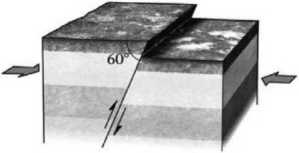
(Multiple Choice)
4.9/5 (90)
(90) Earthquake ___________ is a means of deciding where the ground is stable enough to build on in earthquake-prone areas.
(Multiple Choice)
4.8/5 (88)
(88) If a fault is nearly vertical in orientation and the two walls of rock on opposite sides slide past one another horizontally, the fault is termed a ___________ fault. Refer to the following figure for an example of such a feature. 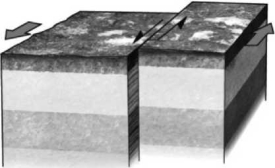
(Multiple Choice)
4.9/5 (88)
(88) According to the image below, where was the epicenter of the earthquake? 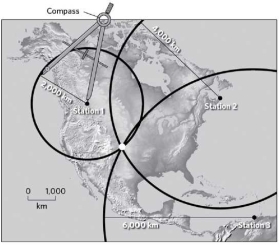
(Multiple Choice)
4.8/5 (73)
(73) Which tectonic setting has the potential to create the largest earthquakes on Earth?
(Multiple Choice)
4.9/5 (78)
(78) Generally, which type of earthquake waves travel with the slowest velocity?
(Multiple Choice)
4.9/5 (80)
(80) 
Filters
- Essay(0)
- Multiple Choice(0)
- Short Answer(0)
- True False(0)
- Matching(0)