



 Chat with AI
Exam 2: The Way the Earth Works: Plate Tectonics

Exam 1: The Earth in Context60 Questions
Exam 2: The Way the Earth Works: Plate Tectonics59 Questions
Exam 3: Patterns in Nature: Minerals59 Questions
Exam 4: Up From the Inferno: Magma and Igneous Rocks60 Questions
Exam 5: A Surface Veneer: Sediments and Sedimentary Rocks60 Questions
Exam 6: A Process of Change: Metamorphism and the Rock Cycle60 Questions
Exam 7: Crags, Cracks, and Crumples: Crustal Deformation and Mountain Building59 Questions
Exam 8: A Violent Pulse: Earthquakes60 Questions
Exam 9: Deep Time: How Old Is Old59 Questions
Exam 10: A Biography of Earth60 Questions
Exam 11: Riches in Rock: Energy and Mineral Resources60 Questions
Exam 12: Shaping the Earths Surface: Landscapes, the Hydrologic Cycle, and Mass Wasting60 Questions
Exam 13: Freshwater: Streams, Lakes, and Groundwater60 Questions
Exam 14: Extreme Realms: Desert and Glacial Landscapes61 Questions
Exam 15: Ocean Waters: the Blue of the Blue Marble61 Questions
Exam 16: Marine Geology: the Study of Ocean Basins and Coasts60 Questions
Exam 17: The Air We Breathe: Introducing Earths Atmosphere60 Questions
Exam 18: Winds of the World: the Earths Major Weather Systems60 Questions
Exam 19: Thunderstorms, Tornadoes, and Local Weather Systems60 Questions
Exam 20: Climate and Climate Change60 Questions
Exam 21: Our Solar System and Beyond60 Questions
Exam 22: Our Neighborhood in Space60 Questions
Exam 23: The Sun, Stars, and Deep Space60 Questions
Exam 24: Prelude: Welcome to Earth Science30 Questions
Select questions type


A geologist aboard a deep-sea research vessel has collected several drill cores of oceanic crust from the bottom of the ocean. The cores are collected in order from east to west along the bottom of the basin and are labeled A1, B1, C1, and D1, respectively. Core A1 has 2.88 meters (m) of clay and siliceous ooze covering 4.86 m of pillow basalt. Core B1 has 2.37 m of muddy, clay ooze covering 3.57 m of basalt. Core C1 has 2.11 m of clay and siliceous ooze above 3.2 m of basalt. Core D1 has 1.87 m of siliceous ooze over 2.54 m of basalt. Which core is closest to the mid-ocean ridge?
(Multiple Choice)
4.9/5  (90)
(90) The primary difference between lithospheric and asthenospheric mantle that gives rise to numerous different patterns of physical behavior is
(Multiple Choice)
4.7/5 (79)
(79) The mid-ocean ridges are elevated above the surrounding seafloor because
(Multiple Choice)
4.8/5 (84)
(84) Consult the figure below. Abundant swamps led to the formation of coal during the Late Paleozoic in which of the following places? 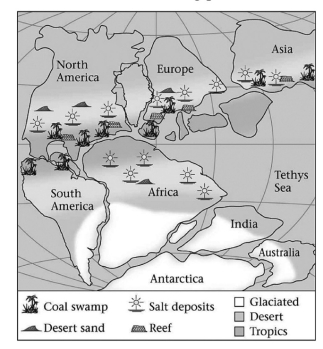
(Multiple Choice)
4.8/5 (69)
(69) Under the theory of plate tectonics, the plates themselves are
(Multiple Choice)
4.8/5 (74)
(74) With increasing distance from a mid-ocean ridge, the age of oceanic crust
(Multiple Choice)
4.9/5 (80)
(80) What happens when a continental plate meets an oceanic plate at a convergent boundary?
(Essay)
4.8/5 (74)
(74) In Wegener's evidence for continental drift, continents were proposed to fit together, such as the east coast of South America with the
(Multiple Choice)
4.9/5 (74)
(74) Beneath a blanket of sediments, oceanic crust is primarily composed of
(Multiple Choice)
4.9/5 (74)
(74) Plate tectonics theory is often referred to as the "unifying" theory in geology. Explain why plate tectonics is such an important theory to the study of Earth.
(Essay)
4.8/5 (78)
(78) Slab pull occurs because subducting slabs are __________ and therefore __________ than surrounding asthenosphere.
(Multiple Choice)
4.8/5 (85)
(85) Which of these parts of the deep-ocean floor is flat and nearly featureless?
(Multiple Choice)
4.9/5 (82)
(82) The image below shows a view of a typical segmented mid-ocean ridge. Which letter below marks the location of the active transform fault? 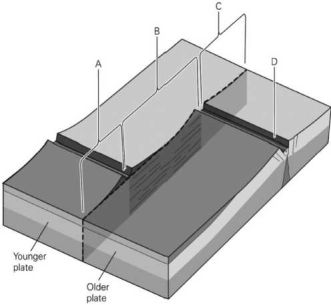
(Multiple Choice)
5.0/5 (74)
(74) Discuss why transform boundaries are found in conjunction with divergent boundaries.
(Essay)
4.8/5 (89)
(89) Wegener's idea of continental drift was rejected by American geologists because
(Multiple Choice)
4.8/5 (81)
(81) 
Filters
- Essay(0)
- Multiple Choice(0)
- Short Answer(0)
- True False(0)
- Matching(0)