



 Chat with AI
Exam 1: The Earth in Context

Exam 1: The Earth in Context60 Questions
Exam 2: The Way the Earth Works: Plate Tectonics59 Questions
Exam 3: Patterns in Nature: Minerals59 Questions
Exam 4: Up From the Inferno: Magma and Igneous Rocks60 Questions
Exam 5: A Surface Veneer: Sediments and Sedimentary Rocks60 Questions
Exam 6: A Process of Change: Metamorphism and the Rock Cycle60 Questions
Exam 7: Crags, Cracks, and Crumples: Crustal Deformation and Mountain Building59 Questions
Exam 8: A Violent Pulse: Earthquakes60 Questions
Exam 9: Deep Time: How Old Is Old59 Questions
Exam 10: A Biography of Earth60 Questions
Exam 11: Riches in Rock: Energy and Mineral Resources60 Questions
Exam 12: Shaping the Earths Surface: Landscapes, the Hydrologic Cycle, and Mass Wasting60 Questions
Exam 13: Freshwater: Streams, Lakes, and Groundwater60 Questions
Exam 14: Extreme Realms: Desert and Glacial Landscapes61 Questions
Exam 15: Ocean Waters: the Blue of the Blue Marble61 Questions
Exam 16: Marine Geology: the Study of Ocean Basins and Coasts60 Questions
Exam 17: The Air We Breathe: Introducing Earths Atmosphere60 Questions
Exam 18: Winds of the World: the Earths Major Weather Systems60 Questions
Exam 19: Thunderstorms, Tornadoes, and Local Weather Systems60 Questions
Exam 20: Climate and Climate Change60 Questions
Exam 21: Our Solar System and Beyond60 Questions
Exam 22: Our Neighborhood in Space60 Questions
Exam 23: The Sun, Stars, and Deep Space60 Questions
Exam 24: Prelude: Welcome to Earth Science30 Questions
Select questions type


Which of the following images shows the formation of the moon? 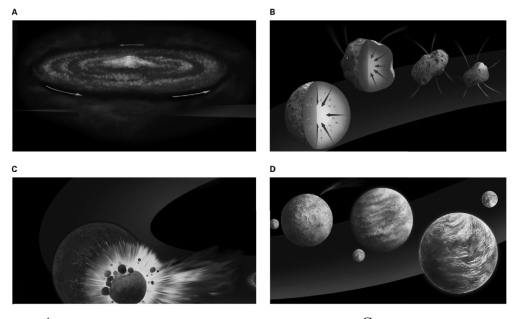
(Multiple Choice)
4.7/5  (77)
(77) The study of the overall structure, formation, and evolution of the universe and all objects within it is known as
(Multiple Choice)
4.9/5 (73)
(73) A substance is NOT required to __________ to be considered a mineral.
(Multiple Choice)
4.7/5 (77)
(77) If two atoms of deuterium (an isotope of hydrogen) are bound together at the atomic level (nuclear fusion), what element is formed?
(Multiple Choice)
4.7/5 (94)
(94) Contrast oceanic crust and continental crust based on their composition and thickness.
(Essay)
4.9/5 (77)
(77) Differentiation of the core from the mantle early in Earth's history was possible because the planet was __________ at the time.
(Multiple Choice)
4.8/5 (69)
(69) The atmosphere is densest closest to the surface of Earth because
(Multiple Choice)
4.8/5 (82)
(82) In the whole Earth, the four most common elements (by mass) are oxygen, silicon, magnesium, and
(Multiple Choice)
4.8/5 (88)
(88) The image below shows Earth's magnetic field. Earth's magnetic field lines are distorted (i.e., not symmetrical) because 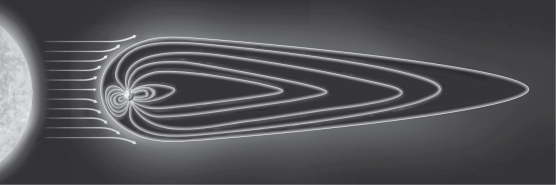
(Multiple Choice)
4.7/5 (79)
(79) Geologists are able to study Earth's interior primarily using
(Multiple Choice)
4.9/5 (81)
(81) The sun was created at the center of the accretionary disk when the temperature became high enough for _________ to occur.
(Multiple Choice)
4.9/5 (76)
(76) 
Filters
- Essay(0)
- Multiple Choice(0)
- Short Answer(0)
- True False(0)
- Matching(0)